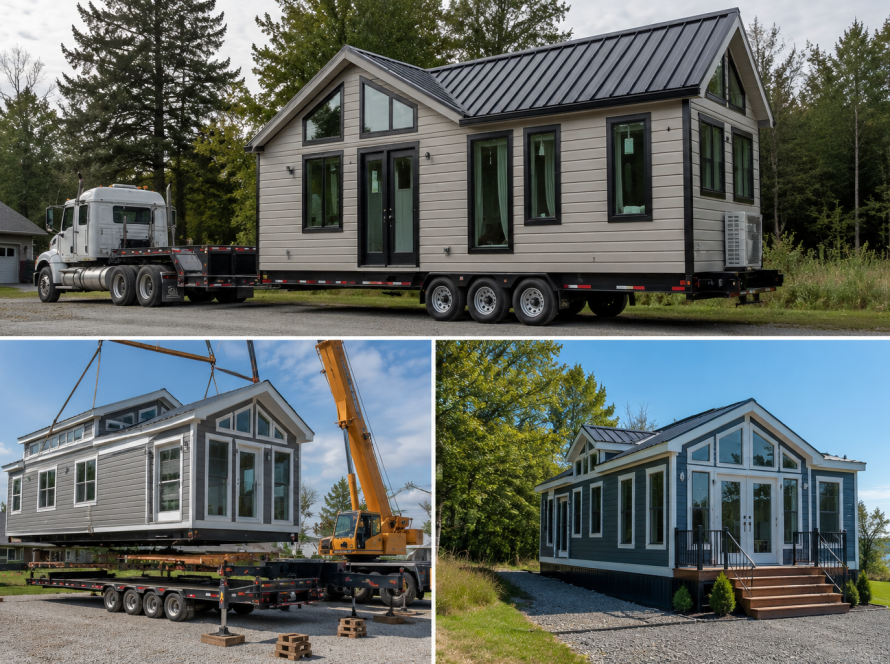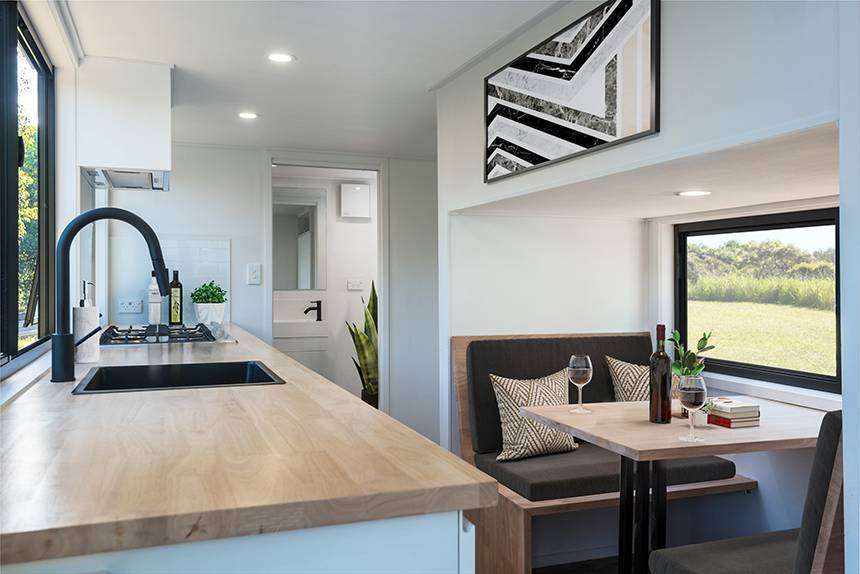
Ecolife Nest 3610 park model home is a preassembled, portable on wheels that is 360 square feet and fits the ANSI A119.5 classification as a Park Model RV (Oversized RV).
Park Model Homes—also referred to as Recreational Park Trailers or Tiny House Park Models—are designed primarily for seasonal or recreational living, such as in campgrounds, vacation sites, or short-term rental settings.
These units are generally larger than standard tiny houses, while still being smaller than modular or manufactured homes. They are built on a wheeled trailer chassis, allowing mobility, but they are typically intended to remain in a stationary location for extended periods.
Installation resembles that of a manufactured home, meaning a full residential foundation is not required—usually, a gravel bed, concrete pad, or a system of levelled piers is sufficient to support the structure.
By regulation, a Park Model must contain no more than 400 square feet of interior living space. Importantly, loft areas and exterior porches are not included in that square footage limit.
It also must be able to be transported as a single wide so they are typically anywhere from 11’-15’ wide, 30’-44’ long, 13’-14’ high and are all oversize loads.
Since each Park Model has a VIN and is technically classified as Park Model RV, in most cases you don’t need permits and aren’t required to pay property taxes on the cabin itself. As a Park Model RV, the RV Industry Association (RVIA) inspects each unit to make sure they meet the ANSI A119.5 Standards for Recreational Park Trailers.
A Park Model is more so intended for recreational use and not so much as a permanent residence even though a Nest 3610 Park Model Home will hold up great year round even in extremely hot or cold climates.
Ideal uses for Park Model Cabins are for campgrounds, cabin rentals, airbnbs, tiny homes, hunting camps, getaway cabins, in-law quarters, offices and guest houses just to name a few.
Key Points for a Park Model Cabin
Preassembled, portable cabin on a fixed trailer frame
400 square feet or less (porches and lofts not included)
Oversize load (can’t haul yourself)
RVIA Certified as a Park Model RV with VIN
Similar set-up and hook-ups to a single wide mobile home
Movable but more so made to stay put
Mainly for recreational use but can be used year round
Benefits of a Park Model Cabin
No permits or property taxes in most cases (check with TWP)
Easier to finance because you can get an RV loan
Quick return on investment for rentals
No foundation required other than stone or concrete pad
Can resell or move later if needed
Quick and easy set up since they are preassembled and turn-key
Simpler way to live and downsize
Built To ANSI 119.5 RV standard
Max Width 10–15 ft — wide load permit necessary
Max Length Up to 40–45 feet
Max Height Can exceed road limit when permanently placed
Mobility Requires professional moving service and permits
Weight Can exceed 20,000–30,000 lbs
Living Space (sq ft) ~300–400+ sq ft
Look & Aesthetic Cottage-style home-like appearance
Zoning Often accepted in RV parks and designated communities
Hookups Requires full utility hookup (water, sewer, power)
Foundation Often set on blocks or semi-permanent base
Roof Type Heavy-duty roof, more insulation
Insulation Home comfort — thick insulation
Climate Suitability Excellent for year-round living
Interior Layout Wide floorplan, real rooms, full-size spaces
Furniture Compatibility Full-size standard furniture fits
Bathroom Size Residential-style bathroom
Kitchen Type Full kitchen with oven, fridge, cabinetry
Safety & Structure Heavy-duty framing for permanence
Financing Easier to finance — recognized structure
Insurance Often easier to insure as a residential-classified RV
Resale Value Generally higher — more demand for permanent use
Target User Families, long-term dwellers, retirees
Living Experience Stability & comfort lifestyle
Maintenance More durable build
Transport Requirements Professional hauling company required
Setup Time Placement, leveling, utility connection
Neighborhood Acceptance More acceptable in regulated environments
Rental Strategy Strong for Airbnb / long-term rental
Longevity Built for residence — longer lifespan
Overall Purpose Permanent, comfortable small-scale housing
Tax Advantages of Park Model Tiny Homes
One of the key financial benefits of owning a Park Model Tiny Home is its tax classification. Since Park Model Homes are legally considered RVs rather than permanent residential structures, they are not subject to traditional property taxes. In most states, owners pay a small annual registration fee similar to a vehicle or RV rather than a high property tax assessment.
Additionally, unlike fixed real estate, Park Models are typically not added to land tax valuation, which can significantly reduce long-term expenses. This makes them an attractive option for homeowners, investors, and rental operators seeking lower carrying costs and improved ROI. Owners may also benefit from depreciation deductions if the unit is used as an income-producing asset, such as short-term or long-term rental housing.