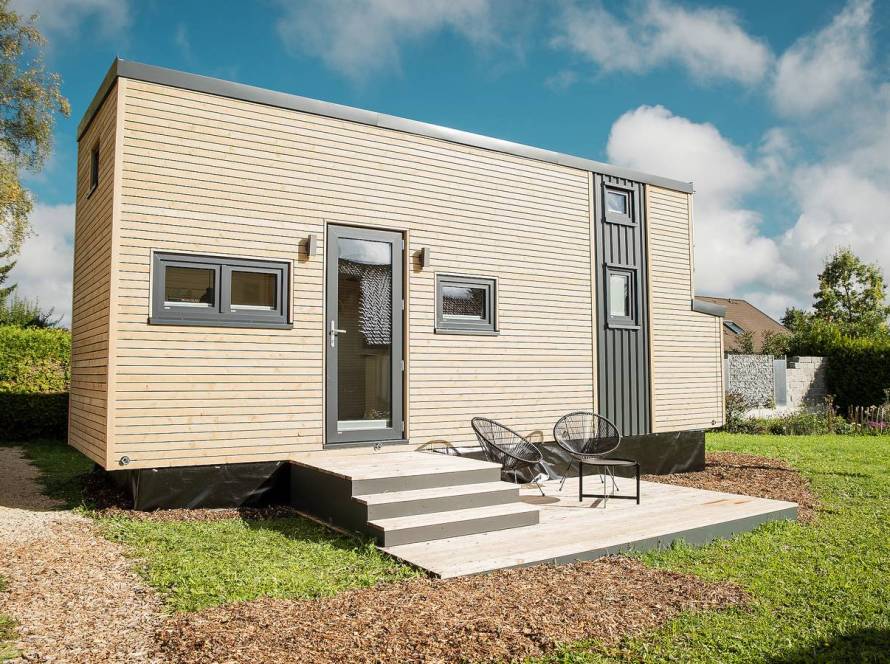
How to finance a tiny house in Florida: complete guide

Financing options for tiny homes in Florida depend on land zoning, foundation type, and property specifics. Florida and federal programs can provide significant down payment assistance for qualified first-time buyers. Zoning, building codes, and insurance requirements are common hurdles impacting tiny home financing approval.
Florida’s housing market keeps pushing prices higher, and more buyers are turning to tiny homes as a practical, eco-friendly alternative. But financing a tiny house in Florida is not as straightforward as a standard mortgage, and first-time buyers often hit unexpected walls. This guide walks you through every step, from checking your eligibility to layering state assistance programs, so you can move forward with confidence. Whether you’re eyeing a park model on a permanent foundation or a movable home on wheels, you’ll find real options here that fit your budget and sustainability goals.
Table of Contents
- Assess your eligibility and prepare your finances
- Compare primary tiny house financing options
- Leverage Florida and federal programs for first-time buyers
- Navigate zoning and compliance hurdles for tiny homes
- Troubleshooting: Overcoming financing hurdles and common mistakes
- What most people get wrong about tiny home financing in Florida
- Ready to finance your Florida tiny home?
- Frequently asked questions
Key Takeaways
| Point | Details |
|---|---|
| Know your loan options | Most tiny homes are financed with personal, builder, or RV loans instead of traditional mortgages. |
| Check zoning first | County rules can make or break your loan chances and long-term home security. |
| Use programs to save | Florida and federal assistance can drastically lower your upfront costs if your home qualifies. |
| Prepare for compliance | Building to code and securing proper insurance are non-negotiable for sustainable homeownership. |
| Have a plan for hurdles | Troubleshoot low credit, unique properties, and documentation issues before you apply. |
Assess your eligibility and prepare your finances
Before you start browsing loan programs, you need an honest look at your financial picture. Lenders evaluate four main factors when you apply for tiny home financing: income stability, credit score, debt-to-income ratio (DTI), and your available down payment. Your DTI is the percentage of your monthly income that goes toward debt payments. Most lenders want this below 43%, and some prefer it under 36%.
Credit score requirements vary by loan type. FHA loans for tiny homes on permanent foundations require a minimum 580 score with 3.5% down, while USDA and VA loans have similar thresholds for rural or permanent setups. Personal loans and in-house builder programs may accept scores as low as 550, but typically at higher interest rates.
Here’s what to gather before you apply:
- Two years of tax returns and W-2s (or 1099s if self-employed)
- Recent pay stubs covering at least 30 days
- Bank statements from the last 3 months
- Credit report from all three bureaus (check for errors first)
- Proof of savings for your down payment and reserves
One step many buyers skip is checking county zoning before shopping for loans. If your target land does not allow tiny homes, no lender will approve your application. Understanding buying a tiny home in Florida means treating zoning as step one, not an afterthought. Also, certified construction and a permanent foundation dramatically expand your loan options, so it’s worth understanding tiny home pricing factors before you commit to a specific model.
Pro Tip: Pull your free credit reports at AnnualCreditReport.com at least 90 days before applying. Disputing errors takes time, and a 20-point score improvement can move you into a better loan tier and save thousands over the life of the loan.
Understanding mortgage basics for tiny homes helps you set realistic expectations before you ever sit down with a lender.
Compare primary tiny house financing options
With your eligibility and documents ready, let’s look at the main financing options open to Florida tiny home buyers.
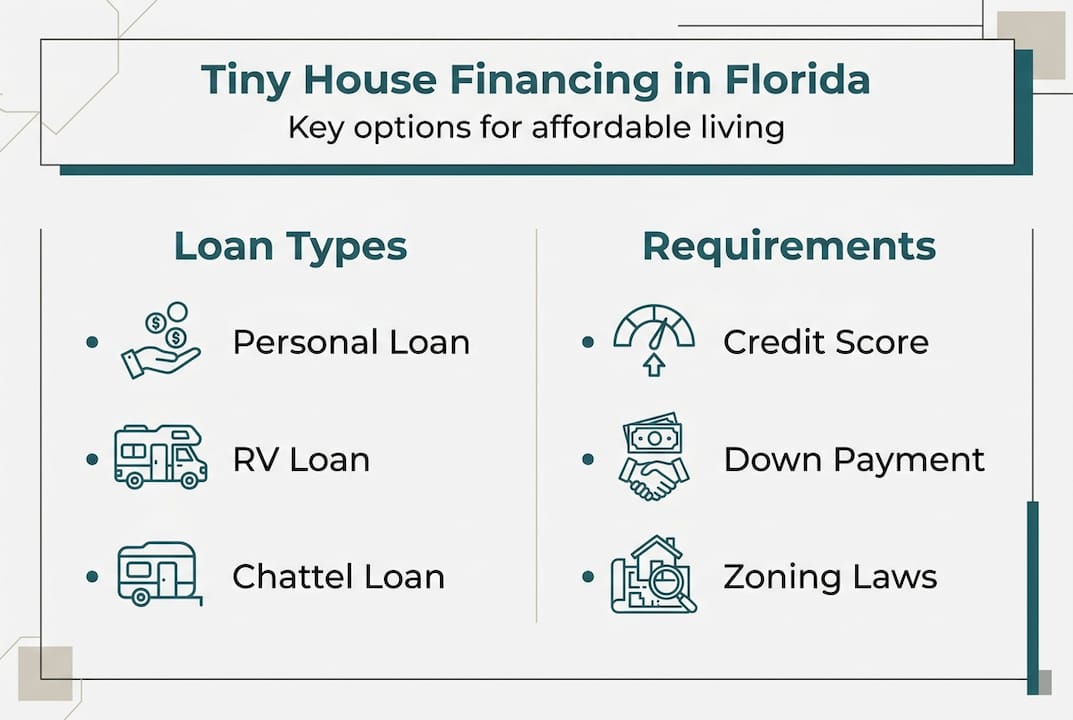
Traditional mortgages are rarely available for tiny homes unless the property is on a permanent foundation and meets the minimum size threshold. That means most buyers rely on alternative products. Here’s a side-by-side comparison of the most common options:
| Loan type | APR range | Min. down | Typical term | Best for |
|---|---|---|---|---|
| Personal loan | 8-18% | 0% | 2-7 years | Homes under $75k, fast funding |
| RV/chattel loan | 4.5-9% | 10-20% | 10-20 years | Certified THOWs, mobile setups |
| Builder/manufacturer financing | 8-12% | 10-30% | 5-20 years | New builds, in-house programs |
| Home equity/HELOC | 6-10% | N/A (equity) | 5-20 years | Existing homeowners |
| FHA/USDA/VA | 6-8% | 0-3.5% | 15-30 years | Permanent foundation, >=400 sq ft |
Data sourced from 7 financing solutions for tiny home buyers.
Each option has real trade-offs. Personal loans fund quickly and require no collateral, but the higher APR adds up fast on longer repayment timelines. RV loans work well for certified tiny homes on wheels (THOWs) but require RVIA or similar certification. Builder financing is convenient but often carries the highest rates. Home equity products offer lower rates but put your existing property at risk.
Key considerations when choosing:
- Permanent foundation unlocks FHA, USDA, and VA options with the lowest rates
- Mobile or THOW setups are limited to RV loans or personal loans
- Speed matters if you’re buying in a competitive market, personal loans close fastest
- Tiny home costs in Florida vary widely, so match your loan size to realistic project costs
If you’re still exploring price points, browsing cheap tiny homes in Florida can help you calibrate your budget before choosing a loan product. You can also review key financing terms to get comfortable with the language lenders use. For a broader perspective on financing without a mortgage, there are solid alternative paths worth exploring.
Leverage Florida and federal programs for first-time buyers
Knowing your loan options, let’s look at how Florida and federal programs can dramatically lower your cost to buy.
Florida offers two major assistance programs that first-time buyers should know about. The State Housing Initiatives Partnership (SHIP) and the Homeownership Loan Program (HLP) can provide between $10,000 and $70,000 in down payment and closing cost assistance. These funds are typically offered at 0% interest and are either deferred or forgivable, meaning you may never pay them back if you stay in the home long enough. Income limits generally fall at 80% to 140% of the Area Median Income (AMI).
| Program | Max assistance | Interest rate | Forgiveness | Income limit |
|---|---|---|---|---|
| Florida SHIP | Up to $70,000 | 0% | Deferred/forgivable | <=80-140% AMI |
| Florida HLP | Up to $10,000 | 0% | Deferred | <=80-140% AMI |
| FHA loan | N/A (loan product) | Market rate | N/A | No hard cap |
| USDA loan | 100% financing | Market rate | N/A | Rural, income limits |
| VA loan | 100% financing | Market rate | N/A | Veterans only |
Here’s how to apply for Florida assistance programs step by step:
- Complete a HUD-approved homebuyer education course. Most programs require this before you can access funds.
- Contact your county’s Local Housing Assistance Plan (LHAP) office. Each county administers SHIP funds differently.
- Confirm your tiny home qualifies. The property must meet construction and habitability standards.
- Layer assistance with your primary loan. SHIP funds can often be combined with FHA or USDA loans for maximum benefit.
- Submit your application through your lender or county housing office. Timing matters since funds are limited and often allocated on a first-come basis.
You can review HLP program details to understand current eligibility windows. If you’re ready to browse qualifying properties, check out homes for sale that may already meet program standards.
Pro Tip: Moderate-income buyers who combine SHIP assistance with an FHA loan often achieve the lowest effective cost of homeownership. Run the numbers with your lender before assuming one program is enough on its own.
Navigate zoning and compliance hurdles for tiny homes
Before you apply, you must address local zoning and compliance, which can make or break your tiny home financing.
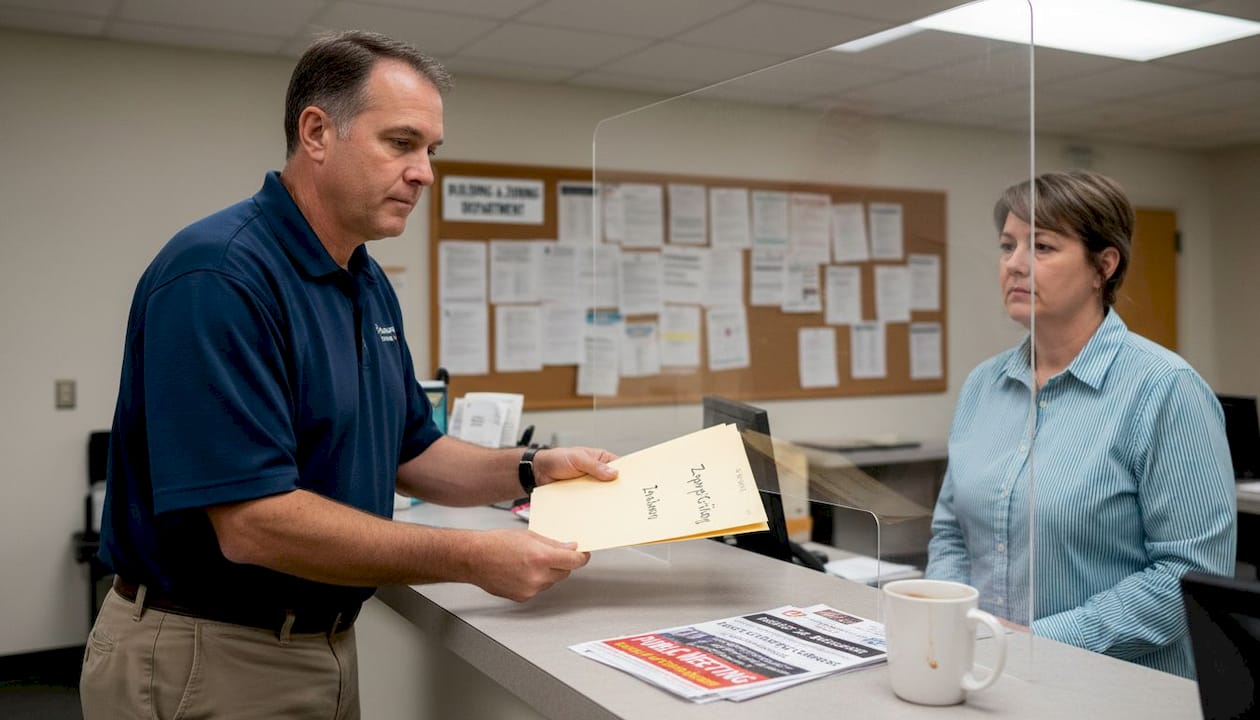
Florida does not have a single statewide zoning rule for tiny homes. Instead, Florida zoning rules are handled county by county. Some counties, like Groveland and Alachua, allow permanent tiny homes under Appendix Q (homes up to 400 sq ft excluding lofts) as primary residences or accessory dwelling units (ADUs). Others restrict tiny homes on wheels to RV parks only.
Here’s a step-by-step approach to clearing zoning hurdles:
- Look up your target parcel on the county’s zoning map. Confirm the land use category allows residential structures.
- Check ADU rules if you plan to place a tiny home on an existing property.
- Verify wind and flood zone requirements. Florida’s hurricane codes are mandatory, and lenders will ask for proof of compliance.
- Confirm foundation type requirements. Permanent foundations are required for most government-backed loans.
- Get written confirmation from the county before signing any purchase agreements.
Zoning mismatches are one of the top reasons tiny home deals fall apart late in the process. Discovering a zoning conflict after you’ve already applied for a loan wastes time, money, and momentum. Always verify land use before you go loan shopping.
Compliance also affects your insurance options. Flood and hurricane coverage in Florida can add $1,500 to $4,000 per year to your costs, so budget for this from the start. Homes built to current codes are easier to insure and qualify for better rates. Review compliance tips to understand what standards your home must meet, and explore finding compliant homes already built to Florida’s requirements. For a deeper look at local rules, Florida zoning laws break down the county-level details.
Troubleshooting: Overcoming financing hurdles and common mistakes
Even with all your preparation, you may face hurdles. Here’s how to overcome them and avoid costly mistakes.
The most common reasons tiny home financing gets denied fall into three categories: credit issues, property problems, and documentation gaps. Knowing the fix for each saves you weeks of frustration.
Credit-related denials:
- Low credit scores (550+) can still qualify through in-house builder programs or manufacturer financing
- Adding a co-signer with stronger credit often unlocks better loan terms
- Paying down revolving debt before applying can improve your DTI and score simultaneously
Property-related denials:
- If your land is not zoned correctly, apply for a variance or look at ADU placement on a family member’s property
- Rural buyers may qualify for USDA 0% down loans for manufactured homes on owned land
- Homes that don’t meet minimum size requirements for traditional loans can still be financed through personal or builder loans
Documentation gaps:
- Missing income records are the most fixable problem; gather 24 months of consistent records
- Self-employed buyers should work with a CPA to present clean, lender-ready financials
- Proof of insurance commitment from a Florida-licensed insurer is often required before final approval
Pro Tip: Enroll in a HUD-approved homebuyer education course early, even before you’re ready to apply. Many Florida DPA programs require it, and the knowledge you gain about budgeting, loan types, and insurance will save you real money.
Exploring affordable tiny home options can also open up builder programs with more flexible qualification paths. If size is a concern for loan eligibility, homes under 400 sq ft in Florida still have solid financing routes through alternative lenders.
What most people get wrong about tiny home financing in Florida
Here’s some hard-won wisdom most guides miss.
The biggest misconception we hear is that tiny home financing is simply “easier than a mortgage.” In some ways, yes. But personal loans and builder programs often carry rates of 8% to 18%, which means your monthly payment on a $90,000 home can rival a traditional mortgage on a much larger property. The total cost of financing surprises a lot of first-time buyers.
Another common mistake is assuming government assistance programs are automatic. SHIP and HLP funds are limited, county-administered, and tied to strict compliance requirements. Buyers who skip the education course, miss the income window, or purchase a non-qualifying property lose access entirely.
The real gatekeepers in this process are zoning and building codes, not lenders. We’ve seen buyers get pre-approved for financing, find a home they love, and then discover the land doesn’t allow it. Researching unpacking tiny home financing and local codes before you start loan shopping is the single best use of your time.
Treat insurance and compliance as non-negotiable from day one. Buyers who skip this step often face denied claims, lender penalties, or costly retrofits later.
Ready to finance your Florida tiny home?
If you’re ready to move forward, Ecolife Homes offers hands-on help for Florida buyers at every stage of the process.
We design and manufacture premium park model tiny homes right here in Florida, and we understand the financing landscape because we work through it with our clients every day. From exploring financing your tiny home to choosing a model that fits your lifestyle, we make the process straightforward. Browse custom eco-friendly designs built to Florida’s codes, or learn more about what tiny homes life actually looks like day to day. We handle permits, delivery, and installation so you can focus on what matters most: moving into a home you’re proud of.
Frequently asked questions
Can I get a traditional mortgage for a tiny house in Florida?
Traditional mortgages are usually only available for tiny homes on permanent foundations that are at least 400 sq ft. Most buyers use personal loans, RV loans, or builder financing instead.
Are there down payment assistance programs for tiny homes in Florida?
Yes. Florida SHIP and HLP programs can provide $10,000 to $70,000 for down payments and closing costs if your tiny home qualifies and you meet income limits.
Do I need a high credit score to finance a tiny home?
Many loans require at least a 580 to 660 score, but some builder programs accept lower scores with higher down payments or co-signers, sometimes as low as 550.
Can I finance a movable tiny house in Florida?
Yes, but you’ll likely need an RV or chattel loan. These require RVIA certification and carry rates of 4.5 to 9% APR with 10 to 20% down.
What are the biggest hurdles to getting tiny home financing?
Local zoning, foundation requirements, insurance, and documentation are the top obstacles. Florida’s zoning patchwork means rules vary significantly by county, so always verify land use before applying for a loan.
Recommended
- How to Buy a Tiny Home in Florida: Step-by-Step Guide – Ecolife Homes – Park Model Home Manufacturer – Florida – USA
- Step-by-step tiny house build guide for Florida 2026
- Tiny Homes for Sale in Florida – Ecolife Homes – Park Model Home Manufacturer – Florida – USA
- Cheap Tiny Homes Florida – Ecolife Homes – Park Model Home Manufacturer – Florida – USA