What makes a home sustainable? Florida’s eco-living blueprint

Florida’s sustainable homes focus on resilience, moisture control, and energy efficiency tailored for the climate. Tiny homes offer cost-effective, high-performance, low-impact options with fast energy savings and strong resale value. Certifications confirm quality but smart design and structural integrity are essential for long-term sustainability.
A fully sustainable home in Florida can save owners up to $2,900 annually on electricity bills alone, which surprises most people who assume going green costs more than it saves. The reality is that smart design, the right materials, and efficient systems pay for themselves faster than you might expect. Florida’s climate adds its own set of demands, from hurricane season to year-round humidity, making the definition of sustainability here a little different than anywhere else in the country. This guide breaks down every pillar of a sustainable home, explains what matters most in Florida, and shows how tiny, customizable homes are leading the way for buyers and investors alike.
Key Takeaways
| Point | Details |
|---|---|
| Florida sustainability pillars | A sustainable Florida home balances energy, water, healthy materials, storm resilience, and site design. |
| Energy and resilience pay off | Upgrading to FGBC- or Net-Zero-certified features can save owners up to $2,900 per year and 20–55% on insurance. |
| Tiny homes lead in ROI | Florida’s tiny and customizable homes deliver lower carbon footprints and higher rental returns, especially when certified. |
| Certification validates, design delivers | Seek both best-in-class design strategies and third-party certifications for real performance and value. |
Defining a sustainable home: Key pillars and Florida’s unique needs
Sustainability in housing is not a single feature. It is a system. Core mechanics of sustainable homes include energy efficiency, water conservation, eco-friendly materials, healthy indoor air quality, resilient site design, and hurricane readiness. Each pillar supports the others, and skipping one weakens the whole structure.
For Florida specifically, sustainable living in Florida means thinking about more than solar panels. The state’s intense sun, high humidity, and hurricane risk require a different order of priorities than, say, a home built in the Pacific Northwest. Here, resilience and moisture control often matter more than passive solar heating.
Here is a quick breakdown of the six main pillars and how Florida shifts the focus:
- Energy efficiency: High-performance insulation, windows, and HVAC systems reduce cooling loads, which dominate Florida’s energy bills.
- Water conservation: Low-flow fixtures and rainwater harvesting address Florida’s seasonal drought and flood cycles.
- Eco-friendly materials: Recycled, locally sourced, and low-toxicity materials reduce environmental impact and indoor health risks.
- Indoor air quality (IAQ): Proper ventilation and humidity control prevent mold, a serious risk in Florida’s climate.
- Resilient site design: Elevated foundations, storm-resistant landscaping, and flood-zone planning protect long-term value.
- Hurricane readiness: Impact-rated windows, reinforced roofing, and wind-rated construction are non-negotiable in Florida.
Here is how Florida’s priorities compare to general sustainable home standards:
| Feature | General standard | Florida priority level |
|---|---|---|
| Insulation R-value | R-38 attic | R-30 to R-60 (heat focus) |
| Window rating | Double-pane | Impact-rated, low-E glass |
| Roof construction | Standard sheathing | Hurricane straps, rated panels |
| Ventilation | Basic ERV | Dehumidification-focused ERV |
| Foundation | Standard slab | Elevated or flood-resistant |
Learning how to make your home sustainable starts with understanding your local climate first, then layering in the right systems.
Pro Tip: In Florida, the building envelope (walls, roof, windows, and doors as a sealed system) delivers the biggest return on investment. Get that right before spending money on solar or smart home tech.
For those exploring compliant tiny homes in Florida, these same pillars apply, but the smaller footprint actually makes it easier and more affordable to hit high performance targets.
Energy efficiency: How Florida homes go green and save money
Energy performance is where sustainable homes prove their financial case most clearly. Net-zero Florida homes save $1,600 to $2,900 annually and achieve a 25 to 50 percent energy use improvement over the state’s code minimum. That is a meaningful number for any household budget.
The key components driving those savings include:
- Wall and attic insulation: Spray foam or rigid foam insulation seals gaps and dramatically reduces heat transfer.
- High-performance windows: Low-emissivity (low-E) coatings and impact-rated glass block heat gain while resisting storm damage.
- Airtight construction: Blower door testing confirms the home has minimal air leakage, keeping conditioned air inside.
- High-efficiency HVAC: Systems with SEER2 ratings of 16 or higher use significantly less electricity to cool the same space.
- LED lighting: Uses up to 75 percent less energy than incandescent bulbs with no performance trade-off.
- Solar photovoltaic (PV) systems: Florida’s sun makes solar one of the fastest-payback upgrades available.
Here is a comparison of energy performance tiers for Florida homes:
| Performance tier | Annual savings | Energy improvement vs. code |
|---|---|---|
| Code minimum (FBC 2023) | Baseline | 0% |
| ENERGY STAR certified | $600 to $900 | 15 to 20% |
| FGBC Gold/Platinum | Up to $1,800 | Up to 70% savings |
| Net-zero | $1,600 to $2,900 | 25 to 50%+ |
Tiny homes have a natural advantage here. A 400 square foot home simply requires far less energy to heat and cool than a 2,000 square foot house. When you combine that smaller footprint with net-zero building a tiny house in Florida strategies, the energy bills can drop to nearly nothing.
The HERS (Home Energy Rating System) score is the standard measurement. A code-minimum home scores around 100. A net-zero home scores 0 or below. The lower the score, the better the performance. Aim for a HERS score below 55 if you want to see real utility savings.
Understanding Florida tiny home building codes is essential before choosing your energy systems, since local amendments can affect which products qualify for compliance and which incentives apply.
Reviewing net-zero home strategies will show you exactly how envelope performance, mechanical systems, and renewables work together to eliminate your energy bill.
Sustainable materials, indoor air quality, and healthy living
Beyond energy, the air you breathe and the materials you touch are just as vital to overall sustainability. Florida’s humidity creates a unique challenge: without the right materials and ventilation, even a well-insulated home can develop mold within months.
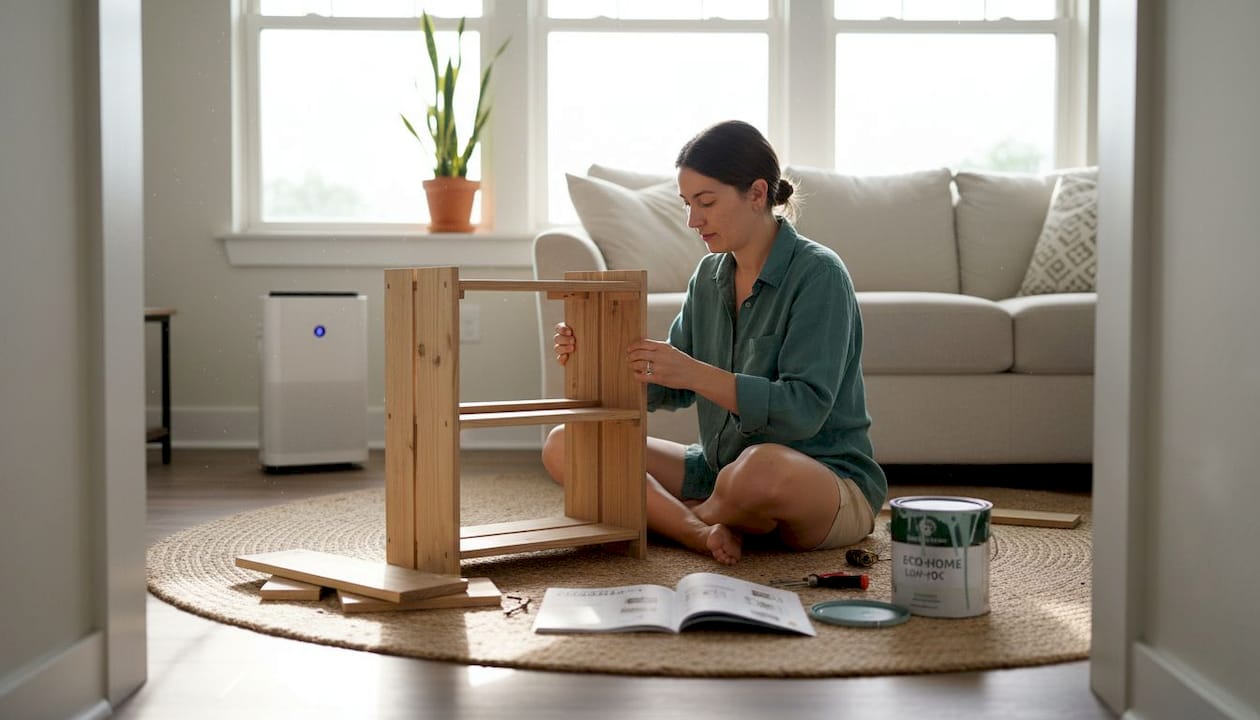
Florida’s 2026 standards require low-VOC materials and strict indoor air quality controls for FGBC certification. VOC stands for volatile organic compound, which is a chemical released by many paints, adhesives, and flooring products that can cause respiratory issues and long-term health problems.
Here is what to look for in sustainable material and IAQ choices:
- Low-VOC paints and finishes: Required for FGBC certification; dramatically improve indoor air quality from day one.
- Recycled or reclaimed materials: Reduce embodied carbon and often perform as well as new materials.
- Locally sourced products: Cut transportation emissions and support Florida’s economy.
- Moisture-resistant sheathing and insulation: Closed-cell spray foam and fiber cement siding resist mold growth in humid conditions.
- Energy Recovery Ventilators (ERVs): These systems exchange stale indoor air for fresh outdoor air while recovering energy, keeping humidity balanced without overworking the AC.
- Formaldehyde-free cabinetry and flooring: Common in certified green homes; important for long-term occupant health.
“The materials inside a home affect occupant health every single day. Choosing low-VOC, moisture-resistant products is not just an environmental decision, it is a quality-of-life decision that pays off for the life of the home.”
For custom eco-friendly tiny homes, the smaller interior volume actually makes IAQ management more critical, not less. Poor ventilation in a compact space concentrates pollutants faster than in a large home.
Pro Tip: Ask any builder to provide their material spec sheet before signing a contract. If they cannot confirm low-VOC standards and ERV inclusion, that is a red flag for both health and certification compliance.
Reviewing healthy home construction strategies gives you a strong baseline for evaluating what any builder is actually delivering versus what they are marketing.
Resilience, storm readiness, and certification: What truly makes Florida homes durable
No Florida sustainable home is complete without resilience. Hurricane readiness is not a bonus feature here. It is a baseline requirement.
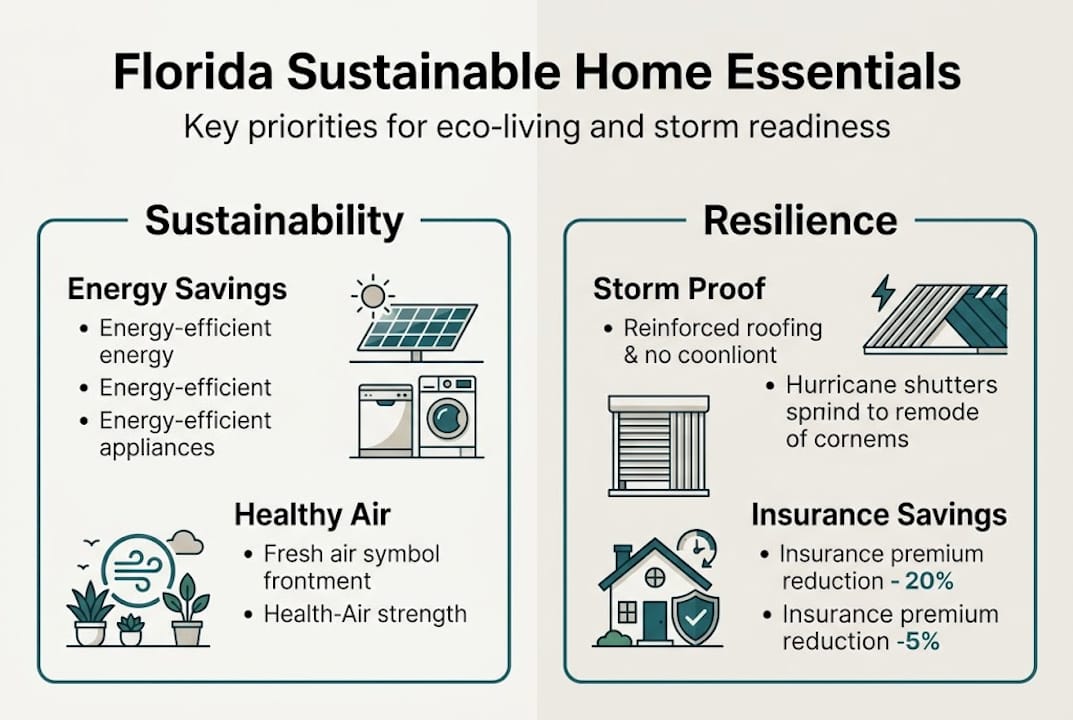
Florida homes with hurricane-resistant features receive 20 to 55 percent insurance discounts and must withstand winds of 140 to 180 mph depending on location. That wind rating requirement alone shapes nearly every structural decision in a Florida build.
The FORTIFIED standard, developed by the Insurance Institute for Business and Home Safety (IBHS), goes beyond basic code. It is a tiered certification (Bronze, Silver, Gold) that validates a home’s ability to resist wind, rain intrusion, and impact damage. Many Florida insurers now offer meaningful discounts for FORTIFIED-certified homes.
Here is how code minimum compares to certified resilience standards:
| Feature | Code minimum | FGBC/FORTIFIED certified |
|---|---|---|
| Roof sheathing | 8d nails, 6-inch spacing | Ring-shank nails, 4-inch spacing |
| Windows | Basic impact rated | High-impact, pressure tested |
| Roof-to-wall connection | Standard straps | Continuous load path |
| Flood protection | Zone-based elevation | Elevated plus flood venting |
| Insurance discount | None | 20 to 55% |
The financial case for resilience upgrades is strong. Here are the main value advantages:
- Insurance premium reductions of 20 to 55 percent annually.
- Lower repair costs after storm events due to stronger construction.
- Higher resale value in Florida’s competitive market.
- Faster recovery and lower displacement risk after hurricanes.
- Qualification for state and federal resilience incentive programs.
Resilient construction typically adds 10 percent or more to upfront costs, but the payback period through insurance savings and avoided repairs is generally 6 to 10 years. For hurricane smart tiny homes, the steel chassis and reinforced construction methods already provide a structural advantage over wood-frame alternatives.
Always confirm that any builder you work with can document Florida 2026 resilience standards compliance, not just claim it.
Tiny and customizable: How Florida’s tiny homes hit every pillar of sustainability
Finally, let’s focus in on Florida’s most flexible and sustainable option. Tiny and customizable homes address every sustainability pillar more efficiently than most conventional builds.
Florida-certified tiny homes achieve 36 to 45 percent lower carbon footprints and average 12 percent ROI as rentals, outperforming traditional homes on both environmental and financial metrics. That combination of eco-performance and investment return is hard to beat.
Here is how tiny homes stack up against traditional homes across key sustainability factors:
| Factor | Tiny home | Traditional home |
|---|---|---|
| Average energy use | 25 to 35 kWh/day | 90 kWh/day |
| Carbon footprint reduction | 36 to 45% | Baseline |
| Build cost per sq ft | $150 to $350 | $200 to $400 |
| Rental ROI | ~12% | 6 to 8% |
| Certification ease | High | Moderate |
Net-zero tiny homes in Florida earn $1,500 to $1,820 per year in solar energy savings and qualify for insurance discounts up to 55 percent. That is a compelling financial profile for investors and owner-occupants alike.
Modern prefab and park model construction methods further boost sustainability outcomes:
- Factory-controlled builds reduce material waste by up to 30 percent compared to site-built homes.
- Steel chassis construction provides superior wind and flood resistance without added weight.
- Modular design allows for easy solar, battery, and ERV integration during the build phase.
- Shorter construction timelines mean less site disturbance and lower labor emissions.
Pro Tip: Before purchasing land for a tiny home, verify local zoning rules for minimum square footage, utility hookup requirements, and ADU (accessory dwelling unit) allowances. Florida’s rules vary significantly by county.
The guide to eco-friendly tiny homes covers costs and compliance in detail, while tiny home pricing factors helps first-time buyers understand what drives the final number.
Compliance in Florida falls under FBC Appendix Q for tiny homes under 400 square feet and ANSI/RVIA standards for park models. Both pathways are well-established, and certified builders navigate them routinely.
Florida’s sustainable home truth: Certifications matter, but smart design is king
Here is something the sustainable home industry does not say loudly enough: a certification badge does not automatically make a home perform well. We have seen homes with green labels that still run high utility bills because the envelope was compromised or the HVAC was undersized for Florida’s heat load.
The smartest buyers and investors we work with use certifications as confirmation, not as the starting point. They ask builders for real-world HERS scores, blower door test results, and actual utility bills from comparable completed homes. Those numbers tell the real story.
Envelope quality, HVAC sizing, and site resilience always deliver more long-term value than add-on features like smart home systems or premium countertops. Invest in the bones of the home first. Certifications should validate the quality of those decisions, not substitute for them.
If you want to see how this plays out in practice, the Florida tiny home build process walks through exactly how design-first thinking produces better outcomes at every stage.
Find your sustainable home solution in Florida
Ready to take the next step toward owning or investing in a truly sustainable Florida home? At Ecolife Homes, we build premium steel park model tiny homes right here in Florida, designed to meet every pillar of sustainability from energy performance to hurricane resilience.
Our park model tiny home options are fully customizable, code-compliant, and built for real Florida conditions. Whether you are looking for a personal retreat, a family space, or a high-ROI vacation rental, we handle everything from permitting to final installation. Explore our tiny and eco home guide to understand your options, or browse custom tiny home designs to see what is possible for your lifestyle and budget.
Frequently asked questions
What is the most important feature of a sustainable home in Florida?
In Florida, the most important feature is a resilient, well-sealed building envelope with hurricane resistance and smart moisture control. FORTIFIED and wind-resistant construction is required for the harshest Florida wind zones, making structural integrity the foundation of every other sustainability goal.
How much does it cost to build a sustainable tiny home in Florida?
Sustainable tiny homes in Florida typically cost between $70,000 and $280,000, with net-zero models paying back in utility savings within about 6 to 10 years. Net-zero tiny homes range from $129,000 to $280,000 all-in, with a median rental ROI of around 12 percent.
Do sustainable homes have higher resale value in Florida?
Yes, certified sustainable homes and tiny homes in Florida can earn a 3 to 6 percent resale premium on top of ongoing utility savings. Sustainable homes often sell for 3 to 6 percent more in Florida markets, making certification a smart long-term investment.
Is it possible to live off-grid sustainably in Florida?
Yes, but strict zoning and permit rules apply, especially for septic systems and water wells in rural areas. Off-grid homes require specific permits, and rural zoning tends to offer the most flexibility for buyers pursuing full energy and water independence.