Why Tiny Homes Built with Magnesium Oxide Board Are Better in Florida
Tiny homes have moved from being a niche lifestyle choice to a practical housing solution across the United States. In states like Florida, where housing prices continue to rise and climate challenges demand smarter construction methods, the materials used in building a tiny home matter more than ever. One material that has gained significant attention among builders and architects is Magnesium Oxide Board, often called MgO board.
Builders looking for durability, fire resistance, and moisture protection are increasingly turning to MgO board when constructing modern tiny homes. At ecolifehomes.com, magnesium oxide panels are used as a core component in many tiny home designs because they perform exceptionally well in humid coastal climates like Florida.
Understanding why MgO board makes tiny homes better helps homeowners make smarter decisions when investing in a small, efficient home that will last for decades.
The Rise of Tiny Homes in Florida
Florida has become one of the fastest growing markets for tiny homes in the United States. According to housing trend reports published in 2025, demand for small footprint housing increased significantly across the state, especially in areas like Orlando, Tampa, Jacksonville, and South Florida.
Several factors are driving this trend. Rising property prices, increasing insurance costs, and the need for flexible living spaces are pushing buyers toward compact homes. Many homeowners are also exploring tiny homes as guest houses, rental properties, or retirement dwellings.
However, Florida presents unique construction challenges. The combination of high humidity, hurricanes, heavy rain, and intense sun exposure means that building materials must be carefully selected.
Traditional drywall and wood sheathing often struggle under these conditions. Moisture can cause swelling, mold growth, and long term structural deterioration.
This is one reason builders like ecolifehomes.com have begun integrating magnesium oxide boards into their tiny home construction systems. The material provides superior resistance to the environmental challenges that Florida homes face every year.
What Is Magnesium Oxide Board
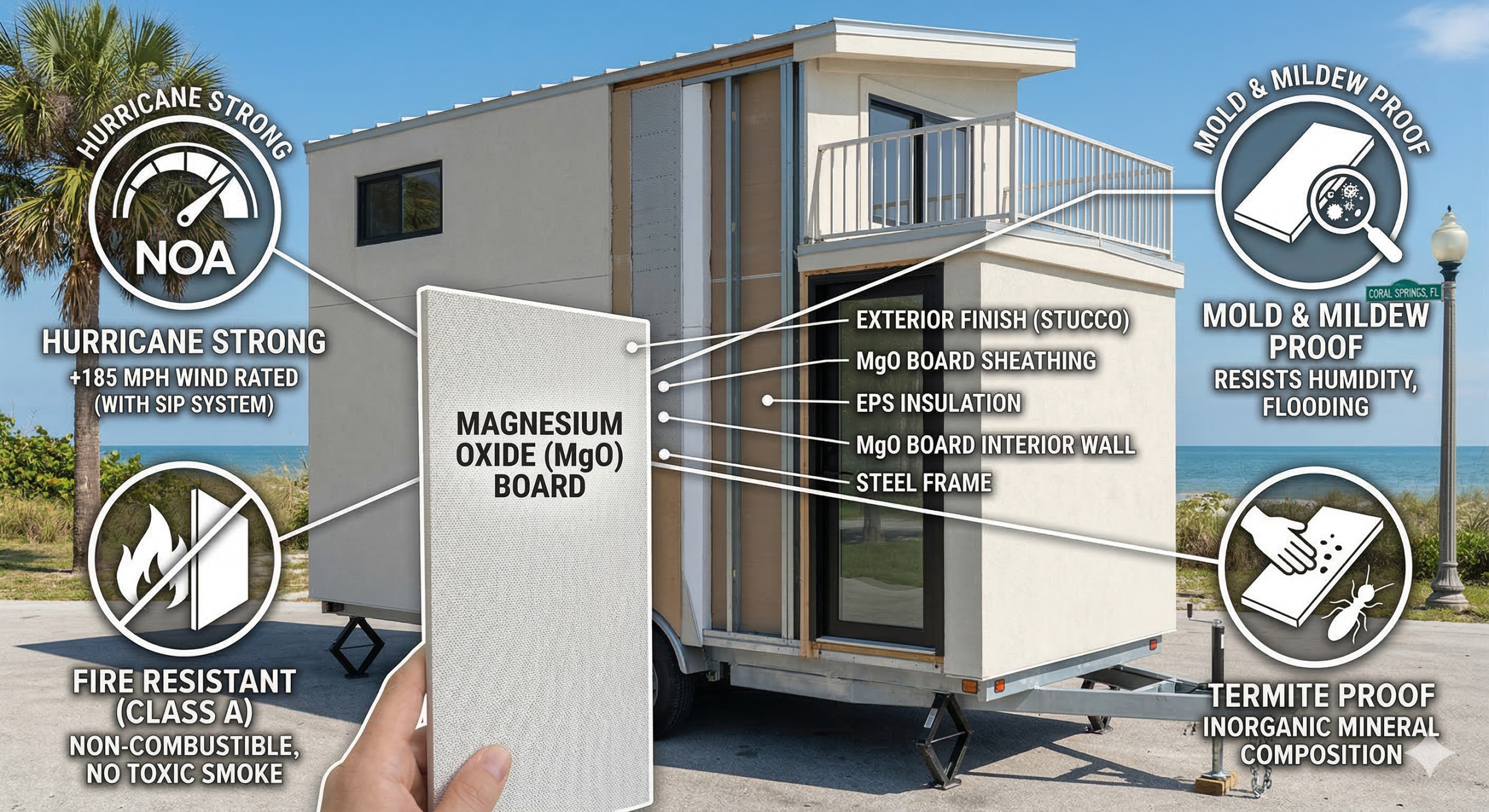
Magnesium oxide board is a mineral based construction panel made primarily from magnesium oxide, magnesium chloride, and reinforcing fibers. The result is a solid, dense board that behaves differently than traditional gypsum drywall or OSB sheathing.
Unlike wood based products, MgO board is non organic, which means it does not feed mold, mildew, or insects. This alone makes it extremely attractive in humid environments.
In construction, magnesium oxide boards can replace several conventional materials including drywall, cement board, and exterior sheathing. They can be used for walls, ceilings, floors, and even structural panels when combined with steel framing systems.
At ecolifehomes.com, MgO boards are frequently paired with steel frame structures to create tiny homes that are stronger, safer, and more durable than traditional wood framed units.
Superior Moisture and Mold Resistance
Florida’s climate is famous for its humidity. In many regions of the state, the relative humidity stays above 70 percent for much of the year.
In conventional homes, moisture can easily penetrate drywall or wooden sheathing, eventually creating mold growth inside walls. This problem becomes even more critical in tiny homes because the smaller interior space means any mold problem spreads faster.
Magnesium oxide boards naturally resist water absorption. They do not swell, delaminate, or degrade when exposed to moisture.
This makes MgO panels an excellent material for coastal regions like Miami, Fort Lauderdale, and the Florida Keys where salty air and humidity constantly challenge building materials.
Builders working with ecolifehomes.com often choose MgO board specifically because it reduces long term maintenance problems related to mold and moisture damage.
Exceptional Fire Resistance
Fire safety has become an increasingly important topic in residential construction. Wildfires in western states and accidental home fires nationwide have encouraged homeowners to look for materials that provide better fire protection.
Magnesium oxide boards are naturally fire resistant. Unlike drywall, which contains paper backing that can burn, MgO boards are made entirely from mineral components.
Many MgO boards are rated for two to four hours of fire resistance, depending on thickness and installation method.
For tiny homes, where every square foot counts, using materials that slow down fire spread can significantly increase occupant safety.
This added layer of protection is one reason builders like ecolifehomes.com recommend magnesium oxide panels in their modern tiny home models.
Stronger and More Durable Structures
One misconception about tiny homes is that they are fragile or temporary structures. In reality, when built properly, tiny homes can be as strong as traditional houses.
Magnesium oxide boards contribute to structural durability in several ways.
They are denser and more impact resistant than standard drywall. This means interior walls resist dents, cracks, and wear over time.
They also work well with steel framing systems, which are increasingly popular in hurricane prone regions like Florida.
When MgO boards are attached to steel studs, they create a rigid wall assembly that performs extremely well under wind loads.
For tiny homes designed to meet Florida wind standards of 140 to 160 mph hurricane resistance, materials like MgO panels play an important role in maintaining structural integrity.
Many modern designs featured by ecolifehomes.com incorporate these systems to improve storm resilience.
Termite and Pest Resistance
Termites are a serious issue throughout Florida. According to pest control industry estimates, termite damage costs U.S. homeowners billions of dollars each year.
Traditional wood framed homes are especially vulnerable because termites feed directly on wooden structures.
Magnesium oxide board provides a natural defense against pests because it contains no organic material.
Termites cannot eat MgO panels, and insects are far less likely to nest inside walls made from mineral based boards.
This is particularly valuable in tropical climates like South Florida where pest pressure remains high year round.
Tiny homes built with MgO board systems from ecolifehomes.com therefore require less chemical treatment and long term pest management.
Environmental Sustainability
Many people choose tiny homes because they want to reduce their environmental footprint.
Magnesium oxide boards support this goal because they are often manufactured with lower carbon emissions compared to traditional cement products.
The boards are also durable enough to last for decades, reducing the need for repairs and material replacement.
Some MgO board products even absorb small amounts of carbon dioxide during curing, making them a more environmentally responsible building option.
Builders focused on sustainable housing, including the team at ecolifehomes.com, often select MgO panels because they align with modern eco friendly construction practices.
Better Indoor Air Quality
Indoor air quality is a major concern for homeowners today, especially in compact living spaces.
Traditional drywall systems sometimes include adhesives or coatings that release volatile organic compounds (VOCs).
Magnesium oxide boards typically contain fewer chemical additives, which helps reduce indoor air pollution.
For tiny homes, where the air volume inside the building is smaller, this difference can significantly impact occupant health.
Homes designed by ecolifehomes.com prioritize clean indoor air by combining MgO panels with energy efficient ventilation systems.
Long Term Cost Savings
While magnesium oxide boards can cost slightly more than drywall initially, they often save homeowners money in the long run.
Their resistance to moisture, fire, and pests means fewer repairs and lower maintenance costs over time.
Insurance companies have also started recognizing the safety benefits of fire resistant building materials.
Some homeowners report lower insurance premiums when homes are constructed with non combustible materials.
When considering the full life cycle cost of a tiny home, MgO board systems frequently prove to be a smarter financial investment.
This long term durability is one reason why ecolifehomes.com continues to incorporate magnesium oxide boards in their tiny home models for buyers throughout Florida and across the United States.
The Future of Tiny Home Construction
Looking ahead to 2026 and 2027, experts expect the tiny home industry to continue evolving toward stronger and more resilient building systems.
Climate challenges, rising construction costs, and increasing demand for affordable housing will push builders to adopt new materials that deliver better performance.
Magnesium oxide board is positioned to play a major role in that shift.
With its combination of durability, fire resistance, moisture protection, and sustainability, MgO board addresses many of the weaknesses found in traditional residential construction.
Innovative builders such as ecolifehomes.com are already integrating these materials into next generation tiny homes designed specifically for Florida’s climate and lifestyle.
Final Thought ecolifehomes.com
Tiny homes are not just about living with less space. They are about living smarter.
Choosing the right materials can determine whether a tiny home lasts ten years or fifty years. Magnesium oxide board offers advantages that are particularly valuable in Florida’s demanding environment.
From fire resistance and mold protection to structural durability and sustainability, MgO panels provide a modern solution for building stronger tiny homes.
As more homeowners look for compact housing that can withstand extreme weather and reduce long term maintenance costs, materials like magnesium oxide board will continue to gain popularity.
For buyers exploring high quality tiny homes built with advanced construction methods, visiting ecolifehomes.com can be a great starting point to see how these innovative materials are shaping the future of small home living.