What’s the Difference Between a Park Model and Modular Home?
An Honest Comparison of Two Very Different Housing Choices
There is a moment that happens almost daily in our Florida showroom. A buyer walks in, looks around, and asks whether what they are looking at is a modular home. The question is reasonable. Both park models and modular homes are built in factories, both arrive at their final location on a truck, and both serve as alternatives to traditional construction. From a distance, they look like cousins in the same family.
The reality is that park models and modular homes are not really cousins at all. They occupy entirely different legal categories, follow different building standards, hold different types of titles, qualify for different financing, and serve very different purposes. Confusing them at the start of a buying decision can cost a buyer significant time and money down the line.
Heading into 2026 and 2027, more Florida buyers than ever are comparing these two categories as they think through affordable housing options, downsizing plans, second home purchases, and rental property investments. The choice between them deserves a careful look, because the right answer depends entirely on what the buyer actually wants the home to do over the next decade and beyond.
The Factory Built Confusion
The shared characteristic of being built in a factory is what causes most of the confusion between these two housing categories. Both park models and modular homes are produced in controlled indoor environments, assembled to specifications, transported to their final site, and set up by professional installers. The factory build process is a real advantage shared by both, offering better quality control, faster construction timelines, less weather damage during construction, and often lower costs than fully site built alternatives.
Beyond that shared factory origin, the two categories diverge in nearly every meaningful way. The building codes are different. The size limits are different. The foundation requirements are different. The titling process is different. The financing options are different. The appreciation potential is different. The use cases are different.
Treating them as similar because they share a factory background is like treating a sports car and a delivery truck as similar because both are vehicles with four wheels. The shared category is real but not particularly useful for making a buying decision.
What a Park Model Actually Is
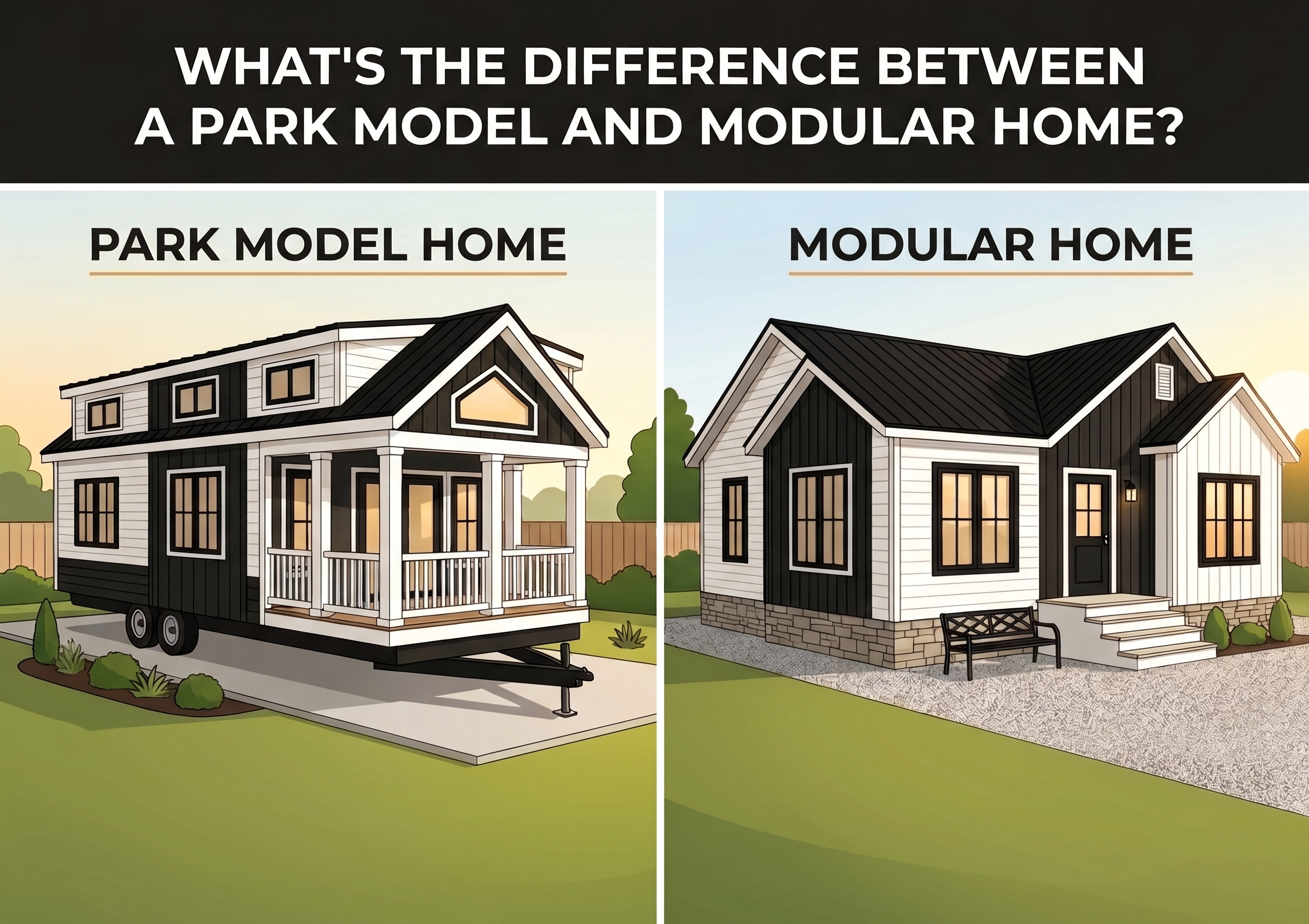
A park model is a home built to the ANSI A119.5 standard, which classifies it federally as a recreational vehicle. The classification limits interior living space to 400 square feet, exempts the home from the HUD code that governs manufactured housing, and assigns it a vehicle title rather than a real estate deed.
The construction is closer to residential building than to typical RV construction. Two by four or two by six wood framing, real drywall in many models, residential windows and doors, vinyl or fiber cement siding, and full size appliances all give the interior a genuine home feel. The home arrives at its site on its own chassis with temporary axles and wheels, gets positioned on piers or blocks, and is anchored according to local wind zone requirements.
Park models in Florida are designed for placement in dedicated park model communities, RV resorts that accept park models, or on private land in counties with permissive zoning. Year round occupancy is permitted in most Florida communities, which makes the park model a viable primary residence as well as a seasonal home.
Pricing for new park models in 2026 runs from about $65,000 for a basic model to $145,000 or more for fully customized units with lofts, large porches, and upgraded finishes. Most buyers land somewhere between $85,000 and $115,000 for a unit they are genuinely happy with.
What a Modular Home Actually Is
A modular home is built to the same building codes as a site built home, typically the International Building Code or the local building code adopted by the jurisdiction where it will be placed. In Florida, modular homes follow the Florida Building Code, which is one of the most stringent in the country due to hurricane considerations.
The construction happens in sections at a factory, with each module typically representing a portion of the home such as half of a floor or a single story. The modules are transported to the site separately, then craned into place, joined together, and finished on a permanent foundation. The completed home is essentially indistinguishable from a site built home in appearance, structure, and legal status.
Modular homes have no federal size limit. They can be small two bedroom cottages or large multi story residences with thousands of square feet. They sit on permanent foundations, hold real estate titles, qualify for conventional mortgages, and appreciate or depreciate based on the same market factors that affect site built homes in the same area.
Pricing for modular homes in Florida varies dramatically based on size and finishes. A small modular home might run $150,000 for the structure alone, while larger or more luxurious modular homes can exceed $500,000 before land costs are included. Adding the cost of land, foundation, utility connections, and permitting brings total project costs significantly higher.
Construction Standards Side by Side
The difference in building codes between these two categories has practical implications that buyers should understand clearly.
A park model built to ANSI A119.5 includes specifications appropriate for its size and use. Wall framing is adequate for the loads involved. Roofing meets requirements for the wind zone where the home will be placed when properly anchored. Plumbing and electrical systems follow the relevant RV industry codes. The construction is solid for the intended use, which is residential living at a smaller scale.
A modular home built to the Florida Building Code follows the same engineering specifications as any site built home. Hurricane straps tie the roof to the walls and the walls to the foundation. Impact resistant windows are required in many coastal zones. Engineered trusses handle higher wind loads. Plumbing and electrical follow full residential codes with all of the inspections required of site built construction.
For buyers in hurricane prone areas of Florida, this difference matters. Both types of homes can be appropriate for Florida conditions when properly installed, but the engineering margins are different. A modular home is engineered for the same wind events as any site built home in the same location. A park model is engineered for its category and depends heavily on proper installation and anchoring to handle severe weather.
Size and Design Flexibility
The 400 square foot limit on park models is the single biggest design constraint separating them from modular homes. Within that 400 square feet, park model designers have become remarkably creative, with efficient layouts, vaulted ceilings, lofts that add functional space beyond the limit, and porches and lanais that extend living areas outdoors. A 400 square foot park model with a 200 square foot lanai effectively provides 600 square feet of usable space in the Florida climate.
Modular homes have no equivalent constraint. Buyers can specify any size from compact 600 square foot cottages to 4,000 square foot family homes. Multi story configurations are possible. Custom layouts can be developed for specific lots or buyer preferences. Garages, basements, and additional structures can be integrated into the design.
The flexibility cuts both ways. Modular homes offer dramatic design freedom but at significantly higher cost. Park models offer constrained design but at a fraction of the price point. The right choice depends on what the buyer actually needs.
Foundation and Permanence
This is the structural difference that most clearly defines the two categories. A park model sits on piers, blocks, or a similar semi permanent foundation. The home retains its chassis, can in principle be relocated, and is anchored rather than permanently affixed to the ground. Even when occupants live in the same park model for thirty years, the home is technically still a vehicle in the legal sense.
A modular home sits on a permanent foundation built specifically for the home. The foundation can be a slab, a crawl space, or a basement depending on the design and the lot conditions. Once the home is installed, the modules are permanently attached to the foundation and to each other. The home becomes real property attached to the land, and relocation is essentially never done because the cost would exceed the value of moving.
The permanence affects everything downstream from this initial choice. Insurance, financing, taxation, resale, and even daily ownership experience all flow from whether the home is classified as semi permanent personal property or permanent real property.
Titling and Legal Status
Park models in Florida receive a vehicle title from the Florida Department of Highway Safety and Motor Vehicles. The title functions similarly to a car title or boat title. Ownership is established through title transfer, and the home is classified as personal property rather than real estate.
Modular homes receive a real estate deed once installed on their permanent foundation. The home is fully integrated with the land in the legal sense, and ownership transfers through the same deed process as any other real estate transaction. Property taxes are assessed on the combined value of land and home, and the home is subject to the same property tax framework as any other real estate.
This distinction affects how buyers can use the home as collateral, how they sell it, how they pass it to heirs, and how it interacts with local government for purposes like homestead exemptions and other real estate based protections that exist in Florida.
Financing Reality
The financing options for these two categories differ dramatically and buyers should understand this clearly before they fall in love with either choice.
Park model financing in 2026 typically comes from specialty lenders that offer terms of 10 to 20 years with rates that run two to four points above conventional mortgage rates. The loans are technically personal property loans rather than mortgages. Down payments of 10 to 20 percent are typical, credit requirements are reasonable, and the process is generally faster than mortgage approval but the total cost of borrowing is higher.
Modular home financing works just like financing for any other site built home. Conventional mortgages, FHA loans, VA loans for qualified veterans, and other standard mortgage products all apply. Terms run 15 or 30 years at current mortgage market rates. Down payments can be as low as 3.5 percent for FHA or zero for VA, though conventional loans typically require 5 to 20 percent down.
The financing difference often determines which category a buyer can realistically afford. A buyer who can manage a $90,000 park model with $20,000 down and specialty financing might struggle to qualify for a $250,000 modular home requiring $50,000 down and a conventional mortgage. The lower total cost of the park model often makes it accessible to buyers who could not realistically pursue modular home construction.
Appreciation Versus Depreciation
Real estate generally appreciates over time, with values reflecting market conditions, location desirability, and local demand. Modular homes, as real estate, participate in this appreciation pattern. A modular home in a strong Florida market often appreciates in line with comparable site built homes in the same area.
Park models, as personal property, follow a different value pattern. Some depreciation is typical, particularly during the first few years of ownership. In strong Florida park model communities though, the depreciation curve flattens and well maintained units can hold value reasonably well over time. A $90,000 park model purchased in 2026 might be worth $75,000 to $85,000 in 2031 if maintained properly and located in a desirable community.
The total cost picture often favors park models even with this difference. A park model owner pays significantly less for the home, has lower monthly carrying costs, often pays lot rent rather than property taxes and HOA fees, and accepts modest depreciation as the tradeoff. A modular home owner pays more for the home, has higher monthly carrying costs including property taxes, but benefits from potential appreciation.
For buyers planning to live in the home for decades, the appreciation difference matters. For buyers planning to use the home for ten years or less and want lower overall housing costs, the park model often comes out ahead financially despite the value pattern.
Florida Zoning Realities
Where you can place each type of home in Florida differs significantly. Modular homes can be placed on any residential lot zoned for site built homes, with the same setback requirements and building code compliance as any other home. The placement options are essentially as broad as those for traditional construction.
Park models are more restricted in placement options. Florida law allows them in licensed park model communities, mobile home parks that accept park models, RV resorts in many configurations, and on private land in counties with permissive zoning. Coastal urban counties tend to restrict park model placement to licensed communities, while rural and central counties often allow private land placement.
For buyers who already own a residential lot or want to buy land for placement, modular homes offer dramatically more flexibility. For buyers who want to live in an established community with amenities and services, park models often offer more attractive options because the communities are specifically designed around them.
The Hurricane Question
Both categories handle Florida hurricanes when properly built and installed, but the engineering approaches differ. A modular home built to current Florida Building Code is engineered to withstand the same wind events as any site built home in the same location, with hurricane straps, impact rated windows in coastal zones, and engineered structural systems.
A park model with proper anchoring meets its category requirements and rides out lower category storms reasonably well, but it lacks the structural margin of a fully code built home. Florida park model communities typically require evacuation during named storms, while modular home owners can usually shelter in place for lower category events.
Insurance reflects this difference. Park model insurance is available but has tightened in coastal areas through 2026, with premiums running $800 to $2,500 per year depending on location. Modular home insurance is essentially identical to homeowner insurance for any site built home in the same area, with all of the normal coverages and exclusions.
Use Cases for Each
The right choice between these two categories comes down to use case rather than personal preference about features. Different lifestyles fit different categories.
A park model works well for buyers who want affordable housing in a community setting, snowbirds who split time between Florida and another state, retirees on fixed incomes who need lower carrying costs, vacation rental investors seeking attractive entry points, and buyers who want to live in Florida without committing to traditional homeownership costs.
A modular home works well for buyers who want a permanent residence on their own land, families needing significant interior space, buyers planning to live in the home for decades and benefit from appreciation, owners wanting full real estate ownership with all the associated protections, and buyers who can qualify for conventional mortgage financing.
Many buyers find that one category clearly fits their needs once they think through how they actually plan to use the home. The confusion happens when buyers compare features without thinking through use cases first.
Resale Considerations
The resale process differs significantly between the two categories. Park models typically sell through community sales offices, specialty brokers, or private transactions. The market is smaller than the traditional housing market, transactions can take longer, and buyers often need to be approved by the community management before purchase.
Modular homes sell through the standard real estate process with licensed agents, multiple listing services, traditional financing for buyers, and the same legal framework as any other home sale. The market is larger, the process is more familiar to most buyers, and competition for desirable homes can support strong pricing.
For buyers thinking about eventual resale, the modular home offers more market depth and a more familiar transaction process. The park model offers reasonable resale options within its niche but requires more specialized handling.
Tax Implications
Property taxes differ meaningfully between the two categories. Modular homes are taxed as real estate, with annual property tax bills based on the combined value of land and home. Florida homestead exemptions apply for primary residences, which can significantly reduce the tax burden.
Park models in lease communities typically have only the underlying land taxed to the community owner, with residents paying through lot rent rather than direct property tax. Park models on owned land may be taxed as tangible personal property at relatively low rates compared to real estate. The overall tax burden for park model living is usually lower than for modular home ownership in equivalent locations.
Choosing Between Them for 2026 and 2027
The honest path through this decision starts with thinking carefully about what the home actually needs to do. A few questions help clarify the right direction.
If the goal is owning real estate, building long term equity, having maximum design flexibility, and qualifying for conventional financing, a modular home is the appropriate category. The higher costs reflect the higher value of what you are buying, and the long term financial pattern matches traditional homeownership.
If the goal is affordable Florida living, low monthly costs, access to established communities with amenities, flexibility to leave seasonally or relocate eventually, and entry into the market without a major down payment, a park model is the appropriate category. The category exists specifically to serve these use cases.
Some buyers genuinely could go either way, and for those buyers, talking through the specifics with someone who knows both categories is the most useful step. At EcoLife Homes, we focus on park models because we believe they serve a real and growing need in Florida, but we recognize that modular homes are the right answer for some buyers. Pointing those buyers in the modular direction when their needs clearly match that category is part of doing the job honestly.
If you are working through this decision for 2026 or 2027 and want a candid conversation about which direction fits your situation, the EcoLife Homes team is happy to help you think it through. The right choice is the one that fits your actual life, not the one with the most features or the lowest sticker price. Once you understand what each category really offers, the answer usually becomes clearer than the initial confusion suggests.