Florida modular housing: affordable, custom, and green
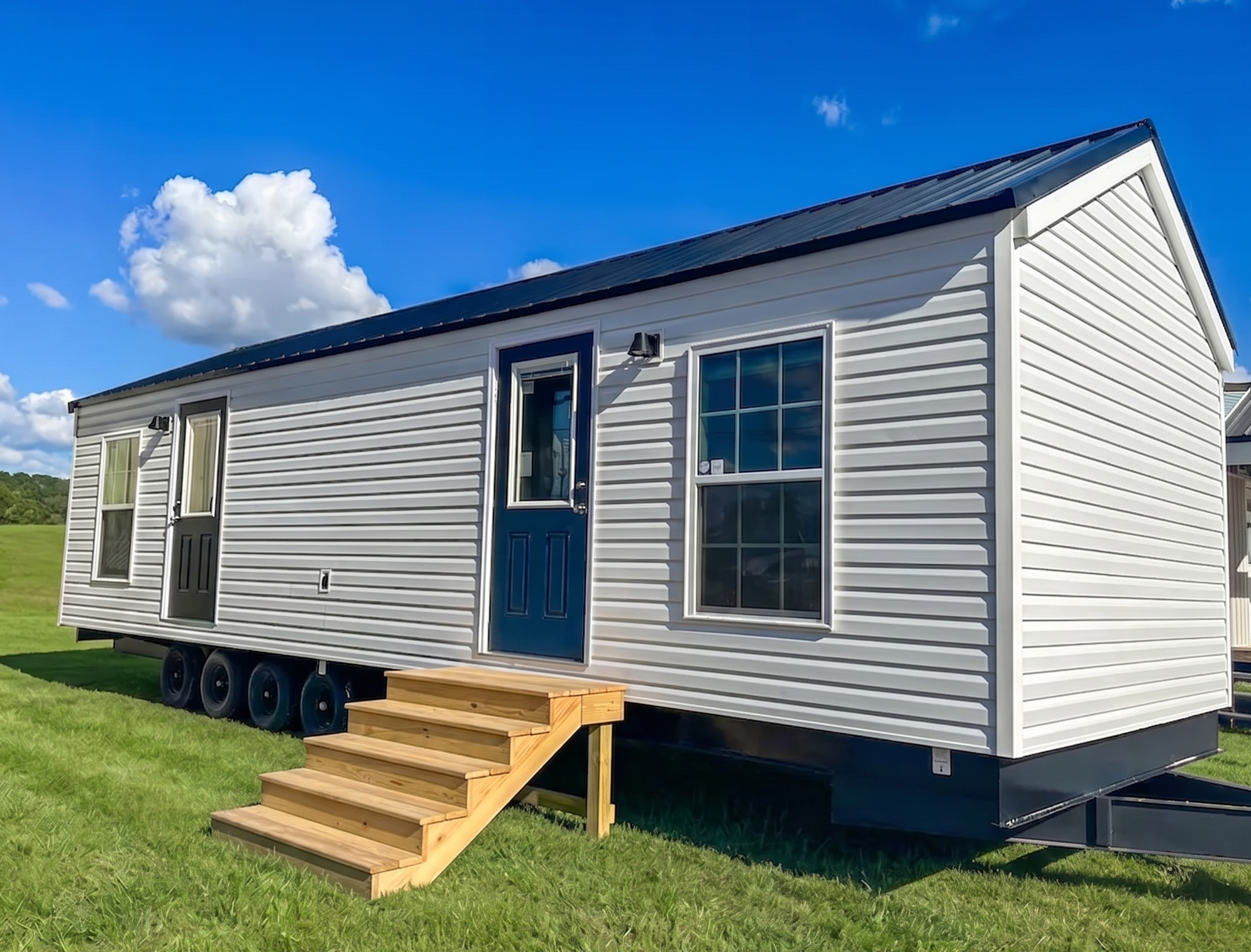
Modular homes are factory-built, meet Florida’s building codes, and sit on permanent foundations. They offer faster construction, cost savings, and customization for Florida buyers. Overcoming zoning, permitting, and lender misconceptions is key to successful modular homeownership.
Modular homes and mobile homes are not the same thing, yet the confusion persists across Florida. Modern modular housing is factory-built to the same codes as traditional site-built homes, then assembled on a permanent foundation with the same durability expectations. For Floridians seeking affordable, customizable, and sustainable housing, this distinction matters enormously. This guide covers what modular housing actually is, how it compares to other options, what you can customize, how to finance and permit your build, and which myths to ignore. By the end, you’ll have a clear picture of whether modular living fits your goals.
Table of Contents
- What is modular housing in Florida?
- Benefits and challenges of modular housing in Florida
- Design options and customization for Florida modular homes
- Buying, financing, and permitting modular homes in Florida
- Common myths and misconceptions about Florida modular housing
- Our take: What most people miss about modular housing in Florida
- Next steps: Explore modular living with Ecolife Homes
- Frequently asked questions
Key Takeaways
| Point | Details |
|---|---|
| Affordable and Flexible | Modular housing offers significant cost savings and custom options for Florida buyers. |
| Sustainable and Resilient | Modern modular homes are energy-efficient and built for Florida’s climate challenges. |
| Clear Buying Process | Financing, permitting, and buying modular homes is straightforward with the right guidance. |
| Customizable Designs | You can tailor your modular home with eco-friendly features, layouts, and designs. |
| Myths Debunked | Common misconceptions about modular housing are outdated—quality and legality are top-notch. |
What is modular housing in Florida?
Modular housing refers to homes built off-site and assembled on a permanent foundation. The home is constructed in sections, called modules, inside a controlled factory environment. Once each module passes inspection, it’s transported to your property and assembled by a crew. The result looks and functions exactly like a traditionally built home.
This process is fundamentally different from buying a manufactured or mobile home. Mobile homes are built to federal HUD standards and sit on a steel chassis that can be moved. Modular homes, by contrast, must meet Florida’s state and local building codes, the same codes that apply to any stick-built house on your block. That distinction affects everything from financing to insurance to resale value.
For Florida specifically, modular construction offers some practical advantages. Factories use moisture-resistant materials and build to wind-load specifications that meet or exceed Florida’s hurricane resilience requirements. The controlled environment also eliminates weather delays during construction, which is a real benefit in a state where afternoon thunderstorms are routine.
Here’s a quick comparison to help clarify the differences:
| Feature | Modular | Manufactured/Mobile | Traditional site-built |
|---|---|---|---|
| Built to code | State/local codes | Federal HUD code | State/local codes |
| Foundation | Permanent | Steel chassis | Permanent |
| Build time | 2 to 4 months | 4 to 8 weeks | 6 to 12 months |
| Average cost | Lower to mid-range | Lowest | Highest |
| Financing | Standard mortgage | Specialized loans | Standard mortgage |
| Resale value | Comparable to site-built | Lower | Highest |
The benefits of choosing modular over traditional construction include:
- Faster completion because factory production runs simultaneously with site preparation
- Consistent quality control since each module is inspected before it leaves the factory
- Less material waste compared to on-site framing and cutting
- Reduced weather exposure during the build process
- Predictable pricing with fewer surprise cost overruns
Florida’s housing market continues to feel cost pressure, and modular construction is increasingly recognized as a practical path to homeownership. When you compare modular vs traditional homes, the speed and cost advantages become especially clear for buyers working within a defined budget.
Benefits and challenges of modular housing in Florida
Affordability is the most immediate reason Florida buyers consider modular housing. Modular homes provide significant cost savings and customizable options compared to traditional construction, with buyers often saving between 10% and 60% on total housing costs. That’s a meaningful difference in a state where median home prices have climbed steadily.
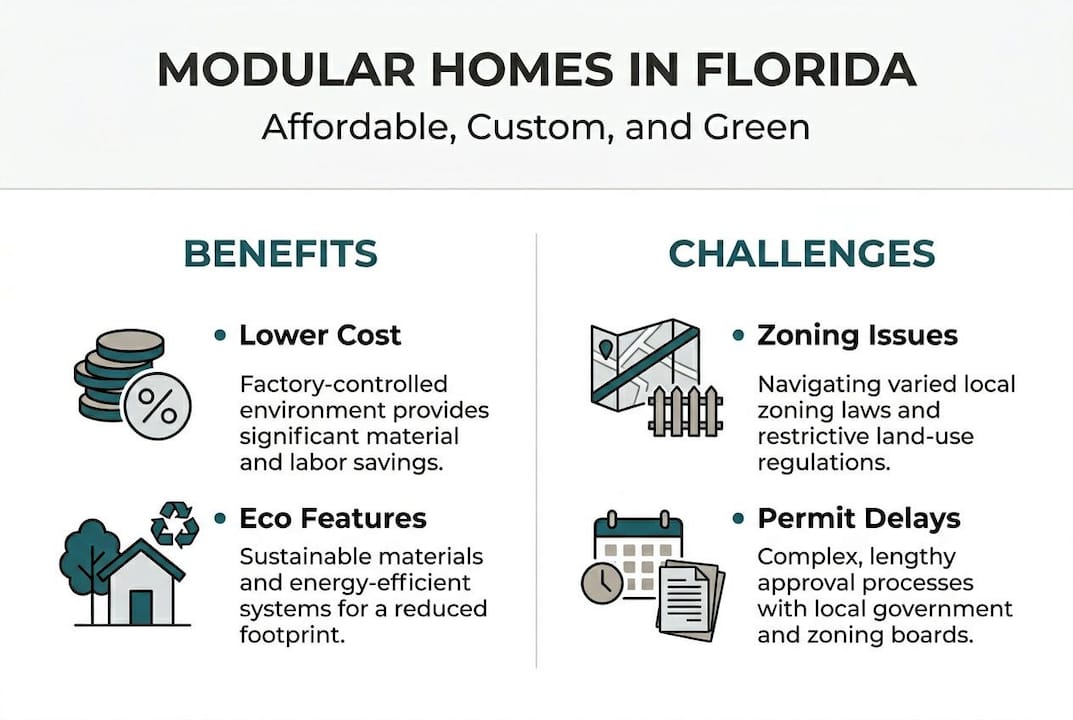
Beyond the price tag, modular homes move faster from contract to keys. A traditional build can stretch 12 months or longer. A modular home is often ready in 2 to 4 months, which matters if you’re paying rent while waiting to move in.
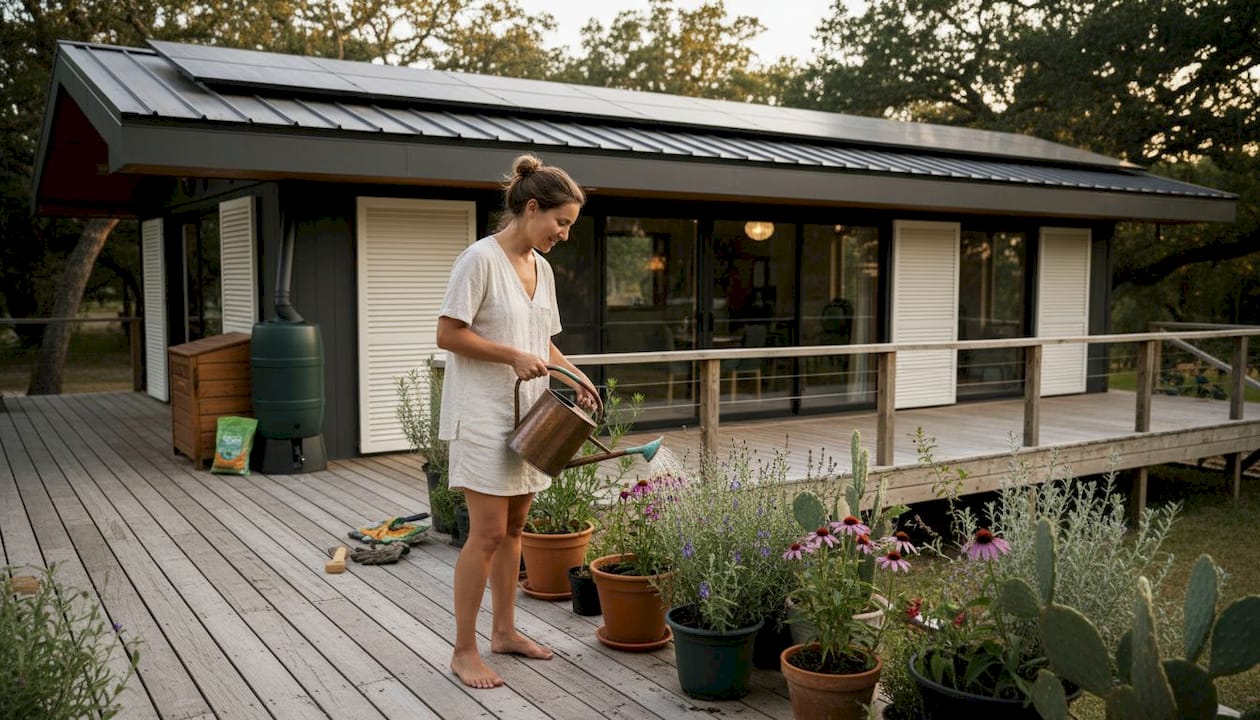
Sustainable features and energy efficiency are among the top reasons Florida buyers choose modular homes. Many models come solar-ready, with pre-wired conduit for panels and roof structures designed to support the added load. Insulation standards in factory builds often exceed minimum code requirements because manufacturers can apply materials more precisely in a controlled setting.
Here are the key pros and cons to weigh:
Pros:
- Lower upfront cost compared to traditional construction
- Faster build timeline
- Strong quality control through factory inspections
- Eco-friendly construction with less waste
- Customizable layouts and green upgrades
- Qualifies for standard mortgage financing
Cons:
- Limited placement options in some zoning areas
- Requires suitable land and site preparation
- Some lenders still confuse modular with manufactured homes
- Builder selection requires careful research
- Permitting timelines vary by county
The challenges are real but manageable. Zoning is the most common obstacle, particularly in rural counties where land use rules haven’t kept pace with modern modular construction. Permitting timelines also vary widely across Florida’s 67 counties, so what takes three weeks in one jurisdiction may take three months in another.
Pro Tip: Work with a builder who has direct experience navigating Florida’s county-level permitting offices. A specialist familiar with local hurricane resilience requirements and eco home benefits will save you significant time and frustration. If you’re exploring affordable tiny homes as an entry point, modular park model options are worth a close look.
Design options and customization for Florida modular homes
One of the most underappreciated aspects of modular housing is how much you can personalize it. Florida modular homes can be tailored for sustainability, size, and design preferences, from compact single-room retreats to multi-bedroom family layouts with open floor plans.
Size is the starting point. Florida buyers can choose from small park model homes around 400 square feet up to larger modular configurations exceeding 2,000 square feet. The number of bedrooms, bathroom count, kitchen layout, and living space configuration are all adjustable before manufacturing begins.
Sustainability upgrades are where modular construction really shines. Popular options in Florida include:
- Energy-efficient appliances pre-installed to ENERGY STAR standards
- Hurricane-resistant windows and doors rated for high wind zones
- Rainwater collection systems integrated into the roof design
- Off-grid capability with solar panels and battery storage pre-wiring
- Multi-generational layouts with separate entrances or in-law suites
- Elevated foundation designs suited for flood-prone Florida zones
Here’s a sample of common custom features and their typical upgrade costs:
| Custom feature | Estimated upgrade cost |
|---|---|
| Solar-ready roof wiring | $1,500 to $3,000 |
| Hurricane-impact windows | $3,000 to $8,000 |
| Off-grid battery system | $8,000 to $15,000 |
| Rainwater collection | $2,000 to $5,000 |
| Accessibility modifications | $2,500 to $6,000 |
| Premium kitchen package | $4,000 to $10,000 |
Before you sit down with a builder to plan your design, it helps to have answers to these questions ready:
- What is your target square footage and bedroom count?
- Do you want the home to be fully off-grid capable?
- What is your budget for green upgrades versus standard finishes?
- Will the home need accessibility features now or in the future?
- What is your site’s flood zone classification?
Understanding the tiny home construction process before your first design meeting puts you in a much stronger position. Builders respond better to buyers who arrive with clear priorities, and you’re less likely to overspend on upgrades that don’t match your actual lifestyle.
Buying, financing, and permitting modular homes in Florida
Financing and permitting for modular homes follows distinct steps in Florida, and knowing them in advance makes the process far less stressful. The good news is that modular homes qualify for conventional mortgages, FHA loans, and VA loans, unlike manufactured homes, which often require specialized products.
Here is the step-by-step process most Florida buyers follow:
- Choose your builder. Research builders with proven Florida experience, verified licenses, and references from completed projects.
- Secure your land. Confirm zoning allows modular construction and check flood zone status through FEMA maps.
- Get pre-approved for financing. Approach lenders who understand modular construction timelines and draw schedules.
- Finalize your design. Lock in floor plan, features, and upgrades with your builder.
- Apply for permits. Submit site plans, engineering documents, and energy compliance reports to your county building department.
- Site preparation. Foundation work, utility connections, and driveway access are completed while your home is manufactured.
- Delivery and assembly. Modules arrive and are set on the foundation, typically within one to two days.
- Final inspections. County inspectors review the completed home before issuing a certificate of occupancy.
- Move in. Once the certificate is issued, the home is legally yours to occupy.
Navigating Florida’s modular housing regulations is crucial for a successful purchase. Documentation requirements vary by county, but most jurisdictions require engineered site plans, energy calculations, and proof that the factory holds a current Florida manufacturer’s license.
Pro Tip: Contact your county building department before signing any contracts. Ask specifically about modular home permitting timelines and any local amendments to the Florida Building Code. Engaging early prevents costly surprises and keeps your project on schedule. You can also review the permitting steps specific to park model homes for a detailed breakdown.
Common myths and misconceptions about Florida modular housing
Persistent myths keep some buyers from exploring modular housing seriously. Let’s address the most common ones directly.
Modern modular homes are built to rigorous standards and differ fundamentally from mobile homes in construction, code compliance, and permanence. Here’s a myth-versus-fact breakdown:
- Myth: Modular homes are just fancy trailers.
Fact: Modular homes are built to Florida’s state building codes and placed on permanent foundations. They are legally and structurally equivalent to site-built homes. - Myth: Modular homes are less durable than traditional homes.
Fact: Factory construction uses precision framing and is inspected at multiple stages. Many modular homes outperform site-built homes in wind resistance testing. - Myth: You can’t get a regular mortgage for a modular home.
Fact: Modular homes on permanent foundations qualify for conventional, FHA, and VA loans, the same products available for any site-built home. - Myth: Modular homes lose value faster.
Fact: Studies show that modular homes on permanent foundations appreciate at rates comparable to traditional homes in the same market. - Myth: Modular homes all look the same.
Fact: Modern modular designs range from minimalist tiny homes to spacious multi-bedroom layouts with custom finishes.
The Florida Building Commission has consistently reinforced that modular homes meeting state certification requirements carry the same legal standing as any other permanent residential structure. That matters when you’re applying for insurance, seeking financing, or planning to sell. Reviewing meeting modular codes gives you a clear picture of what compliance actually involves.
Our take: What most people miss about modular housing in Florida
Most buyers come to us focused on the upfront savings, and that’s a reasonable starting point. But in our experience, the deeper value of modular housing shows up over years, not months. Lower energy bills from better insulation, fewer maintenance surprises from precision factory construction, and the ability to design a home that genuinely fits your life rather than settling for whatever the market offers at a given price point.
What separates buyers who thrive in modular homes from those who feel disappointed is usually one thing: the quality of their builder relationship. Customization is only as good as the builder’s ability to execute it accurately. That’s why we believe choosing a Florida-based team with verifiable experience matters more than chasing the lowest quote.
The sustainable living perspective also shifts when you live it. Energy independence, reduced environmental impact, and a home designed around your actual needs create a quality of life that generic housing rarely delivers. Modular housing in Florida isn’t just an affordable option. It’s a genuinely better one for the right buyer.
Next steps: Explore modular living with Ecolife Homes
If modular housing feels like the right direction, Ecolife Homes is ready to help you move from curiosity to clarity. We design and manufacture premium steel park model tiny homes right here in Florida, handling everything from permits to final installation so you don’t have to manage the complexity alone.
Whether you’re ready to explore tiny homes or want to learn about park model homes in more depth, our team is here to answer your questions without pressure. You can also browse our customized eco-friendly designs to see what’s possible for your budget and lifestyle. Reach out today and let’s talk about what your ideal Florida home looks like.
Frequently asked questions
How much do modular homes cost in Florida?
Factory-built homes save 10 to 60% compared to traditional construction, with final pricing depending on size, custom features, and your specific location in Florida.
Is modular housing legal in all parts of Florida?
Modular homes are legal statewide, but local regulations vary significantly by county, so confirming zoning and permitting requirements in your specific area before purchasing land is essential.
Can modular homes in Florida be customized?
Yes, Florida modular homes can be tailored extensively, including size, bedroom count, eco-friendly upgrades, hurricane-resistant features, and interior finishes to match your lifestyle and budget.
What are common financing options for modular homes in Florida?
Financing a modular home is straightforward because modular homes on permanent foundations qualify for conventional mortgages, FHA loans, VA loans, and in some cases, specialized construction-to-permanent loan products.