ADU Permits and Utility Hookups in Florida
What They Really Cost in 2026 for Adu Permits
There’s a version of ADU budgeting that a lot of people do, and then there’s the version that actually reflects what you’re going to spend. The gap between those two numbers is often somewhere between $10,000 and $20,000 — and almost all of that gap comes from the same place: permit fees and utility hookups that never made it into the original quote.
This is one of the most consistent patterns in the ADU industry, and it catches people off guard constantly. A homeowner gets a construction quote that looks reasonable, commits to the project, and then discovers — sometimes well into the process — that connecting the new unit to water, sewer, and electricity, and clearing all the required permits, is going to cost a significant amount of money on top of what they were originally told.
This post is about making sure that doesn’t happen to you. We’re going to break down every cost category in the permitting and utility connection process for Florida ADU projects, explain why these costs exist, how they vary, and what the total picture actually looks like for someone building in 2026 or planning a project for 2027.
Why Permits and Utility Costs Get Left Out of Quotes
Before getting into the numbers, it’s worth understanding why this problem is so common. The short answer is that it serves the builder’s short-term interest to present the lowest possible number during the sales process. A quote that includes every cost associated with a completed, connected, permitted unit looks higher than a quote that only covers the structure itself. In a competitive market, the builder with the lower-looking number often wins the conversation — even if the real total is identical or higher once everything is factored in.
This isn’t unique to the ADU industry. It’s a pattern that shows up across residential construction, home improvement, and contracting of all kinds. But it’s particularly consequential in the ADU space because the permit and utility costs are significant, they’re not optional, and many homeowners are budgeting carefully and have limited flexibility when surprise charges emerge.
The other dynamic at play is that permit fees and utility connection costs are genuinely variable — they depend on your specific property, your municipality, and the condition of the existing infrastructure on your lot. A builder who says “we’ll figure out those costs later” may sometimes be reflecting genuine uncertainty rather than deliberate omission. But uncertainty is not an excuse for leaving major cost categories out of a client’s budget picture. The right approach is to research the specific costs for your property upfront and include realistic estimates from the beginning.
At EcoLife Homes, permit fees and utility hookup costs are discussed openly in the earliest stages of every project. The goal is always a complete picture before any commitment is made, not a low number that grows as the project progresses.
The Total Range: What Florida Homeowners Actually Spend
For most ADU projects in Florida in 2026, the combined cost of permits and utility connections falls somewhere between $10,000 and $20,000. That’s a wide range, and the specifics of your project will determine where within that range you land. Let’s go through each component.
ADU Permit Fees in Florida
Typical Range: $3,000 to $6,000
Permit fees are the charges your local municipality assesses to review your construction plans and authorize the project. They exist at every level — building permits, electrical permits, plumbing permits, mechanical permits — and they’re required before any legal construction can begin.
In Florida, ADU permit fees vary by county and municipality, and they’re typically calculated based on the square footage of the new structure, the valuation of the project, or sometimes a combination of both. A smaller studio ADU will generally carry lower permit fees than a two-bedroom unit, but the relationship isn’t always perfectly linear because many municipalities have fixed minimums and tiered structures.
The $3,000 to $6,000 range reflects what EcoLife Homes clients typically see across Florida’s diverse permitting jurisdictions. Projects in municipalities with simpler fee structures and smaller units tend toward the lower end. Larger units, jurisdictions with higher fee schedules, or projects that require additional specialized reviews — stormwater management plans, energy compliance documentation, structural engineering sign-offs — can push toward the upper end of the range or occasionally beyond it.
One thing worth understanding about permit fees is that they’re not negotiable. They’re set by ordinance, they apply to every project equally, and no amount of relationship or volume will get them waived or reduced. What a knowledgeable builder can do is research your specific municipality’s fee schedule before the project starts, so the number that goes into your budget is accurate rather than approximate.
Permit fees also typically don’t cover the cost of the inspections that happen throughout the construction process, or the final Certificate of Occupancy inspection that has to be passed before the unit is legally habitable. These are usually included in the permit fee structure or covered as separate line items depending on the jurisdiction. Your builder should know how this works in your specific area.
Utility Hookup Costs: Water, Sewer, and Electric
Typical Range: $6,000 to $9,000
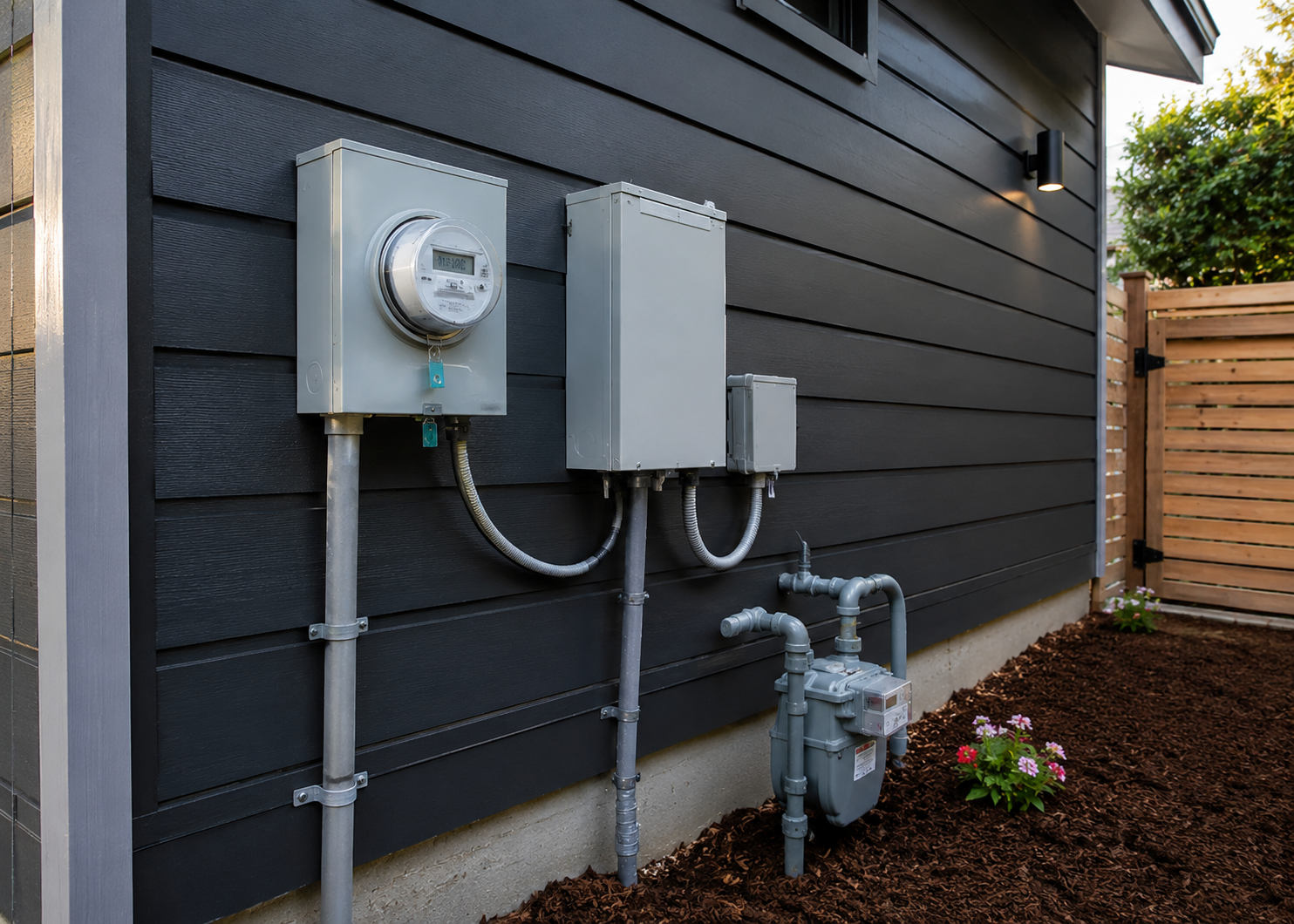
This is often the most significant cost category that gets left out of builder quotes, and it’s the one that creates the most unpleasant surprises. Connecting a new ADU to municipal water, sewer, and electrical service is not free, and in many cases it’s not cheap.
Water and sewer connection typically represents the largest portion of utility hookup costs. Most municipalities charge connection fees that are assessed per unit — you’re adding a new dwelling unit to the municipal water and sewer system, and the fees are intended to offset the infrastructure capacity that new unit requires. These fees vary significantly by municipality, and in some Florida markets they’ve increased meaningfully over the past few years as infrastructure improvement costs have risen.
Beyond the connection fees themselves, there’s the actual physical work of connecting the new unit to the existing service infrastructure on your property. Depending on where your main water and sewer lines run, the distance to the new structure, and what’s in the ground between here and there, this can be straightforward or it can involve more extensive excavation. Your existing water meter may need to be upsized to handle the additional demand. Your sewer lateral may need evaluation. None of this is extraordinary — it’s standard construction work — but it costs money, and that money belongs in your budget from day one.
Electrical service for a new ADU typically requires its own electrical panel and meter, its own utility account, and connection to the primary service that feeds your property. This work is done by licensed electrical contractors in coordination with your utility provider, and it includes the utility company’s own connection fees on top of the labor and materials costs. In Florida, where air conditioning is not optional and electrical demand is accordingly significant, proper electrical sizing matters — an underpowered installation is both a comfort problem and potentially a safety issue.
The $6,000 to $9,000 range for utility hookups covers the typical scenario for Florida ADU projects in 2026: a unit that’s within reasonable distance of existing service infrastructure, connecting to municipal water and sewer, with standard electrical requirements. Projects with more complex site conditions, longer runs from existing infrastructure, or utility provider fees that fall on the higher end of the scale can push beyond this range.
Septic System Costs
Range: $7,000 to $10,000 When Required
Not every ADU project in Florida involves septic system work, but when it does, it’s a significant cost category that absolutely must be in the budget.
Florida has a substantial number of properties — particularly in rural areas, exurban communities, and on larger lots outside of densely served municipal areas — that aren’t connected to municipal sewer service. These properties handle wastewater through on-site septic systems. When you add an ADU to a property with an existing septic system, the system’s capacity has to be evaluated relative to the additional demand the new unit will create.
In some cases, an existing septic system has sufficient capacity to handle an ADU, and no upgrade or replacement is required. In other cases, the system needs to be expanded or upgraded — or in some situations, a completely new system needs to be installed for the ADU separately. The local Health Department has jurisdiction over septic system requirements in Florida, and their determination about what’s needed is not subject to negotiation.
A new or upgraded septic system in Florida currently runs $7,000 to $10,000 in typical cases. More complex situations — difficult soil conditions, larger system requirements, sites with limited space for drain fields — can push costs higher. Conversely, situations where only minor modifications are needed to an existing system may cost less.
The critical thing about septic costs is that they can’t be determined definitively without a site assessment. A builder or contractor who quotes you a septic number without having evaluated your specific property and consulting with the Health Department is giving you a placeholder, not a real number. At EcoLife Homes, the site assessment process specifically includes evaluation of existing utility and wastewater conditions, so clients have a realistic picture of septic implications before the project budget is finalized.
Impact Fees: The Cost That Surprises People Most
Florida municipalities charge impact fees on new residential construction as a mechanism for funding the infrastructure capacity that new development requires — roads, schools, parks, water treatment, and other public systems. ADUs are new residential units, and in many Florida jurisdictions, they’re subject to impact fees.
Impact fees are not included in the permit fee figures above, and they’re assessed separately by the jurisdiction. They vary enormously by county and municipality — some Florida jurisdictions charge relatively modest impact fees on ADUs, others charge amounts that can be substantial, and some have specifically exempted ADUs from certain impact fee categories as part of broader housing policy goals.
This is genuinely one of the more variable cost categories in the ADU budget, and it’s one that requires research specific to your property’s location. In some markets, impact fees add a few thousand dollars to the project cost. In others, they can be significantly more. Knowing what applies to your situation before you finalize your budget is essential — this is not a cost category where discovering the real number at permit application time works out well.
In 2026, some Florida municipalities have been revisiting their impact fee structures for ADUs as part of broader efforts to encourage housing supply. Whether any of these changes apply to your specific project requires current, jurisdiction-specific research — which is one reason the early site review process at EcoLife Homes is structured to address exactly these questions.
How to Think About the Total
When you add up permit fees, utility hookups, and the potential for septic work, the $10,000 to $20,000 total range for permitting and utility costs makes complete sense. The specific number for your project depends on your municipality’s fee structure, your property’s existing utility infrastructure, whether septic work is required, and the applicable impact fees in your area.
What’s important is that this range represents real money that belongs in your budget from day one. A construction quote that leaves these costs out isn’t giving you a complete picture — it’s giving you a number that will grow when these costs surface later in the process.
The right way to think about ADU budgeting is total cost to reach a move-in-ready, permitted, connected, legally habitable unit. That means the construction cost plus permits plus utility connections plus any required septic work plus impact fees. All of it. Before you sign anything.
Why Some Builders Don’t Include These Costs
It’s worth being direct about this, because understanding the incentive structure helps you ask the right questions when you’re evaluating builders.
A builder who leaves permit and utility costs out of their quote is presenting a lower number than one who includes them. In a competitive environment, lower numbers win more conversations. Some clients don’t ask enough questions to realize what’s missing from the quote until it’s too late. And some builders have convinced themselves — or would have you believe — that these costs are somehow your responsibility to figure out separately, outside of the “construction” quote.
This framing doesn’t hold up to scrutiny. Permits and utility connections are required for a legal, usable ADU. They’re not optional extras. Any builder who presents them as separate from the project cost is asking you to compare their incomplete number against another builder’s complete one — which is not a fair comparison and not useful for making good decisions.
When you’re evaluating builders, ask directly: does your quote include permit fees, utility connection costs, and any required septic work? If the answer is anything other than a clear yes — or if the builder seems uncertain about these costs or unwilling to research them specifically for your property — that’s important information about how the project is likely to be managed.
What a Transparent Process Actually Looks Like
Transparency in ADU pricing isn’t complicated — it just requires a commitment to giving clients accurate information even when accurate information makes the number bigger than a stripped-down quote would show.
At EcoLife Homes, the process starts with a site review that specifically evaluates the factors that drive permit and utility costs: your municipality’s fee schedule, the existing utility infrastructure on your property, your wastewater situation, and any applicable impact fees. The goal is to give clients a realistic total cost picture before any design work begins and certainly before any commitment is made.
This approach means the number a client sees at the beginning of the project is the number they can actually budget around. There’s no $15,000 utility surprise halfway through construction. There’s no permit fee that surfaces at application time and reshapes the project economics. The complete picture is on the table from the first substantive conversation.
This is how every ADU project should work, and it’s worth holding every builder you speak with to this standard.
Planning Your 2026 or 2027 ADU Project
If you’re actively researching ADU projects in Florida for 2026, the permitting and utility cost information in this post should be going directly into your budget planning. If you’re thinking about a 2027 project, this is equally relevant — these cost categories are not going away, and if anything, fee schedules tend to move upward over time as infrastructure costs rise and municipalities update their fee structures.
The practical implication is straightforward: add $10,000 to $20,000 to your construction budget to account for permits and utilities, and then research the specific numbers for your property to see where within that range you land. If your property is in an area that requires septic work, add another $7,000 to $10,000 as a contingency until the actual scope can be determined.
Get these numbers on the table before you compare builder quotes, because a comparison between a complete quote and an incomplete one isn’t a comparison at all. The complete picture is the only one that’s useful.
EcoLife Homes builds ADUs throughout Florida with full cost transparency from the first conversation. If you’re planning a project for 2026 or 2027 and want to understand the real total cost for your specific property — construction, permits, utility connections, and everything in between — a free site review is the right starting point. You’ll leave with real numbers, not marketing minimums, and a clear sense of what your project actually involves.
Ready to get the complete cost picture for an ADU on your Florida property? Contact EcoLife Homes to schedule a free site review. We’ll break down every expense — permits, utility hookups, septic costs, and construction — before a single shovel hits the ground.