How Do You Transport a Park Model Home?
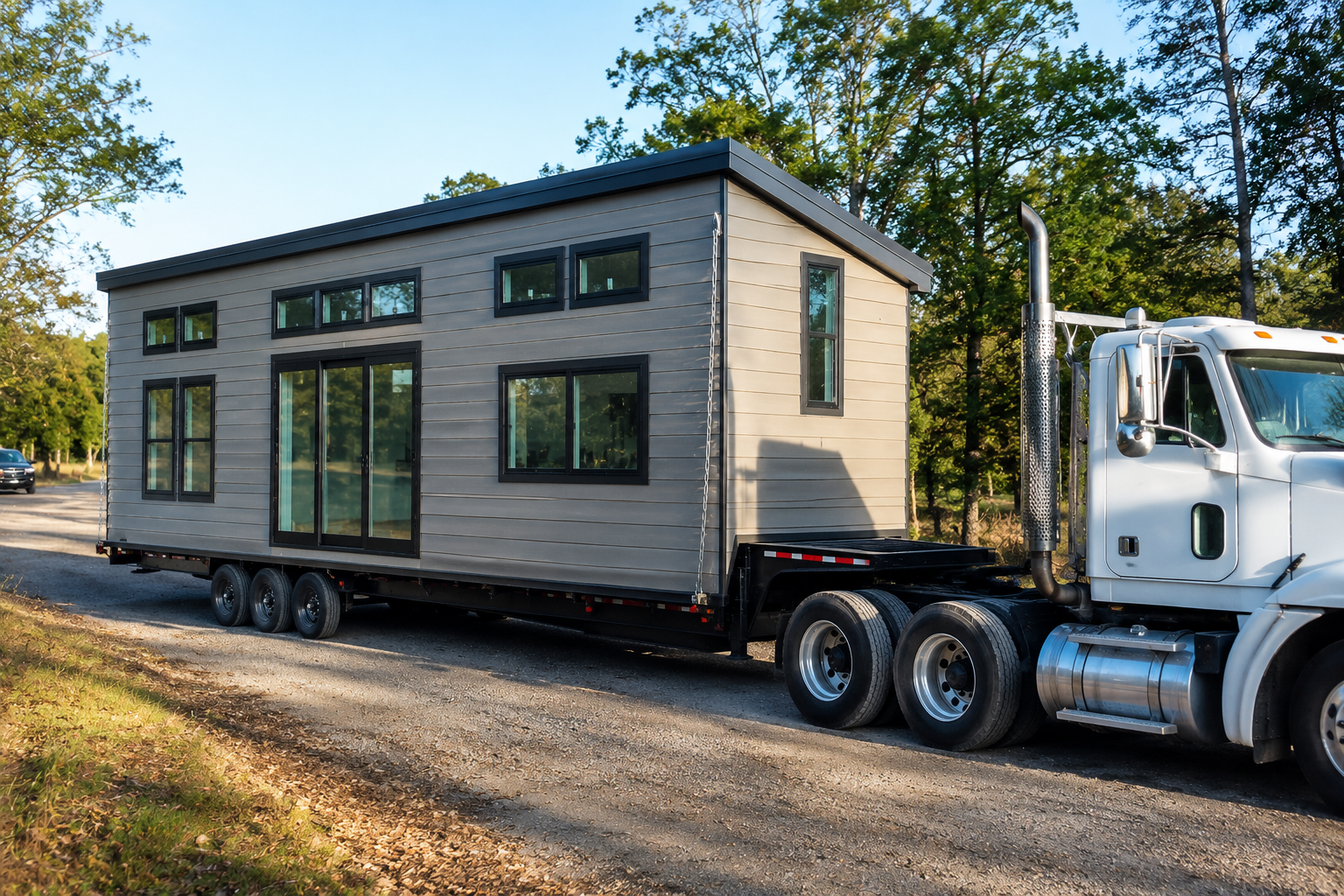
Most people who buy a park model home never personally witness the transportation process. The unit arrives at their site — already positioned, already level, already being connected to utilities — and the logistics of how it got there feel like someone else’s problem. For a first-time buyer, that’s a reasonable way to experience it. For anyone making a relocation decision, planning a purchase from an out-of-area manufacturer, or simply trying to understand what they’re getting into, knowing how the transportation process actually works is genuinely useful.
It’s also more interesting than it sounds. Moving a structure that is 14 feet wide, up to 45 feet long, and weighs between 15,000 and 30,000 pounds down public roads requires a specific combination of equipment, permits, planning, and coordination that most people have never thought about. When it works well — and with experienced professionals it almost always does — the whole process is surprisingly seamless. When it goes wrong, usually due to inadequate planning or the wrong transport company, the consequences range from inconvenient to expensive.
Here’s how the process actually works, from the moment a park model leaves the factory to the moment it’s sitting on its foundation ready to be hooked up to utilities.
The Equipment Involved
A park model doesn’t move itself in the literal sense — it rolls on its own trailer chassis, which is the steel frame and axle assembly it was built on. But that chassis is a trailing structure, not a self-powered vehicle. Moving it requires a commercial truck with the power, the rating, and the hitch configuration to pull the loaded unit safely at highway speeds.
The specific truck used for park model transport is typically a Class 8 semi-tractor — the same category of vehicle that pulls freight trailers on interstate highways. Not all semi-tractors are configured for park model transport, however. The hitch connection point needs to match the park model’s trailer coupler, the truck needs enough wheelbase length to handle the turning characteristics of a long trailer, and the driver needs commercial licensing appropriate for oversize loads.
For a standard park model of 14-foot width and 35 to 40-foot length, the truck and loaded trailer combination typically runs 50 to 60 feet in total length. That combination has turning radius characteristics that require route planning to avoid tight corners, low clearance underpasses, and roads with width restrictions that would make passing other vehicles impossible.
Some park model transports also use a separate setup truck or pilot vehicle — a lighter vehicle that travels with the load to assist with coordination at intersections, communicate with the truck driver about road conditions ahead, and manage the traffic interactions that an oversize load creates. Whether an escort vehicle is required depends on the width of the load, the state through which it travels, and local regulations that vary by jurisdiction.
Oversize Load Permits: What They Are and Why They’re Required
A park model at 14-foot width significantly exceeds the standard legal vehicle width of 8.5 feet in Florida and every other state. Moving a load of this width on public roads without authorization is illegal and creates genuine safety risks for other road users. The permit system exists to ensure that oversize load movements are planned, coordinated, and executed safely.
Oversize load permits are issued by each state’s department of transportation for movements through that state. A park model moving entirely within Florida requires a Florida oversize load permit. A unit moving from a manufacturer in another state into Florida requires permits from each state the route passes through — a Georgia-to-Florida transport requires permits from both states, for example.
The permit specifies the route the transport must follow, the time windows during which the movement is permitted, any escort vehicle requirements, and any specific conditions — speed limits, reporting requirements, or restrictions near airports, military bases, or other sensitive areas. Most states restrict oversize load movements to daylight hours, and many prohibit movement during holiday weekends when traffic volumes are highest. Some routes require prior coordination with utility companies whose power lines might need to be temporarily raised to allow the load to pass.
Transport companies that specialize in manufactured housing and park models handle permit acquisition as a routine part of their business. They know which routes work in which states, they have relationships with the permitting agencies, and they understand how to route a load efficiently while satisfying all permit requirements. This is one of the clearest reasons to use an experienced specialist rather than a general freight carrier who doesn’t know this territory.
The cost of permits varies by state and load dimensions. For a Florida-only move, permit fees typically run $50 to $300 depending on the route and the issuing authority. Multi-state moves accumulate permits from each state, which adds cost and coordination complexity to the transport process.
Route Planning: More Involved Than It Sounds
Before a park model moves an inch, the transport company plans the route in detail. This is not a matter of plugging an address into a navigation app — it’s a systematic evaluation of every segment of the planned path for height clearances, width clearances, load limits, and turn feasibility.
Height is the first consideration. A park model with a peaked roof can reach 14 to 16 feet of total travel height — the distance from the road surface to the highest point of the unit. Every bridge, overpass, utility line crossing, and overhead obstruction along the planned route needs to have sufficient clearance. In Florida, where highway infrastructure is generally modern, this is usually manageable with route selection, but it requires explicit verification rather than assumption.
Width clearance is the second consideration. A 14-foot-wide load needs sufficient road width to travel safely without forcing other vehicles onto shoulders or into oncoming lanes. Interstate highways and major state roads generally accommodate this. Narrow county roads and city streets may not. Routes that look geographically direct on a map sometimes aren’t viable from a width clearance standpoint and require longer alternatives.
Weight is the third consideration. Some roads, bridges, and culverts have posted weight limits that a loaded park model transport combination may approach or exceed. The transport company verifies that the planned route doesn’t require crossing structures with inadequate load ratings for the specific vehicle combination being used.
Turn feasibility is the final major routing consideration. A 50-to-60-foot truck and trailer combination making a right-hand turn onto a residential street has very different clearance requirements than a passenger car making the same turn. Routes are evaluated for whether the necessary turns at origin, destination, and any intermediate waypoints can be executed with the specific equipment being used.
The result of this planning is a route that has been specifically validated for the load — not just theoretically possible but confirmed to work with the actual dimensions and weight of the transport combination. Experienced transport companies have software tools and databases that assist with this evaluation, but it still requires experienced judgment about conditions that don’t always appear in databases.
The Day of Transport: What Actually Happens
On transport day, the process begins at the origin — either the manufacturer’s facility for a new unit delivery or the existing site for a relocation move. The sequence is somewhat different for each.
From the Manufacturer
When a new park model leaves the factory, the unit has been built on its own trailer chassis and is structurally complete — all interior finishing, cabinetry, fixtures, and mechanical rough-in have been done. The unit is inspected at the factory before release and receives its RVIA certification plate if it hasn’t been affixed already. Any accessories that ship with the unit — steps, skirting panels, installation hardware — are either loaded into the unit or secured to the chassis.
The transport truck backs up to the factory’s exit area, connects to the park model’s trailer hitch coupler, performs a safety check on the connection including lights and brake connections, and departs once the escort vehicle (if required) is in position. The factory’s delivery coordinator typically communicates with the transport driver about any site-specific information for the destination and confirms the expected arrival window.
From an Existing Installation (Relocation)
Relocating a unit that has been installed requires preparation work before the transport truck arrives. The unit needs to be fully disconnected from utilities — water, sewer, electrical — before it can move. Any additions that were installed separately from the unit — porches, screen enclosures, skirting, steps — need to be removed or prepared for separate transport. Hurricane tie-down systems need to be properly removed by a qualified contractor, not just unbolted hastily. The unit needs to be inspected for any road travel preparation requirements — securing interior items, protecting fixtures, ensuring that anything that could move during transport is stabilized.
This preparation work typically takes one to two days with a qualified crew and should be coordinated carefully with the transport company’s scheduled arrival. Having the truck arrive before the unit is ready for pickup creates either waiting costs or scheduling complications that cascade through the rest of the timeline.
Once the unit is prepared and the truck is connected, the process is structurally identical to a new delivery — route, permits, and destination site preparation all apply the same way.
During Transit: What the Driver Is Managing
Park model transport looks simple from the outside — a big truck moving slowly down the highway with an unusual load. From the driver’s perspective, it involves continuous active management of variables that most drivers never have to think about.
Load sway is the primary dynamic concern. A park model’s height creates a high center of gravity that responds to crosswinds, lane changes, and road surface variations in ways that a low, dense freight load doesn’t. Experienced park model transport drivers understand the load’s behavior characteristics and manage speed, following distance, and lane changes accordingly. They’re conservative in crosswind conditions and reduce speed on roads with significant crown or camber that creates lateral load.
Clearances during transit require ongoing attention. Even a well-planned route can present unexpected situations — a tree branch that wasn’t in the database, a temporary sign structure that wasn’t there during the route survey, construction equipment that has narrowed a road. The driver is continuously monitoring overhead and lateral clearances and communicating with the escort vehicle when conditions require coordination.
Bridge crossings and weight-sensitive structures get extra attention even on a pre-cleared route. The transport driver knows which segments of the route were identified as requiring specific weight management and observes any posted restrictions they encounter.
At fuel stops, inspection stations, and any required breaks, the driver performs a condition check on the load — verifying that the connection remains secure, that the load hasn’t shifted in any way, and that the lights and brakes on the trailer are functioning correctly. These checks take a few minutes and are standard practice for any responsible oversize load operator.
Arrival and Positioning at the Destination Site
The arrival process is where careful advance preparation pays the most visible dividends. A site that is ready to receive the unit — with a clear, firm access path, a prepared pad or foundation, and utility stub-outs at the right locations — allows the truck to back in, position the unit accurately, and disconnect cleanly. A site that isn’t ready creates delays that cost money and can back up the transport company’s schedule for subsequent deliveries.
Site Access
The transport truck and its load need to access the site — turn off the road, navigate any gates or entrance restrictions, and back the unit into its final position. For community placements, the community typically has experience managing this access and can advise on approach angles and clearances. For private land placements, the access route needs to be evaluated in advance for the same clearance and turning characteristics that apply to the road route.
If the access path to the placement site is narrow, has overhead obstructions, or requires a difficult backing maneuver, the transport company needs to know this before arrival. Surprises at the destination that make final positioning difficult or impossible create expensive problems — the unit may need to be temporarily parked at a different location while the access issue is resolved.
Positioning
Once the truck has backed the unit to its approximate final position, the precise placement is a more careful process. The unit needs to be positioned accurately over the pad or foundation, aligned with the utility stub-out locations, and oriented correctly relative to the site’s drainage, neighboring structures, and any required setbacks. The transport driver and the installation crew work together to achieve this positioning before the truck disconnects.
For community placements, the community’s installation coordinator typically oversees this process and has experience positioning units precisely on the prepared pad. For private land placements, the installer who will handle the foundation work and utility connections needs to be present to direct the final positioning.
Disconnect and Departure
Once the unit is in its final position, the truck disconnects from the trailer coupler, and the transport company’s involvement in the delivery is complete. The unit is now in the hands of the installation crew — the people who will handle leveling, blocking, anchoring, skirting, utility connections, and the final work that makes the unit ready to occupy.
The transport driver provides any relevant documentation to the installation crew — the RVIA certification paperwork, any manufacturer delivery documentation, and confirmation of the unit’s condition at delivery — before departing.
What Can Go Wrong and How Good Planning Prevents It
The transport process, handled by experienced professionals with proper planning, is reliable and uneventful in the great majority of cases. The problems that do occur most commonly trace to one of a few preventable situations.
Inadequate site preparation. The most common delivery-day problem is a destination site that isn’t ready — a pad that isn’t level, utility connections that aren’t in the right location, or an access path that wasn’t evaluated for the truck’s clearance requirements. All of these are solvable in advance. None of them are solvable quickly on delivery day with an 18-wheeler waiting.
Underqualified transport companies. Not every carrier that owns a semi-tractor and trailer has the experience, the permitting knowledge, or the park model-specific expertise to move a unit safely and legally. Using a general freight carrier who hasn’t handled park model transport before because their quote was lower creates risk that isn’t worth the savings.
Poor weather decisions. Florida’s weather is generally cooperative for transport, but thunderstorms, high wind events, and occasional fog create conditions that affect oversize load safety. Experienced transport operators are willing to delay a move for weather — inexperienced or deadline-pressured operators sometimes push through conditions they shouldn’t. The unit arriving a day late is inconvenient. A unit damaged in transit or involved in a weather-related incident is catastrophic.
Insufficient preparation for relocation moves. Relocating an installed unit without proper disconnection and preparation — rushing the process because the truck is arriving in the morning — creates risks of utility connection damage, structural stress from improperly removed anchoring, and interior damage from items that weren’t secured. The preparation for a relocation move deserves as much planning time as the transport itself.
Working With Manufacturers and Transport on a Florida Delivery
For Florida buyers purchasing from EcoLife Homes, the delivery coordination is a process we manage actively — not just hand off. We work with transport companies who have specific experience with Florida routes, Florida permitting requirements, and the specific communities and site types where our units are placed. We communicate site requirements to the transport company before delivery day, and we coordinate with buyers and installation crews to ensure the arrival is as smooth as the rest of the process.
For buyers sourcing units from out-of-state manufacturers in 2026 and 2027, the transport cost and logistics are a meaningful consideration that should be fully understood before the purchase commitment is made. The permit requirements across multiple states, the route planning complexity, and the delivery timeline for a multi-state move add both cost and lead time that can affect project planning.
Understanding how transportation works — not just that it happens — gives buyers the foundation to have more informed conversations with manufacturers and transport companies, to ask the right questions about route planning and site requirements, and to set realistic expectations about timelines and contingencies. A park model delivery that goes smoothly usually goes smoothly because the people involved planned it carefully. The planning starts with understanding the process.