Can You Get a Mortgage for a Park Model Home?
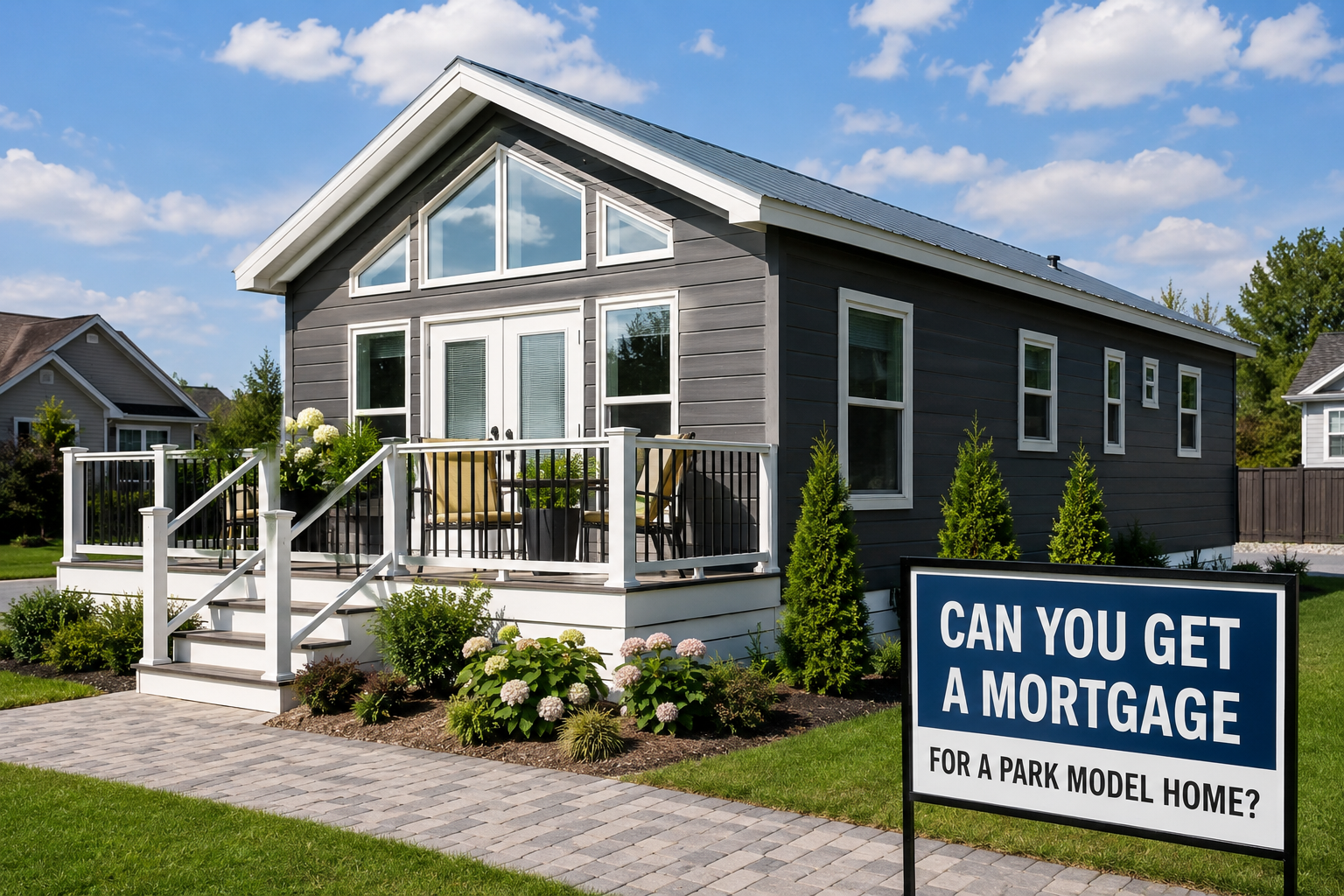
This question stops a surprising number of people in their tracks. They’ve done the research. They’ve toured units. They’ve found a community they like. They know what they want to buy. And then they run into the financing question and suddenly the whole process feels uncertain, because the answer isn’t the clean yes or no they were hoping for.
Here’s the honest version: you cannot get a conventional mortgage for a park model home in the traditional sense — the kind of 30-year fixed-rate loan backed by Fannie Mae or Freddie Mac that most Americans think of when they hear the word mortgage. Park models don’t qualify for that product. But that statement, taken in isolation, gives a deeply incomplete picture of what’s actually available — because the financing ecosystem that exists for park models in 2026 is broader, more accessible, and more varied than most people realize when they first start asking around.
The real question isn’t “can I get a mortgage” — it’s “what financing options exist, which one fits my situation, and how do I get it done.” That’s what this piece answers.
Why Conventional Mortgages Don’t Apply
Understanding why conventional mortgages aren’t available for park models helps clarify what you’re actually navigating and why the alternatives exist.
Conventional mortgages — the ones most people have used to buy a house — are secured loans backed by real property. The lender holds a lien on the real estate itself: the land and the structure permanently affixed to it. The loan is underwritten based on the combined value of land and improvements, and in the event of default, the lender can foreclose on and sell that real property to recover the debt.
Park models don’t fit that framework for several reasons. First, they’re titled as personal property — similar to a vehicle — rather than as real estate. Second, they typically sit on land that the buyer doesn’t own (in land-lease communities) or on land that’s separately titled and may not be bundled with the unit for financing purposes. Third, they’re built under the ANSI A119.5 recreational park trailer standard rather than the HUD manufactured home standard, which affects how they’re classified under federal housing finance rules.
Fannie Mae, Freddie Mac, FHA, and VA loan programs all have specific requirements that park models don’t meet. This isn’t a gap in the system that’s about to be corrected — it’s a structural feature of how these programs are designed, and it’s been stable for decades. The financing solutions for park models exist outside that framework, and the ecosystem of lenders who specialize in those solutions has been building for years.
Chattel Loans: The Most Common Path
The financing product most commonly used for park model purchases in 2026 is a chattel loan — sometimes called a home-only loan or personal property loan. The term sounds exotic but the structure is familiar: it’s essentially the same concept as an auto loan, applied to a factory-built home.
A chattel loan is secured by the park model itself rather than by real estate. The lender holds a security interest in the unit, and in the event of default, they can repossess it — similar to how a vehicle repossession works. Because the collateral is personal property rather than real estate, the foreclosure process is simpler and faster for the lender, which is part of why chattel loans are available for products that don’t qualify for real estate financing.
For the borrower, chattel loans have both advantages and trade-offs compared to traditional mortgages.
On the positive side, the application and approval process tends to be faster and less paperwork-intensive than a conventional mortgage. Down payment requirements, while not trivial, are often lower than what’s required for manufactured home loans. Approval timelines can run two to four weeks rather than the six to eight weeks typical of conventional real estate transactions. And the loan products exist specifically for factory-built housing, meaning the lenders involved understand the product category and don’t need to be educated about what a park model is.
On the trade-off side, chattel loan interest rates are typically higher than conventional mortgage rates — the spread has historically been 1.5 to 3 percentage points above comparable conventional products. Loan terms are generally shorter, typically running 15 to 23 years rather than 30. And because the loan isn’t secured by real estate, the interest paid on a chattel loan may not qualify for the mortgage interest deduction that real estate loans provide — a tax consideration worth discussing with an accountant.
In 2026, chattel loan interest rates for qualified borrowers with good credit profiles are generally running in the 7.5% to 11% range depending on the lender, the borrower’s credit score, the loan term, and the down payment. These rates are meaningfully higher than conventional mortgage rates, which is a real cost that deserves honest accounting in your budget. At the same time, when you’re financing a $90,000 park model rather than a $450,000 house, the absolute monthly payment often comes out favorably even with the higher rate.
A concrete example: a $85,000 chattel loan at 9% over 20 years produces a monthly principal and interest payment of approximately $765. That’s the complete financed cost of a mid-range park model — not a down payment, not a teaser rate on a much larger loan, but the actual payment on the whole thing. Compared to carrying a $336,000 mortgage at 6.8% on a $420,000 Florida home (a monthly payment of approximately $2,190 before taxes and insurance), the difference in monthly housing cost is not subtle.
RV Loans: An Often-Overlooked Option
Because most park models carry RVIA (Recreation Vehicle Industry Association) certification, they’re eligible for financing through RV loan programs — a product category that many park model buyers don’t think to explore but that can offer competitive terms.
RV loans are available through credit unions, banks, and specialty lenders who focus on the recreational vehicle market. The loan structure is similar to a chattel loan — personal property secured, shorter terms than conventional mortgages — but RV lending is a mature, well-developed market with significant lender competition that can translate into better rates for qualified borrowers than some chattel-specific products offer.
Credit unions are particularly worth exploring for RV financing. Many credit unions have dedicated RV loan programs with rates that are meaningfully competitive with bank products, and credit unions often have more flexible underwriting approaches that can benefit borrowers whose profiles don’t fit neatly into standard lender boxes.
To access RV financing, the park model needs to carry an RVIA certification plate — most quality park models from reputable manufacturers do, but it’s worth confirming before you get deep into the process. Lenders will ask to see the RVIA certification as part of the loan documentation.
In 2026, RV loan rates for well-qualified borrowers are generally running in the 7% to 10% range depending on the lender, loan amount, term, and credit profile. For buyers with strong credit histories who take the time to shop multiple lenders, RV financing can be one of the more cost-effective paths to park model ownership.
Personal Loans: Fast, Simple, and Sometimes Right
For buyers purchasing at the lower end of the price range or making a large down payment that brings the financed amount down significantly, an unsecured personal loan can be the simplest and fastest financing path available.
Personal loans require no collateral — the loan is made on the strength of the borrower’s creditworthiness rather than secured against the park model or any other asset. They’re available from banks, credit unions, and online lenders in amounts up to $100,000 or more for qualified borrowers, and approval timelines can be as short as one to three business days for straightforward applications.
The trade-offs are real. Personal loan interest rates are typically higher than secured loan products because the lender has no collateral to recover in a default scenario. For borrowers with excellent credit, personal loan rates in 2026 might run 8% to 13%. For borrowers with good but not exceptional credit, rates can be higher. Loan terms are also typically shorter — five to seven years is common, though some lenders offer terms up to 12 years for larger amounts.
Where personal loans make the most financial sense: buyers who are financing a relatively small amount (say, $40,000 to $60,000 after a substantial down payment), buyers whose credit profiles qualify for competitive rates, and buyers for whom speed and simplicity are priorities — particularly those purchasing a unit that needs to be committed to quickly before another buyer moves on it.
Where they make less sense: buyers financing larger amounts over longer terms, where the higher rate and shorter term combine to produce monthly payments that are higher than a chattel or RV loan would require for the same amount.
Land-and-Home Loans: When You Own the Land
The financing picture changes meaningfully when a buyer is purchasing land and placing a park model on it simultaneously — or when a buyer already owns land and is adding a park model to it.
In these scenarios, some lenders will bundle the land value and the park model into a combined loan — similar in concept to a construction-to-permanent loan for site-built homes. The land provides real property collateral that the lender can hold a lien against, which changes the risk profile of the loan and can open access to products and rates that aren’t available for community-placed park models where no land is being purchased.
This loan category is less standardized than chattel or RV products — the terms, rates, and availability vary significantly by lender, by state, and by the specific transaction structure. Specialty manufactured housing lenders and some community banks in Florida have developed loan products that accommodate this structure, but finding the right lender requires more research than finding a chattel lender.
For buyers who are planning a private land placement in Florida in 2026 or 2027, working with a mortgage broker who has experience with manufactured and factory-built housing is often the most efficient path to identifying which lenders have appropriate products for the specific transaction structure being contemplated.
Home Equity and Cash-Out Options for Existing Homeowners
A significant segment of park model buyers in Florida are existing homeowners who are either downsizing, adding an accessory dwelling unit to their current property, or purchasing a second property. For these buyers, home equity financing is often both available and attractive.
A home equity line of credit (HELOC) or a cash-out refinance on an existing primary residence can provide funds to purchase a park model without any of the personal property financing complications. The loan is secured by the existing home — real property — which means conventional underwriting standards, competitive interest rates, and the full range of available loan terms.
For a Florida homeowner who has built meaningful equity in an existing property, particularly given the home value appreciation of the past several years, tapping that equity to purchase a park model — whether as a personal residence, an investment property, or an ADU on existing land — is often the most financially efficient path available. The rate differential between a home equity product and a chattel or RV loan can be meaningful, and that difference compounds over a multi-year repayment period.
The consideration on the other side is that a HELOC or cash-out refinance puts the existing home at risk as collateral for the park model purchase. For buyers who are comfortable with that structure and who have sufficient equity to maintain a healthy loan-to-value ratio after the withdrawal, it’s a legitimate and often superior financing approach.
Cash Purchases: More Common Than You’d Think
It’s worth noting that a substantial percentage of park model transactions in Florida are cash purchases — and not just because buyers happen to be wealthy. The relatively modest acquisition cost of a park model compared to traditional real estate means that equity from the sale of a larger home frequently covers the purchase price entirely, without any financing required.
A Florida homeowner selling a house that has appreciated significantly over the past decade — particularly in coastal markets where values have risen dramatically — and downsizing into a park model often finds that the proceeds from the sale cover not just the park model but the site costs, furnishing, and a meaningful reserve fund with cash remaining. For these buyers, the financing question becomes irrelevant entirely, and the monthly cost of housing drops to lot rent, utilities, and insurance — often a fraction of what they were paying previously.
This dynamic is one of the most powerful financial arguments for the park model transition for the right buyer. The net financial position after the move — lower monthly costs, reduced or eliminated debt, meaningful liquid assets from the home sale — is often dramatically better than the situation before. Understanding that this path exists, and running the numbers for your specific situation, is worth the time even if you initially assumed you’d need to finance.
What Lenders Are Looking For
Regardless of which financing path you pursue, understanding what lenders are evaluating helps you approach the process in the strongest possible position.
Credit score is the primary driver of both approval and rate in all personal property and RV loan categories. For chattel lenders in 2026, scores above 720 typically access the best available rates and terms. Scores in the 660 to 720 range generally qualify for financing but at meaningfully higher rates. Below 660, options narrow considerably and rates increase further. If your credit score has room for improvement before you begin the loan process, spending three to six months addressing specific factors — paying down revolving balances, resolving any collection accounts, correcting errors on your credit report — can make a significant difference in the terms you ultimately access.
Debt-to-income ratio is the second major underwriting factor. Lenders want to see that your total monthly debt obligations — including the proposed park model payment — don’t consume too large a percentage of your gross monthly income. Most lenders are looking for total debt service below 43% to 45% of gross income, though specific thresholds vary by lender and loan type.
Down payment affects both approval odds and rate. For chattel loans, 10% to 20% down is typical, with larger down payments generally associated with better rates and stronger approval odds. For RV loans, requirements vary by lender. Having the down payment ready in a verifiable account before you begin the application process keeps things moving cleanly.
Employment and income documentation follow the patterns familiar from any loan application — recent pay stubs, two years of tax returns for self-employed borrowers, bank statements, and documentation of any additional income sources. Self-employed buyers and those with non-traditional income — rental income, investment distributions, consulting revenue — should expect to document those income streams thoroughly.
Finding the Right Lender
The practical challenge for many park model buyers is that not every lender handles park models, and walking into a major bank branch and asking for a park model loan often leads nowhere productive. The lenders who specialize in this category require intentional search.
Specialty manufactured housing lenders like 21st Mortgage Corporation and Triad Financial Services have developed specific programs for factory-built housing including park models and are worth contacting directly. The RVIA and various manufactured housing associations maintain lender directories that are useful starting points. Credit unions — particularly those with RV loan programs — are worth calling directly with specific questions about whether their products apply to RVIA-certified park models.
A mortgage broker who specializes in manufactured and factory-built housing can do much of this legwork on your behalf, shopping your application across multiple lenders simultaneously to identify the best available terms. For buyers who find the lender landscape confusing or who have credit or income situations that don’t fit standard boxes, a specialist broker often produces better outcomes than direct-to-lender applications.
EcoLife Homes works regularly with buyers navigating the financing process and maintains relationships with lenders who have actually closed park model transactions in Florida. We can point you toward lenders who are familiar with the product and have active programs — which saves significant time compared to starting cold with a general lender directory.
Building Your Complete Budget Around the Financing Reality
The financing picture for park models in 2026 is more accessible than many buyers initially fear — but it’s also genuinely different from conventional real estate financing in ways that affect total cost of ownership. Building a budget that honestly accounts for those differences produces a much cleaner decision.
Start with the total financed amount — unit price plus any financed site costs. Apply realistic current rates for the financing path you’re most likely to access. Run the monthly payment calculation for the term you’re considering. Add lot rent, insurance, utilities, and a maintenance reserve. Compare that total to your current housing cost and to what you’d be paying if you chose a different housing path.
For most buyers who run this exercise honestly, the park model’s total monthly cost of housing — even with higher personal property loan rates factored in — compares very favorably to alternatives. The lower principal amount does more work than the rate differential undoes, and the financial flexibility that comes from lower monthly housing costs has compounding value over time that doesn’t show up in a simple rate comparison.
In 2026 and 2027, as Florida’s housing affordability challenges continue to intensify and as more buyers discover the park model category, the financing ecosystem will likely continue to mature. More lenders are entering the space. More credit union programs are being developed. The pathways are becoming clearer and more competitive.
The financing isn’t a barrier. It’s a puzzle with real solutions — and understanding the solutions is simply part of making a well-informed decision.