How Long Does a Park Model Home Last?
Durability is one of those topics that reveals a lot about whether a manufacturer or salesperson is being straight with you. Ask a bad actor and you’ll get a vague, enthusiastic answer with no specifics. Ask someone who genuinely understands what they’re building and how materials behave over time, and you’ll get a more nuanced answer — one that acknowledges the variables that actually determine lifespan rather than papering over them with optimistic generalities.
So here’s the honest version.
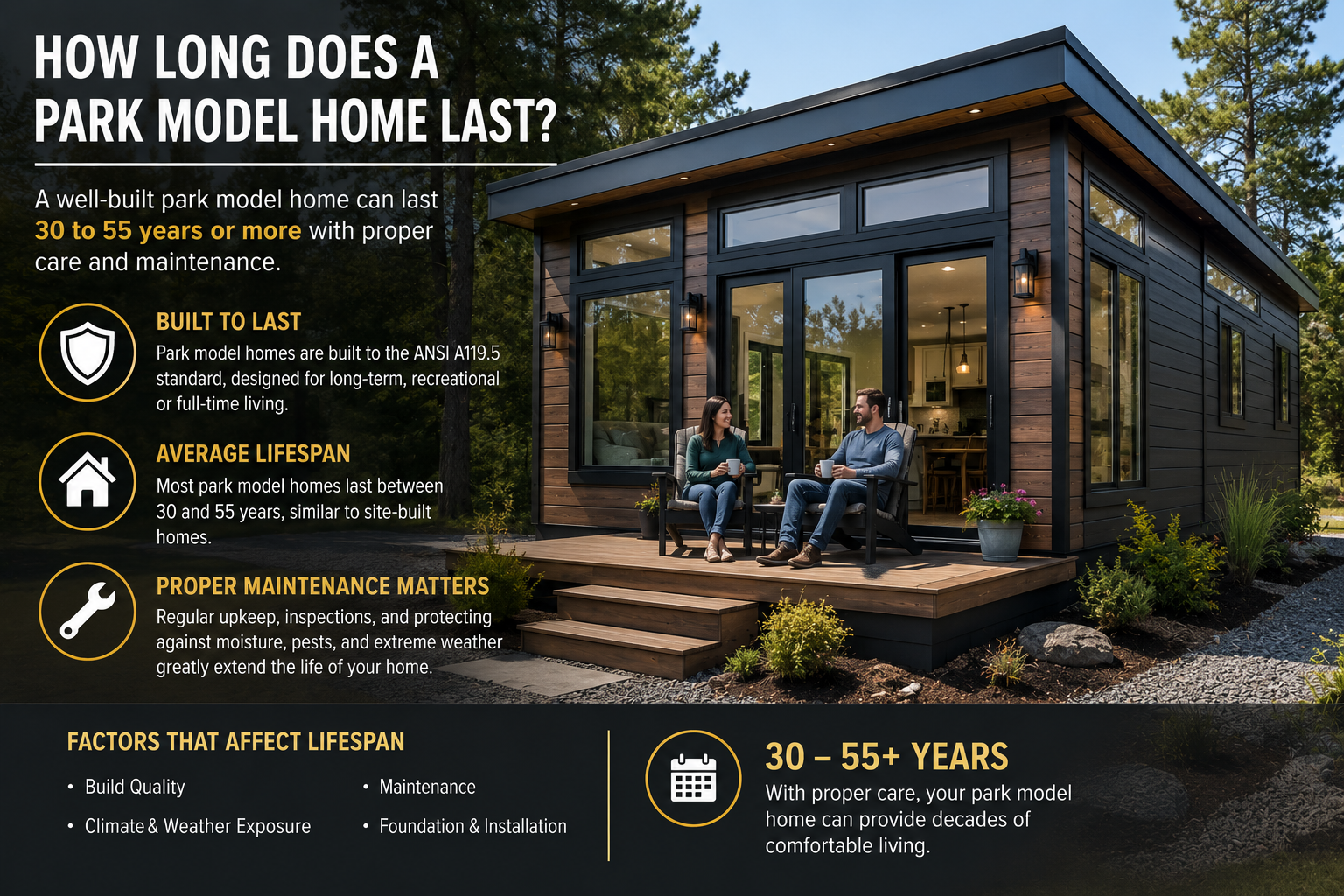
A park model home built by a quality manufacturer, maintained with appropriate regularity, and sited in conditions that don’t work against its materials can realistically serve as a comfortable, functional home for 30 to 50 years. Some well-preserved units from reputable manufacturers are pushing beyond that. Others — built to a price point rather than a standard, placed in harsh conditions, or simply neglected — deteriorate much faster and are functionally obsolete in 10 to 15 years.
The range is that wide because lifespan isn’t primarily a product of what year the unit was manufactured. It’s a product of three compounding factors: how well it was built, how well it was maintained, and what environment it’s been living in. Understanding each of those factors puts you in a position to make a much smarter decision — both in what you buy and in how you care for what you have.
What “Built to Last” Actually Means in a Park Model Context
Factory construction has a reputation in some quarters for being inherently inferior to site-built construction, and that reputation is sometimes deserved — but not as a categorical truth about factory-built housing. The right frame is that factory construction can be excellent or poor, and the controlling variable is whether the manufacturer is competing on quality or competing on price.
A manufacturer competing on quality invests in materials, processes, and people in ways that compound over decades of ownership. The structural framing members are properly sized and consistently placed. The roof system is built with quality decking, underlayment, and finish materials that are installed correctly rather than quickly. The insulation is applied thoroughly, without gaps, with attention to moisture management that prevents the long-term degradation that inadequate insulation causes. The windows are sealed properly. The plumbing is routed with enough slope and support to function correctly for years without developing the stress points that lead to leaks. The electrical work is done by licensed tradespeople who understand load calculations and don’t improvise.
A manufacturer competing on price cuts in places that aren’t visible to the eye during a showroom visit or a pre-purchase walkthrough. Thinner framing members. Cheaper roofing materials. Batt insulation with voids that allow moisture infiltration over time. Windows that seal adequately on day one but don’t hold up to thermal cycling over years of Florida heat. Plumbing and electrical that pass inspection but weren’t installed with the same care that adds years to a system’s service life.
The buyer who picks the cheaper unit because it looks similar on the surface — same square footage, similar finishes, lower price — is often buying a unit that will require significant intervention in year eight or ten that a better-built unit wouldn’t need until year twenty-five. Over the total cost of ownership horizon, the savings frequently disappear entirely.
The lesson isn’t that every expensive park model is superior to every less expensive one. It’s that price is a legitimate signal worth investigating, and that looking below the surface — asking about framing specifications, insulation systems, roofing materials, and window brands — reveals information that the sticker price doesn’t.
The Structural Foundation: Where Longevity Starts
The backbone of a park model’s longevity is its structural system, and specifically the quality and construction of its chassis, floor framing, wall framing, and roof system. These elements are the ones that, when they’re right, quietly do their job for decades; and when they’re compromised, create problems that eventually become expensive and sometimes catastrophic.
The Chassis
The steel trailer chassis that a park model sits on is the structural foundation of the entire unit. Quality chassis are built from appropriately sized steel with protective coating systems — galvanizing or quality paint systems — that resist the corrosion that Florida’s humidity and occasional salt air can accelerate. A chassis that was built with adequate steel gauge for the unit’s weight, properly coated, and kept off direct ground contact with appropriate blocking or support will last the life of the unit. One that was built to minimum specifications, inadequately coated, and allowed to accumulate moisture and road debris over years will begin to rust in ways that compromise structural integrity within a decade or two.
Inspecting the underside of a used park model — looking at the chassis condition, the floor joist condition, and the condition of plumbing and electrical runs that pass through the floor cavity — is one of the most telling indicators of a unit’s overall condition and remaining service life.
Wall Framing
Park model walls are typically framed with wood studs, and the quality of that framing — the species, the grade, the spacing, the connection details — directly affects structural performance over time. Quality manufacturers use properly dried lumber that won’t twist and shrink as it settles, frame walls with appropriate stud spacing for the loads they carry, and use connection hardware that doesn’t rely on the wood alone to hold the assembly together under stress. Florida’s occasional wind events test wall framing in ways that reveal construction quality with clarity.
Roof System
The roof is the element of a park model that Florida’s environment tests most aggressively, and it’s where maintenance attention returns the most value in terms of extended service life.
Most park models are built with a truss roof system finished with either metal roofing or asphalt shingles. Metal roofing — standing seam or corrugated panel systems — is the better choice for longevity in Florida’s climate. A properly installed metal roof from a quality manufacturer can last 40 to 70 years with minimal maintenance beyond periodic cleaning. It handles Florida’s intense UV exposure, high rainfall, and hurricane-force winds better than any alternative at a comparable price point.
Asphalt shingles have a shorter service life in Florida’s climate than in cooler regions. The intense sun degrades asphalt shingles faster than it does in northern markets, and a shingle roof in South Florida that might have lasted 25 years in Minnesota might need replacement in 12 to 18 years. For buyers in Florida choosing a new park model, asking specifically about roofing material and the manufacturer’s expected service life in Florida conditions is worth the conversation.
Insulation Quality and Moisture Management: The Hidden Determinant
If there’s a single factor that most determines how well a park model ages in Florida’s specific climate, it’s the quality of the insulation system and how effectively the unit manages moisture. This is where the difference between a park model that looks good at thirty years and one that has developed structural problems at fifteen most often originates.
Florida’s climate creates a consistent moisture pressure — warm, humid outdoor air working against a cooled, conditioned interior. That pressure drives moisture toward the interior in ways that insulation systems must be designed to manage. When they manage it well, the interior structure stays dry, wood members maintain their integrity, and the unit ages gracefully. When they manage it poorly — when insulation has gaps that allow condensation to form inside wall cavities, or when vapor barriers are incorrectly placed for Florida’s climate zone — moisture accumulates in places that aren’t visible until damage is already significant.
Closed-cell spray foam insulation is the gold standard for Florida park model applications. It provides both thermal insulation and an air and vapor barrier in a single application, fills irregularly shaped cavities completely without gaps, and adds structural rigidity to the wall assembly. A park model insulated with closed-cell spray foam throughout — walls, roof cavity, and floor — is dramatically better positioned for Florida’s climate than one insulated with batt products, regardless of what the nominal R-values suggest.
Batt insulation — fiberglass or mineral wool — installed carefully by an experienced crew performs acceptably, but it requires more attention to installation quality to avoid the gaps and compression points that allow moisture to find pathways into the structure. Batt insulation installed quickly by crews focused on production speed, as often happens in entry-level manufacturing, is the origin of many of the moisture problems that shorten park model service life.
When evaluating a park model — new or used — asking specifically about the insulation system used in the walls, roof, and floor is one of the highest-value questions you can ask. The answer tells you a great deal about the manufacturer’s priorities and the unit’s likely aging characteristics in a Florida environment.
Mechanical Systems: What Wears Out and When
The structural shell of a well-built park model can last 40 or 50 years. The mechanical systems inside it — HVAC, plumbing, electrical, water heater — have shorter service lives and require attention at predictable intervals. Understanding those intervals is part of honest long-term ownership planning.
HVAC Systems
The mini-split systems that power the majority of modern park models in Florida have expected service lives of 15 to 25 years depending on the brand, the installation quality, and the maintenance regimen. Units from established brands — Mitsubishi, Daikin, LG — with proper installation and annual professional service consistently reach the upper end of that range. Units from lesser brands or those that went years between service visits may deteriorate faster.
In Florida’s climate, the HVAC system runs for most of the year. Annual professional maintenance — cleaning coils, checking refrigerant levels, verifying drain lines, testing electrical connections — extends service life meaningfully and prevents the efficiency degradation that makes older systems expensive to operate even before they fail. A well-maintained mini-split in a well-insulated park model can run efficiently in Florida’s climate for two decades before requiring replacement.
Plumbing
Modern park model plumbing in quality units uses PEX tubing for supply lines — a flexible, freeze-resistant, corrosion-resistant material that has an expected service life of 25 to 40 years under normal operating conditions. Drain lines are typically PVC, which is similarly durable when properly installed. Water heater replacement is the most predictable plumbing cost over a park model’s life — tankless units last 15 to 20 years with proper maintenance, traditional tank units typically 8 to 12 years in Florida’s conditions.
Electrical Systems
The wiring in a park model installed to code standards — copper conductors, properly rated components, appropriate breaker protection — has a functional service life that typically exceeds the building’s useful life. Electrical issues in park models more often trace to connection quality and component selection than to wiring deterioration, and they’re usually addressed during the course of normal maintenance and inspection rather than requiring wholesale system replacement.
How Florida’s Environment Specifically Affects Longevity
Florida presents a specific set of environmental conditions that affect park model aging differently than more temperate climates, and being direct about those conditions helps owners make better maintenance decisions.
UV Exposure
Florida’s sun is intense year-round, and it degrades exterior finishes, caulking, sealants, and synthetic materials at a faster rate than it does in northern climates. Exterior paint on wood-sided units needs attention on a shorter cycle in Florida than the same paint in a milder climate. Caulking around windows, doors, and roof penetrations needs inspection and renewal more frequently. Vinyl and composite exterior materials hold up better than wood in Florida’s sun, which is part of why most quality Florida-oriented park models use them as the primary exterior cladding.
Humidity and Rainfall
Florida receives significant annual rainfall, and the humidity is consistently high for most of the year. These conditions make roof maintenance and exterior envelope integrity more consequential than in drier climates. A minor roof issue that might remain dormant for a year in a dry climate can create significant interior damage in Florida within a season of rainy weather. Annual roof inspections — looking at seams, penetrations, flashing, and field membrane condition — and prompt response to any identified issues is the most important maintenance habit for Florida park model owners.
Salt Air Exposure
Coastal Florida locations add salt air to the environmental equation, which accelerates corrosion in metallic components — chassis steel, roof fasteners, exterior hardware, HVAC components. Units within a mile or two of saltwater should be inspected more frequently for corrosion indicators, and metallic components should be treated with appropriate protective products on a regular schedule. This doesn’t make coastal placement inadvisable — plenty of park models live long, healthy lives within sight of Florida’s coastlines — but it does mean that maintenance discipline matters more in those locations than in interior placements.
Hurricane Exposure
Florida’s hurricane exposure is a real physical stress on park models, particularly for units that experience near-miss conditions or direct impacts. Quality anchoring systems — properly installed hurricane tie-downs to current wind zone standards — protect units from the most severe movement and structural loading that major storms create. Units that experience significant storm events should be inspected thoroughly after the storm for structural, roof, and utility damage that may not be immediately visible. Addressing storm damage promptly prevents secondary damage that compounds over time.
What Maintenance Actually Looks Like Over a 30-Year Life
Honest longevity planning includes a realistic picture of the maintenance investments that keep a park model in good condition over decades. This isn’t a scare story — the maintenance demands of a well-built park model are genuinely modest compared to those of a site-built home of comparable value. But they’re real, and planning for them makes the ownership experience dramatically better than encountering them as surprises.
In the first five years of a new park model’s life, maintenance demands are minimal. Warranty coverage handles manufacturing defects. The mechanical systems are new and operating efficiently. The primary maintenance habits to establish are HVAC filter cleaning and coil inspection, roof inspection after significant weather events, and attention to exterior caulking and sealant condition.
Years five through fifteen are typically the most stable ownership period. The unit is broken in and performing as designed. Maintenance costs are low. The owner who has maintained properly during the early years typically reaches this phase with a unit that looks and functions very close to its original condition.
Years fifteen through twenty-five are when the first significant component replacements typically arrive. HVAC replacement is the most common event in this window. Water heater replacement if a tank unit was the original installation. Possible roof replacement if the original roofing material was asphalt shingles rather than metal. Exterior paint or cladding refresh depending on material selection. These are planned, predictable expenditures — not crises — for owners who have been setting aside a maintenance reserve from the beginning.
Beyond twenty-five years, the picture depends heavily on what went before. A well-built, well-maintained park model at the thirty-year mark is a structurally sound, comfortable home that may need cosmetic updating but doesn’t need to be replaced. A poorly built or neglected unit at the same age may be approaching the end of its useful life. The divergence is real and it begins on the day of purchase with the decision about which unit to buy.
The 2026 and 2027 Buyer’s Longevity Advantage
Buyers entering the park model market in 2026 and 2027 have meaningful advantages over buyers who purchased even a decade ago, because manufacturing quality, material science, and building technology have all improved substantially in that window.
Modern insulation systems — particularly closed-cell spray foam — are dramatically better at managing Florida’s moisture challenges than the products available in earlier manufacturing eras. Current metal roofing systems are more durable and better sealed than their predecessors. Mini-split HVAC technology from leading manufacturers has reached a level of efficiency and reliability that makes 20-plus-year service life realistic with proper maintenance. Structural connectors and anchoring systems have been refined through hurricane research that has produced meaningful improvements in how park models perform under wind loading.
A park model built in 2026 by a quality manufacturer, properly maintained, and thoughtfully sited in Florida’s environment is better positioned for a long service life than any comparable unit built fifteen or twenty years earlier — not because the concept has changed, but because the materials and systems available to build it have improved substantially.
EcoLife Homes builds with that longevity orientation from the ground up. The insulation choices, the roofing systems, the mechanical equipment selections, and the structural details in our units reflect what we’d want in a home we were planning to own for thirty years — because that’s exactly how long we expect our buyers to have the option of staying in them.
If you want to talk through what the build specifications in a specific floor plan mean for long-term performance in Florida’s climate, that’s a conversation we’re genuinely glad to have.