Downsizing in Florida
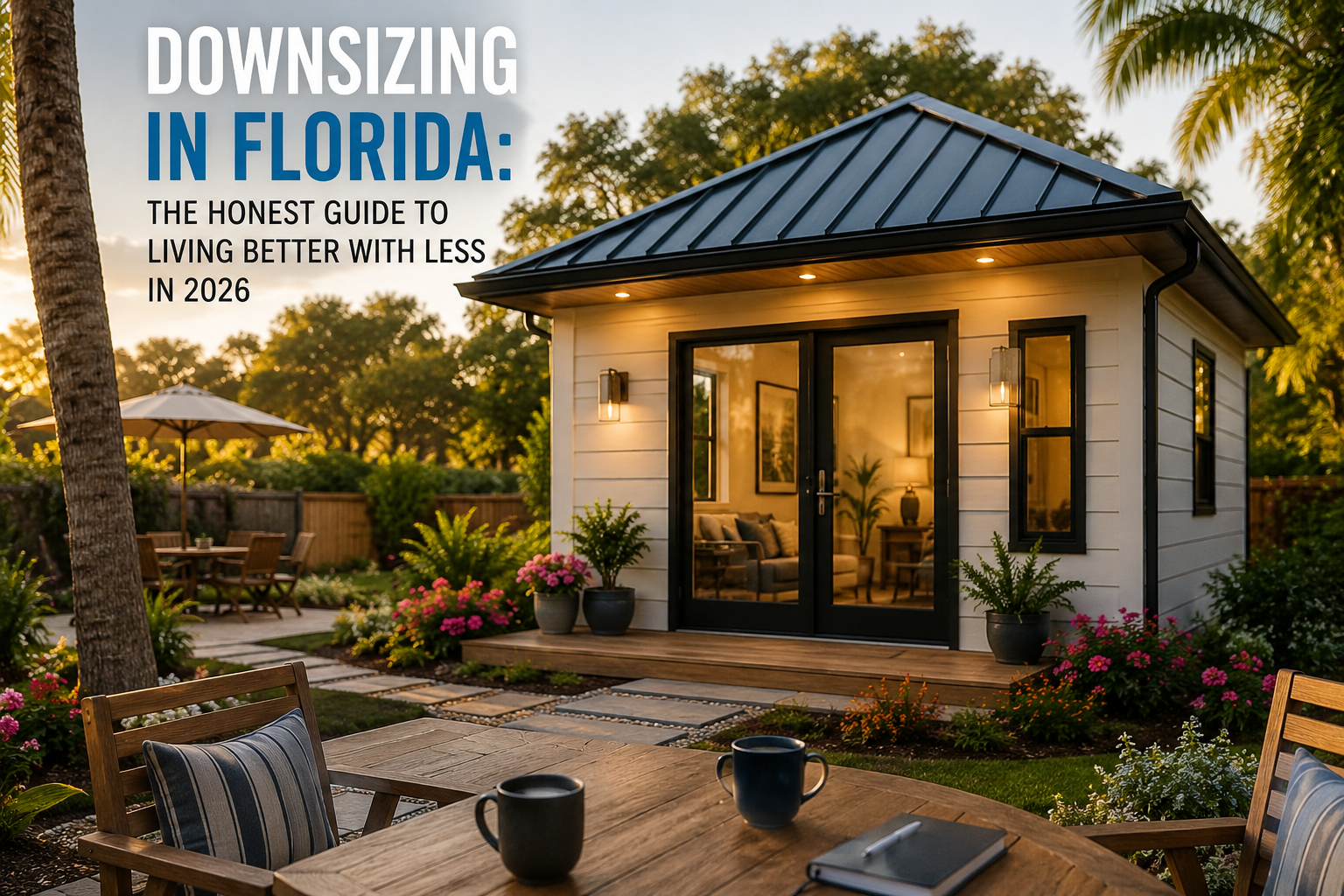
The Honest Guide to Living Better With Less in 2026
Nobody sits down one morning and decides to downsize on a whim. It’s not that kind of decision. It builds up over time — in the drawer you haven’t opened in two years, in the guest room that’s become a storage space with a bed in it, in the Saturday mornings that disappear into maintenance on a house whose primary function seems to be demanding your attention. It builds up in the mortgage statement, in the utility bills, in the property tax notice that arrives every year and reminds you what percentage of your financial life is dedicated to maintaining space you don’t really use.
By the time most people start seriously researching downsizing, the question isn’t really whether to do it. The question is how to do it well — how to make a transition that genuinely improves life rather than just trading one set of complications for another. That’s the question this guide is written to answer, specifically for Florida residents and for people considering Florida as the place they want to land when they simplify.
Downsizing done well is one of the most powerful quality-of-life improvements available to people in the second half of life. Downsizing done poorly — rushed, under-researched, emotionally unprepared — is a source of regret that’s hard to undo. The difference between those two outcomes is almost entirely in the preparation, and this guide is about the preparation.
What Downsizing Actually Means Beyond the Square Footage
The word “downsizing” is used almost exclusively to refer to moving into a smaller home, which is accurate as far as it goes. But the people who do it most successfully tend to think about it more broadly than that.
Downsizing is really a recalibration of your relationship with stuff, space, and the financial and time commitments that maintaining both requires. It’s a decision to allocate resources — money, energy, attention, time — differently than you have been. The smaller home is the mechanism, but the actual goal is almost always something else: financial freedom, geographic flexibility, reduced maintenance burden, the ability to travel or pursue interests that the large home and its demands have been crowding out, or simply a living situation that fits the actual life you’re living rather than the life the house was built for.
When people frame it this way — as a resource reallocation rather than a reduction — the emotional weight of the decision shifts. You’re not losing space. You’re redirecting what that space has been costing you toward things that matter more. The 2,400-square-foot home that was the right choice when three kids were under that roof and life organized itself around school schedules and soccer practices is not automatically the right choice twenty years later when it’s two adults and a dog and three rooms that get used on holidays.
This reframing matters because the emotional resistance to downsizing is real and deserves to be engaged with honestly rather than dismissed. A home is rarely just a financial asset. It carries memories, identity, the accumulated evidence of a life. The process of leaving it — and deciding what to bring and what to release — is emotionally significant for most people. Acknowledging that upfront, giving it its due weight, and then moving through it rather than around it tends to produce better outcomes than treating downsizing as a purely practical transaction.
Why Florida Has Become the Downsizing Capital of the Country
Florida’s dominance in the downsizing market isn’t an accident or a product of retirement-community marketing. It reflects a convergence of real advantages that make the state genuinely well-suited to the kind of living that downsizing enables.
The climate is the foundation. Florida’s year-round warmth fundamentally changes the relationship between indoor and outdoor space in ways that make smaller homes feel larger and more livable than they would in climates where outdoor living is a seasonal luxury. A 600-square-foot home with a covered lanai, a porch, and an outdoor dining area in Florida operates as a much larger effective living space for most of the year. People who downsize to smaller homes in cold climates are confined to those square feet through the winter. People who downsize in Florida expand into the outdoor spaces that the smaller footprint makes both affordable and sustainable.
The financial landscape of Florida downsizing is compelling in specific ways. Florida has no state income tax, which matters significantly for retirees living on fixed incomes, investment returns, or retirement account distributions. Property taxes on smaller homes are proportionally lower. The homestead exemption, which is available to Florida primary residents, reduces the taxable value of a primary residence in ways that make the ongoing cost of homeownership here more manageable than in many other states.
Florida’s housing market creates downsizing equity math that works particularly well for people coming from high-cost markets. Someone selling a home in the Northeast or Midwest — where they may have accumulated significant equity — often finds that the proceeds from that sale can purchase a high-quality smaller home in Florida outright or with minimal financing, eliminating the mortgage entirely and restructuring their monthly cost of living in ways that are genuinely life-changing.
The community infrastructure for alternative housing in Florida is more developed than anywhere else in the country. Hundreds of land-lease communities, manufactured home parks, and planned communities specifically designed for the downsizing demographic have evolved over decades to offer living environments that combine affordability with amenity, community, and the kind of social engagement that isolated suburban living often fails to provide.
The Spectrum of Downsizing Options in Florida
One of the things that makes downsizing planning complicated is that “smaller home” covers an enormous range of options with very different financial structures, regulatory contexts, and lifestyle implications. Understanding what’s actually available in Florida’s market helps you evaluate options against your own situation rather than defaulting to whichever option you happen to encounter first.
Conventional smaller homes — site-built houses in the 800 to 1,400 square foot range — are the most familiar option and come with the most straightforward financing, title, and resale structure. They exist throughout Florida’s residential market, in established neighborhoods and new developments, at price points from the low $200s in smaller markets to well above that in South Florida and coastal communities. The trade-off is that even at smaller sizes, conventional homes in Florida’s current market carry price tags that may not achieve the financial restructuring that’s often the primary goal of downsizing.
Condominiums and townhomes offer a different kind of downsizing — smaller private space, lower maintenance burden because exterior upkeep is handled by the association, and often amenities that a free-standing smaller home wouldn’t include. The HOA fees that come with condos and townhomes are a real ongoing cost that needs to be factored into the comparison, and the rules that govern condo living — about rentals, pets, modifications, and use — vary significantly between communities and are worth understanding before purchasing.
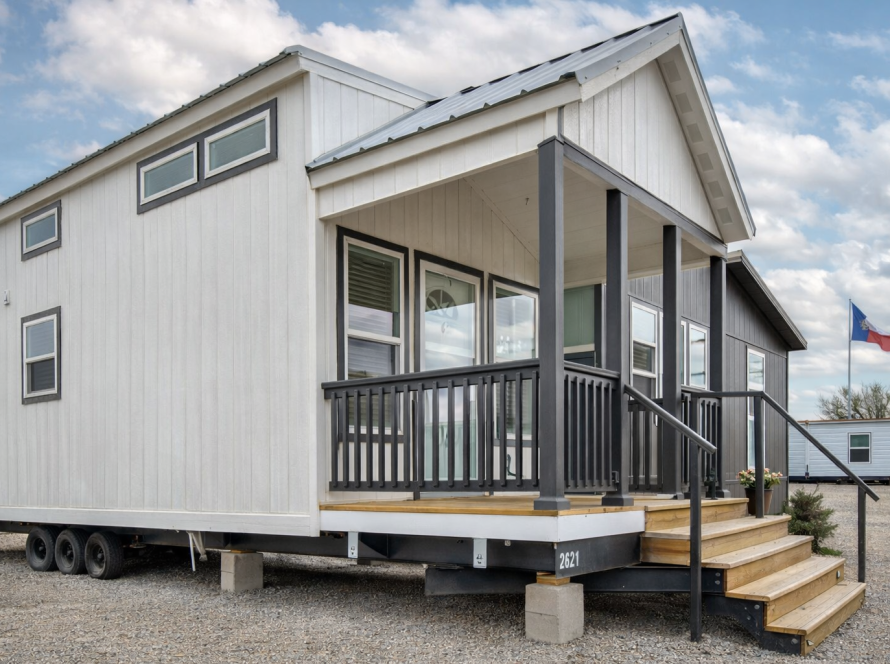
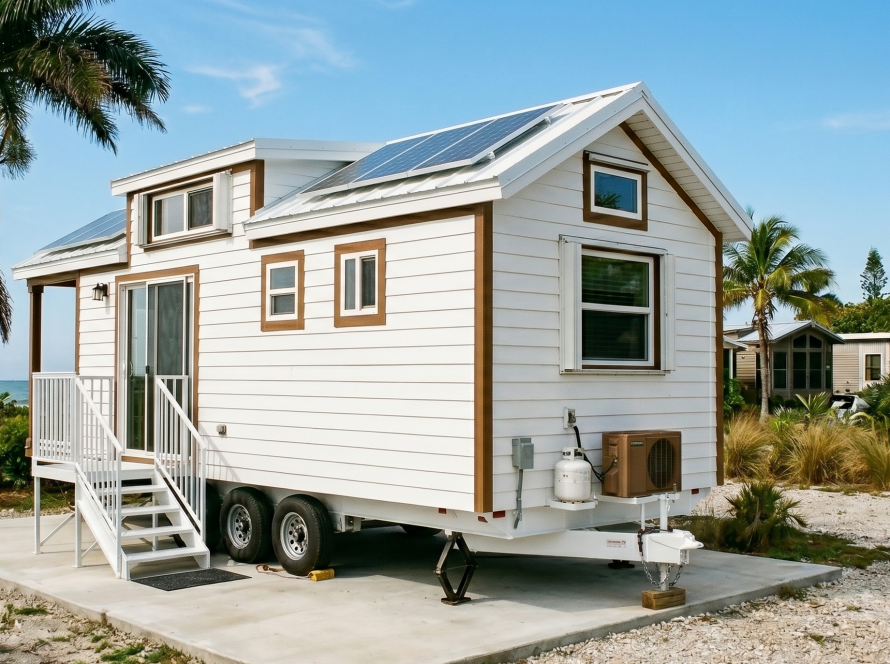
Park model homes in Florida’s land-lease communities represent one of the most financially compelling downsizing paths available. A high-quality park model home can be acquired and set up for $80,000 to $150,000, placed on a leased lot in a community with pool, clubhouse, and organized activities for $500 to $800 per month. The total monthly housing cost — lot rent plus insurance plus utilities — often comes in well below $1,500, which is a number that restructures retirement finances in genuinely significant ways. EcoLife Homes specializes in this path, working with clients to identify the right community, select quality homes from vetted manufacturers, and manage the installation process.
ADUs — accessory dwelling units on properties where a family member owns the primary home — represent a growing downsizing option in Florida, particularly for people who want to remain close to family while maintaining independent living. A parent who moves into a permitted, purpose-built ADU on an adult child’s property gets genuine independence — separate entrance, separate kitchen, their own space — while being close enough for daily connection and practical support. The financial structure of this arrangement varies by family, but it often allows the parent to sell their conventional home, invest or deploy the equity, and live in the ADU with minimal ongoing housing cost. EcoLife Homes builds ADUs throughout Florida specifically for this kind of multigenerational arrangement.
Small cottages and micro homes on private land round out the spectrum for people who want land ownership combined with a significantly reduced footprint. In Florida’s rural and semi-rural markets — particularly in North Central Florida, the Ocala region, and parts of the Panhandle — land prices are accessible enough that this combination remains financially achievable in 2026. The appeal is a quieter, more land-connected lifestyle with the ownership satisfaction of a private parcel, at a total cost that often competes favorably with conventional downsizing options in more developed markets.
The Downsizing Process: What Actually Has to Happen
People who have done it successfully describe a process that happens in roughly the sequence below, and the sequencing matters because decisions made in the wrong order tend to create problems that decisions in the right order prevent.
The emotional and psychological work comes first, even though it’s tempting to start with the practical logistics. This means honest conversations with yourself — and with a partner if you’re making this decision together — about what you’re actually moving toward and what you’re letting go. It means sitting with the house and acknowledging what it has meant, which is different from becoming attached to continuing to maintain it. It means getting clear on what objects carry genuine meaning and will come with you, and what carries only the weight of having been there a long time. This work isn’t fast, and trying to rush it typically produces regret about specific decisions later — the chair that went to a garage sale that someone wishes they’d kept, the room that got dismantled before they were ready.
The financial analysis comes early in the process and needs to be more thorough than most people initially do it. What does the current home sell for in today’s market? What are the transaction costs of selling — agent commissions, closing costs, any repairs or staging investment? What are the acquisition costs of the next home — purchase price or park model cost plus setup, any community fees, utility connection costs, furniture that needs to be right-sized for a smaller space? And then the ongoing monthly cost comparison: current housing costs versus projected housing costs in the new situation, including all the line items that don’t always make it into the initial estimate.
This financial analysis is one of the places where EcoLife Homes adds genuine value for clients considering park model or ADU transitions. The numbers are laid out completely and honestly — not the best-case version, but the realistic version — so the decision is made with accurate information rather than optimistic projections.
The market research phase involves understanding what’s actually available in the Florida market segment you’re targeting — what communities exist, what their cultures and amenity levels are, what the lot rent structure looks like and what it’s likely to do over time, what the park model manufacturers servicing that market are building and at what quality level. This takes more time than people expect, and it benefits from being done in person — visiting communities, talking to residents, getting a felt sense of whether a specific place and culture fits — rather than solely through websites and brochures.
The decluttering and downsizing of possessions is its own substantial project. The research on how much space a specific home provides, mapped against an honest inventory of current possessions, typically produces a list of decisions that needs to be made. Some people find this process liberating in ways they didn’t expect. Others find it grinding and emotionally taxing. Few find it quick. Giving it adequate time — starting well before the move rather than trying to compress it into the week before closing — consistently produces better outcomes and less regret.
Downsizing With a Partner: The Conversations That Matter
Downsizing decisions made by two people are more complex than individual decisions, and the complexity deserves acknowledgment rather than the assumption that if one person is enthusiastic, alignment will follow.
Partners often have different attachment to the current home, different visions of what the next chapter should look like, different feelings about what objects need to come along, and different ideas about community versus privacy, urban versus rural, busy versus quiet. These differences aren’t obstacles to the decision — they’re the conversation that needs to happen before the decision gets made.
The conversations that produce good outcomes tend to involve both people articulating what they want the next phase of life to feel like, not just what house they want to live in. What does a good day look like? What activities do they want more time and energy for? What social environment do they thrive in? What would they regret not doing if the opportunity to restructure their housing costs existed but they didn’t take it?
These conversations sometimes surface real differences in vision that need to be worked through. Sometimes they reveal that both people want essentially the same thing and have been separately building toward it without quite saying so. Either way, the conversation is worth having explicitly rather than letting the logistics of a move substitute for it.
The Timing Question: When Is the Right Time to Downsize?
There’s a version of this question that’s about market timing — when is the real estate market favorable for selling a large home and buying or transitioning to a smaller one — and a version that’s about life stage timing.
On the market timing question in 2026: Florida’s conventional housing market has moderated somewhat from the peaks of 2022 and 2023, but remains at historically strong levels in most markets. Sellers of conventional homes in desirable Florida locations are generally selling into a market that has retained much of the appreciation of recent years. Buyers in the park model and smaller home segment are entering a market where quality has improved, supply has expanded, and the financial case for the transition is as strong as it’s been. This is not an argument for urgency, but it’s not an argument for waiting either.
On the life stage timing question: the most consistent finding among people who have downsized successfully is that they wish they’d done it earlier. Not dramatically earlier — not before they were ready — but earlier than the deadline that eventually forced the decision. The people who downsize at 62 or 65, when they have the energy to set up a new home, explore a new community, and genuinely enjoy the financial freedom the transition creates, consistently report a different experience than the people who downsize at 75 or 80 under the pressure of health changes or financial necessity.
The best time to downsize is when it’s a choice rather than a necessity. When it can be done deliberately, with adequate time for research, emotional processing, and thoughtful decision-making. That window exists for most people, and it’s shorter than it seems.
What Life After Downsizing Actually Looks Like
The question worth sitting with, after all the logistics and finances have been considered, is what life actually looks like on the other side of this decision.
The most common reports from Florida residents who have successfully downsized — to park model homes in communities, to ADUs near family, to small cottages on private land — cluster around a few consistent themes.
Time is the most frequently mentioned gain. The hours that used to go into maintaining, cleaning, and managing a larger home become available for other things. This sounds abstract until it’s real, and then it’s one of the most tangible improvements in daily experience that people describe. Saturday mornings that used to belong to the house now belong to the person.
Financial breathing room is the second most commonly cited change. Not necessarily wealth — many people who downsize are not dramatically changing their net worth — but liquidity, flexibility, and the absence of the low-grade financial anxiety that comes with carrying a large mortgage or managing the ongoing costs of a large property. This changes the texture of daily life in ways that are hard to overstate.
Social connection, for people who move into communities rather than isolating on private land, is often a genuine surprise. Many people who downsize into well-functioning communities describe finding social richness there that they hadn’t had in suburban neighborhoods where everyone pulls into their garage and disappears. The proximity, the shared amenities, the organized activities, and the common experience of having made a similar life choice creates the conditions for genuine connection.
EcoLife Homes sees these outcomes in the clients who work with us, and those outcomes are part of what motivates the work. Helping someone make a transition that genuinely improves their life — that gives them back time, financial flexibility, and a home that fits who they actually are rather than who they used to be — is work worth doing well.
The Florida Downsizing Decision in 2026 and Looking Ahead
Heading into 2026 and planning toward 2027, the conditions for Florida downsizing are as favorable as they’ve been. The housing market provides strong selling conditions for those transitioning out of conventional homes. The park model and small home market has matured to offer genuine quality at accessible price points. Community options have expanded and improved. And the financial case — the comparison between what conventional homeownership costs and what smaller, intentional living costs — has never been more compelling given where conventional home prices have landed.
If you’re in the window where downsizing is a choice rather than a necessity — where you can do it on your timeline, with adequate research and emotional preparation — 2026 is a year worth taking seriously on this question. Not necessarily to move this year, but to have the conversations, do the research, visit the communities, and make a decision that’s genuinely informed rather than indefinitely deferred.
EcoLife Homes is a resource for that process across Florida’s park model and ADU markets. Free consultations that cover your specific situation — where you are, what you’re considering, what questions you haven’t been able to answer yet — are available and genuinely useful as a starting point.
The smaller life, done deliberately and well, is often a bigger life in the ways that matter most.
Thinking about downsizing in Florida in 2026 or 2027? EcoLife Homes works with people at every stage of this decision — from early exploration to active planning. Reach out for a free consultation and see what’s actually possible for your situation.