How Much Does It Cost to Set Up a Park Model Home?
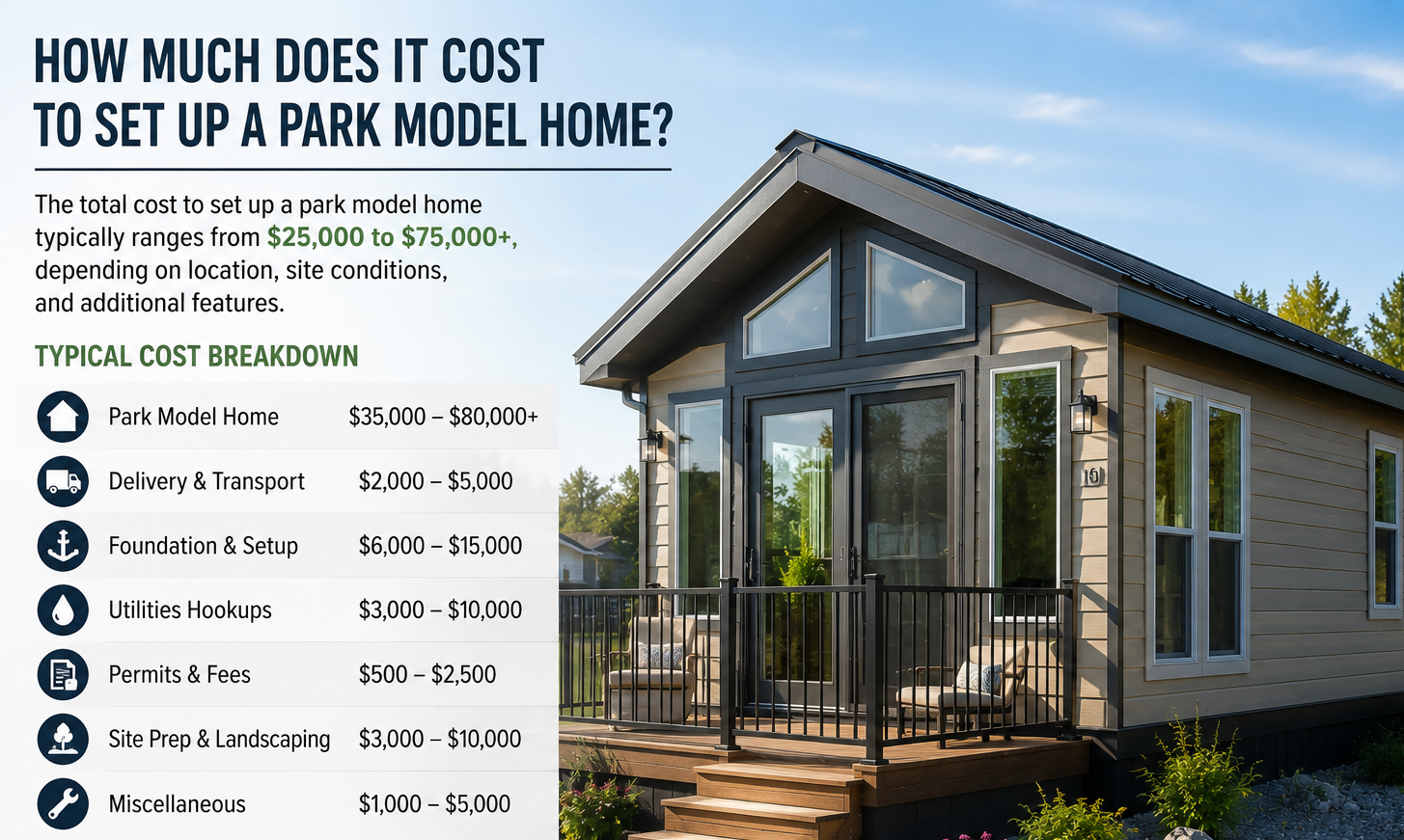
The purchase price of a park model is the number that shows up in listings, gets quoted in conversations, and tends to anchor the budget conversation from the beginning. It’s real — but it’s only the first number in a longer equation, and buyers who plan around it exclusively tend to arrive at move-in day having spent considerably more than they expected.
Setup costs are the part of the park model acquisition that catches people most off-guard. Not because manufacturers are hiding anything, but because the costs involved in taking a unit from the factory to a fully functioning, move-in-ready home span multiple contractors, multiple service providers, and multiple decisions that feel small in isolation and add up quickly in aggregate.
This piece walks through every meaningful setup cost category — what drives each one, what realistic ranges look like in Florida in 2026, and where the variation is large enough that your specific situation could land well above or below the midpoint. The goal is to give you a planning number you can actually use, not a best-case estimate that makes the purchase look attractive and leaves you scrambling later.
Why Setup Costs Vary So Widely
Before getting into specifics, it’s worth understanding why setup cost estimates from different sources range so dramatically — from “a few thousand dollars” to “add 40% to the unit price.” Both ends of that range are real, and they’re not talking about the same buyer situation.
The buyer placing a park model into an established Florida land-lease community where the site is already prepared, utilities are stubbed in, and the process is handled by an experienced community team has a very different setup cost profile than the buyer placing a unit on raw rural land where every element of infrastructure needs to be developed from scratch. Both buyers paid the same unit price. One spends $5,000 on setup. The other spends $40,000. The difference isn’t luck — it’s site conditions.
Understanding where you fall on that spectrum before you commit to a budget is the most important step in setup cost planning. Everything that follows is organized around that distinction so you can identify which costs apply to your situation and which don’t.
Delivery and Transport: The First Cost After the Unit Price
The moment a park model leaves the factory, the meter starts running on delivery costs. A park model is an oversize load — typically 12 to 14 feet wide and 30 to 45 feet long — that requires a commercial transport vehicle, specialized equipment, and oversize load permits for every state the unit passes through.
For Florida buyers purchasing from a Florida-based manufacturer like EcoLife Homes, transport distances are shorter and delivery costs are lower than for buyers sourcing units from out-of-state manufacturers. This is a meaningful practical advantage that doesn’t always make it into the price comparison conversation.
In-state Florida delivery costs for a park model typically run:
For distances under 100 miles: $1,500 to $3,500. This covers the transport truck, driver, fuel, and the Florida oversize load permit. For most buyers in South or Central Florida purchasing from a Florida manufacturer, delivery lands in this range.
For distances of 100 to 300 miles: $3,000 to $6,500. Longer hauls add fuel, drive time, and potentially a driver overnight stay. Still very manageable in the context of a total project budget.
For out-of-state purchases requiring interstate transport: $6,000 to $15,000 or more depending on origin. A unit shipped from a manufacturer several states away — before it even arrives at your site — has already consumed budget that a locally sourced unit wouldn’t require.
The transport quote should include everything to get the unit to your site. Confirm explicitly whether the quote includes the pilot car escort that Florida law requires for oversize loads of certain widths, whether permit fees are included, and what the policy is if the delivery needs to be rescheduled due to weather or site access issues.
Site Preparation: The Category With the Most Variation
Site preparation is where the gap between community placement and private land placement becomes most financially visible. It’s also where the most significant surprises tend to occur for buyers who didn’t investigate their specific site conditions before committing to a budget.
Community Placement Site Prep
If you’re placing your park model in an established land-lease community, the site preparation has typically already been done. Most quality Florida communities maintain concrete or asphalt pads, utility stubs at appropriate locations, and level, stable base conditions that the incoming park model can be set on with minimal additional preparation.
In this scenario, your site prep costs are modest:
Final grading and leveling (if needed): $300 to $800. Most community pads are ready as-is, but minor adjustments for drainage or leveling are occasionally required.
Utility hookup connections: $500 to $1,500. Connecting the unit’s plumbing, electrical, and sometimes cable or internet to the community infrastructure stub-outs. This work is typically done by the community’s maintenance staff or a contracted installer.
Community move-in fee: $500 to $2,500 depending on the community. Many Florida communities charge a one-time move-in fee that covers administrative processing, inspection, and any community-provided setup services. This is separate from the first month’s lot rent and any required deposit.
Total site prep for community placement: realistically $1,500 to $5,000, with the lower end more common in established communities with well-maintained infrastructure.
Private Land Placement Site Prep
Private land placement is an entirely different conversation. When you’re placing a park model on land you own — whether rural acreage, a residential lot, or a family property — the infrastructure that a community has already built needs to be developed from scratch. The cost range is wide because soil conditions, access, local permit requirements, and the presence or absence of nearby utility infrastructure all vary significantly.
Here’s what each major component typically costs in Florida in 2026:
Land clearing and grading: If the site has vegetation, trees, or uneven terrain, clearing and grading precede everything else. A relatively clear site needing only rough grading might cost $500 to $2,000. A heavily wooded site requiring tree removal, stump grinding, and extensive grading could run $5,000 to $15,000 or more depending on acreage and equipment access.
Foundation pad: The park model needs a prepared, level, stable base to sit on. The options in Florida, in order of typical cost, are:
Compacted gravel pad: $1,500 to $3,500. A properly prepared and compacted gravel base provides stable support and good drainage. It’s the most common choice for rural placements and for buyers on tighter setup budgets.
Concrete runners or piers: $2,500 to $5,500. Concrete support runners or pier footings under the main structural members of the chassis provide more permanent, stable support. Required by some counties as a minimum standard.
Full concrete slab: $4,000 to $9,000 depending on size and thickness. A complete concrete pad under the full footprint of the unit provides the most stable base and is required by some communities and some county codes. It’s also the most expensive foundation option and adds to the permanence of the placement.
Septic system: If the property doesn’t have access to a municipal sewer connection — which describes the majority of rural Florida properties — a septic system is required. Florida septic installation costs in 2026 typically run:
Conventional gravity septic system: $6,000 to $12,000. A standard drainfield system in appropriate soil conditions.
Alternative or advanced treatment system: $10,000 to $20,000 or more. Required in areas with high water tables, poor soil percolation, or proximity to water bodies. Much of Florida’s geography creates conditions that require more sophisticated systems than basic gravity drainfields.
Permit and inspection fees add $500 to $1,500 to the septic installation cost regardless of system type.
Water supply: If municipal water is not available at the property — again, common in rural Florida — a well is the primary alternative.
Well drilling and pump installation: $5,000 to $12,000 depending on the required depth to reach usable groundwater and local geology. Some areas of Florida have shallow water tables where wells are relatively inexpensive. Others require drilling hundreds of feet to reach potable water.
Water treatment system: $800 to $3,500 if the well water requires filtration or treatment for hardness, iron content, or other quality issues. Florida groundwater quality varies considerably by region and often requires some level of treatment.
Electrical service: Connecting the property to grid power requires a service entrance, a meter base, and a main panel installed to Florida’s electrical code standards.
Power company connection and transformer (if not already on the property): $1,500 to $8,000 depending on how far the power company needs to extend service. Rural properties with no existing service infrastructure face higher costs than properties where power lines already run nearby.
Main electrical panel, meter base, and service entrance installation: $2,500 to $5,500 installed by a licensed Florida electrician.
Underground vs. overhead service run to the unit: $800 to $3,000 depending on distance and method.
Total private land site prep: A realistic planning range for a rural Florida private land placement with all new infrastructure is $25,000 to $55,000. The wide range reflects genuine variation in soil conditions, local permit requirements, utility extension costs, and site-specific factors. Budget toward the upper end unless you have specific confirmed cost quotes in hand.
Hurricane Tie-Down and Anchoring System
This cost is non-negotiable in Florida and applies to both community and private land placements. Florida’s wind zone requirements mandate that park models be anchored to engineered standards appropriate for the wind zone of the installation location. South Florida and coastal areas carry higher wind zone requirements than interior counties, which affects both the specification and the cost of the anchoring system.
A standard hurricane tie-down installation in Florida typically costs $1,500 to $3,500 depending on:
The wind zone classification of the installation location. Higher wind zones require more anchor points and heavier hardware.
The foundation type. Anchoring into concrete is different from anchoring into earth anchors or ground screws.
Whether the unit comes pre-drilled for anchor strap attachment or whether drilling is required during installation.
This work should be performed by a licensed contractor familiar with Florida’s specific requirements and should include documentation that satisfies both community requirements and insurance carrier requirements. Don’t cut corners here — proper anchoring is what keeps a park model on its foundation when a significant storm event occurs, and the difference between compliant and non-compliant anchoring becomes apparent in the worst possible circumstances.
Skirting Installation
The space between the bottom of the park model’s floor system and the ground needs to be enclosed with skirting — both for aesthetics and for practical protection against moisture accumulation, pest intrusion, and the kind of debris accumulation that can create maintenance problems in the undercarriage over time.
Vinyl skirting is the most common choice in Florida communities and on private land. It’s durable, low-maintenance, available in colors that coordinate with most exterior finishes, and handles Florida’s heat and UV exposure reasonably well.
Vinyl skirting installation costs for a typical park model in Florida run $1,500 to $3,500 depending on perimeter dimension and the complexity of fitting around steps, utility connections, and uneven grade conditions. The lower end applies to a straightforward installation on a level site. The upper end reflects more complex fitting requirements.
Vented skirting — with built-in ventilation panels that allow air circulation under the floor system — is the standard specification in Florida’s climate. Ventilation prevents the moisture and heat buildup under the floor that can accelerate deterioration of the floor system over time. Solid skirting without ventilation is not appropriate for Florida’s conditions and should be avoided regardless of cost.
Steps, Entry Structures, and Accessible Entry
The park model sits on its chassis at a height above grade that requires steps for entry. Some manufacturers include steps as a standard feature; others provide them as an optional add-on or leave the buyer to source them separately.
Basic prefabricated steps: $300 to $800 installed. Adequate for most situations but minimal in appearance.
Custom wood or composite landing and step structure: $1,200 to $3,500 depending on size, material, and whether a railing is included. A well-designed entry structure with a small landing, proper railing, and quality material makes a significant difference in both curb appeal and daily usability.
Accessibility ramp (if required): $1,500 to $4,000 depending on the rise height and ramp length needed to meet ADA slope standards. For buyers with mobility considerations or for rental properties that want to be accessible to a broader market, a proper ramp installation is worth budgeting.
Outdoor Living Additions: The Florida Essential
In Florida’s climate, a covered outdoor living space is not a luxury amenity — it’s a functional room that you’ll use for a significant portion of the year. Planning and budgeting for it as part of the initial setup, rather than as an afterthought, produces better results at lower total cost than adding it later.
Covered porch addition: $3,500 to $9,000 depending on size, roofing material, and whether the structure is attached to the unit or freestanding. A 10-by-16-foot attached covered porch with composite decking and a metal roof sits comfortably in the middle of this range and provides meaningful additional living area.
Screen enclosure: $4,000 to $10,000 for a screened room addition or full-perimeter screen enclosure around the porch area. The screen enclosure extends comfortable outdoor living through Florida’s mosquito season and allows open-air living even during rain events with appropriate roof overhang design.
Carport: $3,000 to $7,500 depending on size and construction method. A covered parking structure protects vehicles from Florida’s sun and rain and adds a sense of arrival to the property.
Outdoor kitchen stub-out or basic outdoor kitchen: $1,500 to $6,000 depending on the level of development. Even a basic outdoor cooking setup — a gas line stub, a weather-resistant counter, and a simple grill connection — meaningfully expands the entertainment capability of the outdoor space.
Utility Connection Fees and Service Initiation
Whether you’re connecting to community utilities or to municipal services on private land, there are typically one-time fees associated with initiating service that go beyond the physical installation work.
Electric utility connection fee: $150 to $500 depending on the utility provider and the nature of the connection.
Water and sewer connection fees (municipal): $1,500 to $5,000 or more in some Florida municipalities that charge significant impact fees for new service connections. These fees are set by local utilities and can vary dramatically — some municipalities charge nominal amounts while others have impact fee structures that add thousands to a new connection.
Internet and cable installation: $100 to $500 depending on provider and whether infrastructure already passes the site. Most Florida communities have cable or fiber internet service available, and connection is straightforward. Rural private land placements sometimes require satellite internet, which involves equipment purchase costs of $400 to $600 in addition to monthly service fees.
Permits and Inspections
Some setup work requires permits, and permit costs are a real line item that belongs in your budget.
In communities: The community itself typically handles the relationship with local authorities and inspectors, and permit costs may be folded into the community’s move-in fee or handled separately. Confirm what’s covered before you assume anything.
On private land: Building permits for site preparation work, electrical installation, septic installation, and in some counties the park model placement itself involve permit fees that vary by county and by project scope. A realistic budget for permit fees on a complete private land setup in Florida is $1,500 to $4,500 covering all required permits. Some rural counties are more affordable; some urban-adjacent counties with higher development activity charge more.
Inspection fees are sometimes separate from permit fees and cover the inspectors’ visits for each phase of work. These are typically modest — $50 to $200 per inspection — but the total across electrical, plumbing, structural, and final inspections can add $500 to $1,500 to the project.
Furnishing and Making It a Home
The final setup cost category is furnishing — and while it’s the most personally variable line item on the list, it’s also the one that most directly determines whether your park model feels like a home or a model unit.
Owner-occupied setup, functional and comfortable: $5,000 to $10,000. This covers a quality sofa or sectional, a dining table and chairs, bedroom furniture, bedding, window treatments, kitchen essentials, and the miscellaneous items that make a space livable. At this budget level you’re making practical choices that work well, not splurging on design.
Owner-occupied setup, nicely appointed: $10,000 to $18,000. At this level you’re making intentional design choices — coordinated furniture, quality bedding and linens, wall art and décor, outdoor furniture, a properly equipped kitchen with the tools you actually use.
Short-term rental setup, photography-ready: $12,000 to $22,000. A rental property where presentation drives revenue demands a higher level of investment in the furnishing and accessory layer. Professional-quality photography requires spaces that read well — cohesive styling, no visual clutter, quality pieces that communicate care and attention. The return on this investment in the form of better listing performance and higher nightly rates typically makes it economically sound within one to two rental seasons.
The Complete Setup Budget: Putting It Together
For planning purposes, here is a realistic all-in setup cost summary for the two primary buyer situations in Florida in 2026:
Community Placement (established community with prepared site)
Delivery: $1,500 – $4,000 Site connection and hookups: $800 – $1,800 Hurricane anchoring: $1,500 – $3,000 Skirting: $1,500 – $2,500 Steps and entry: $400 – $1,500 Community move-in fee: $500 – $2,000 Permits and inspections: $300 – $800 Outdoor additions (porch, basic): $3,500 – $6,000 Furnishing: $6,000 – $15,000
Total community setup: $16,000 – $36,500
Private Land Placement (raw land, all infrastructure)
Delivery: $2,000 – $6,000 Land clearing and grading: $2,000 – $10,000 Foundation pad: $2,500 – $9,000 Septic system: $7,000 – $20,000 Well and water treatment: $6,000 – $15,000 Electrical service: $5,000 – $16,000 Hurricane anchoring: $1,500 – $3,500 Skirting: $1,500 – $3,000 Steps and entry: $600 – $2,500 Permits and inspections: $1,500 – $4,500 Outdoor additions: $4,000 – $9,000 Furnishing: $6,000 – $15,000
Total private land setup: $39,600 – $113,500
These ranges are wide because the variables are genuinely wide. The buyer who gets confirmed quotes on every line item before committing will land somewhere in the middle of each range. The buyer who budgets the low end and encounters difficult soil, a high water table, or an extended utility run will experience the upper end.
One more number worth knowing: most experienced park model buyers and contractors suggest adding a 10% to 15% contingency on top of your estimated setup costs. Not because catastrophe is likely, but because real projects always encounter something the estimate didn’t capture — an extra yard of concrete, an additional inspection trip, a soil condition that required a different anchor specification. Having that cushion built in means a surprise becomes a line item rather than a crisis.
EcoLife Homes works with buyers from the first conversation to develop setup cost estimates that reflect their specific site, their specific community or land situation, and their specific intended use. That conversation is most valuable before you commit to a purchase — not after. If you’re building a budget and want a realistic picture of what your total project costs, that’s exactly the kind of conversation we’re set up to have.