Septic Tank for ADU
If your Florida property runs on a septic system rather than municipal sewer service, you’ve probably wondered whether that changes your options for building an accessory dwelling unit. Maybe someone told you it would be a problem. Maybe you read something online that left you more confused than when you started. Maybe you’ve just been sitting on the idea because you weren’t sure where to begin with this particular piece of the puzzle.
Here’s the direct answer: yes, you can absolutely build an ADU on a property with a septic system in Florida. Thousands of Florida homeowners have done exactly that, and thousands more will in 2026 and 2027 as ADU development continues to grow across the state. Septic is not a dealbreaker. It’s a variable — one that needs to be understood, evaluated, and addressed correctly — but it’s a variable that has known solutions.
What it is not is something you can skip over or figure out later. The Health Department has authority over septic systems in Florida, and their approval of your system’s capacity for the additional load an ADU creates is required before permits are issued. Projects that try to move forward without addressing this upfront either get stopped when the permitting process surfaces the issue, or they encounter expensive problems after the fact. Neither outcome is acceptable when the information needed to avoid it is available from the beginning.
This guide walks through how septic systems interact with ADU construction in Florida, what the Health Department actually looks at, what your realistic options are, what each option costs, and how to approach this part of the project so it informs your planning rather than derailing it.
Why Septic Systems and ADUs Require Special Attention in Florida
Florida has a significant number of properties — particularly in rural counties, agricultural areas, and communities developed before widespread municipal sewer infrastructure — that manage wastewater through on-site septic systems rather than connecting to a municipal treatment system. Estimates suggest that roughly a third of Florida’s population relies on septic systems, and in many counties outside the major urban cores, the percentage is considerably higher.
A conventional septic system is designed and permitted for a specific capacity based on the number of bedrooms in the home it serves. This is because bedroom count is the standard proxy for the number of occupants a dwelling is expected to house, and occupant count drives wastewater generation. A system permitted for a three-bedroom home is sized for the wastewater output of the household that would typically occupy that home.
When you add an ADU to that property, you’re adding another dwelling unit with its own bedrooms, kitchen, bathroom, and occupants. That additional load has to go somewhere, and it has to be processed by the on-site system. If the existing system doesn’t have the capacity to handle the combined load of the primary home and the new ADU, it won’t perform correctly — which creates health hazards, environmental problems, and regulatory violations.
This is not a Florida-specific overreach. Septic system capacity management exists to protect public health and groundwater quality, and the consequences of overloaded septic systems — system failures, groundwater contamination, sewage surfacing in yards — are real problems that affect the property owner, neighbors, and the broader environment. The Health Department’s role in reviewing septic capacity before ADU permits are issued reflects appropriate oversight of a system that has genuine potential for harm if mismanaged.
Understanding this context makes the regulatory requirement less frustrating. The Health Department isn’t creating an obstacle for its own sake — it’s managing a legitimate infrastructure concern. Once you understand that, the practical question becomes straightforward: what’s the capacity situation on your specific property, and what does addressing it require?
How the Health Department Evaluates Septic Capacity
The Florida Department of Health, operating through county health departments, has jurisdiction over onsite sewage treatment and disposal systems throughout the state. When a property owner applies to add an ADU to a property with a septic system, the Health Department reviews whether the existing system has sufficient capacity for the additional dwelling unit.
This evaluation typically involves reviewing the existing system’s permitted capacity, the soil conditions on the property, the available area for drain field expansion if needed, and the proposed ADU’s bedroom count. The process usually requires submitting an application, and in many cases a site evaluation by a licensed inspector.
The bedroom count of the proposed ADU is the primary driver of the capacity calculation. A studio ADU is treated differently than a two-bedroom unit because the anticipated wastewater load is different. This is one of several reasons why the size and configuration of the ADU you’re planning matters to more than just the construction budget — it affects the septic analysis and may affect the cost of any required system upgrades.
Timeline matters here too. The Health Department review is a separate process from the building permit review, and in some counties the two processes run in parallel while in others the Health Department approval must come first. Knowing how your county handles this sequencing is important for realistic project timeline planning. At EcoLife Homes, the septic evaluation is initiated early in the project process specifically because it can affect both the timeline and the budget, and both of those need to be understood before design commitments are made.
Option One: Connect to the Existing System
For some properties, the existing septic system has enough remaining capacity to handle the additional load an ADU creates without any modification. If the system was originally designed with excess capacity, or if the primary home consistently uses less than its permitted capacity, the additional bedroom or two in an ADU may fall within what the system can handle.
This is the best-case scenario, and it does happen. When the Health Department review concludes that the existing system is adequate, no septic work is required, and that cost category drops out of the project budget entirely. The ADU connects to the existing system through a standard plumbing connection, and the process moves forward.
How do you know if your system has adequate capacity? You don’t, without an evaluation. The system’s permitted capacity is in the records the Health Department maintains, and a licensed septic inspector can assess the current condition of the system and its components. Some systems that were permitted for adequate capacity years ago have components that have degraded over time — drain fields that have lost absorption capacity, tanks that need servicing — and the on-paper capacity may not reflect current actual performance.
This is why EcoLife Homes coordinates a full septic evaluation with licensed contractors before any contract is signed on an ADU project. The evaluation produces a clear picture of what the system is actually capable of, not just what the old permit says. That information is what goes into the project budget and timeline, not an optimistic assumption.
Option Two: Upgrade the Existing System
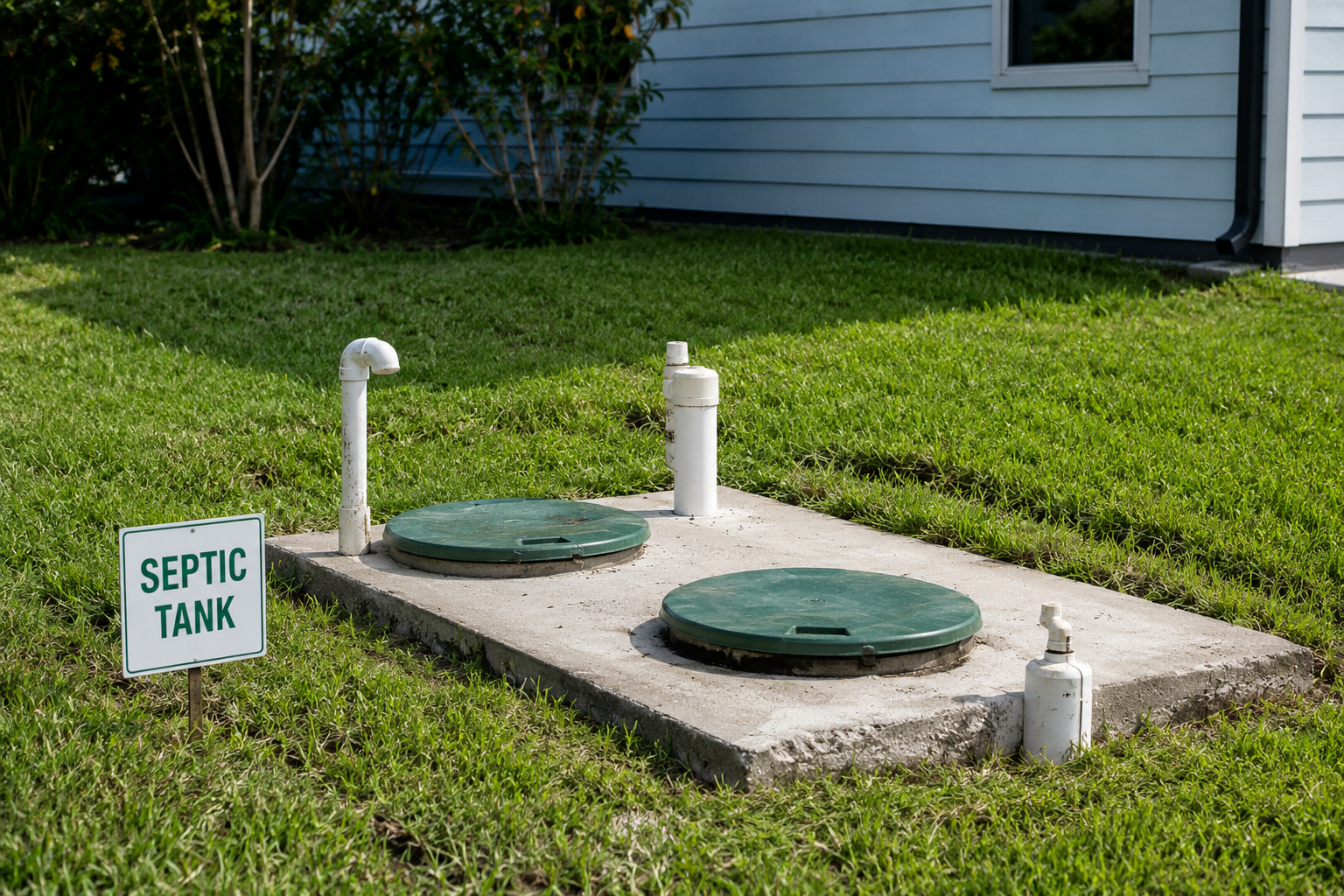
When the existing system is in good condition but doesn’t have sufficient capacity for the additional ADU load, an upgrade is often the most practical path. Upgrades typically involve expanding the drain field — the area where treated effluent is distributed into the soil — or adding capacity to the treatment components of the system.
The cost of a septic system upgrade for ADU purposes in Florida typically runs between $2,000 and $5,000 for standard cases, though more complex situations can push toward $7,000 or beyond. The variables that affect the cost include the size of the upgrade needed (which depends on the ADU’s bedroom count and the existing system’s capacity gap), the soil conditions on the property, the available space for drain field expansion, and any site-specific complications like existing structures, trees, or utilities that are in the way.
Drain field expansion is the most common upgrade scenario. The existing treatment tank is usually adequate in these cases — the bottleneck is the area available for effluent disposal. Adding drain field capacity requires suitable open land on the property, which brings up an important spatial consideration: the drain field area needs to be protected from structures, vehicles, and heavy planting that would compact the soil and reduce its absorption capacity.
This has implications for ADU placement. If the most logical location for your ADU footprint is also where the drain field expansion needs to go, you have a conflict that requires design resolution. This is another reason to complete the septic evaluation early in the process — before the design has locked in a placement that might need to change.
Some properties have existing drain field areas that are undersized not because of original design decisions but because of changes over time: areas that were once suitable have been built over, paved, or otherwise compromised. In these cases, finding suitable area for expansion requires more creative site planning, and the cost of the upgrade may be higher because of the additional excavation and site work involved.
Option Three: Install a New Septic System
In some situations, upgrading the existing system isn’t practical or sufficient, and a new system — either replacing the existing one or installed separately to serve the ADU — is the right path. This happens when the existing system is near the end of its service life and would be better replaced than expanded, when the property’s soil conditions or available space don’t support expansion of the current system, or when the ADU’s additional load is large enough that a separate system dedicated to the new unit makes more sense than trying to expand a system designed for a different load.
A new septic system in Florida currently runs $7,000 to $10,000 for typical residential configurations, with more complex situations — difficult soil conditions, larger system requirements, sites with constrained space — potentially reaching $15,000. These are meaningful numbers that belong in the project budget from the beginning.
Florida’s soil conditions vary considerably across the state, and soil type matters significantly for septic system design and cost. Sandy, well-draining soils that are common in many parts of Central and North Florida are generally favorable for conventional septic systems. Heavier, slower-draining soils require more sophisticated system designs — mound systems, drip systems, or other alternative configurations — that cost more to install and maintain. Properties with high water tables, which are common in South Florida, have their own set of constraints that require specific system types.
The Health Department’s site evaluation process assesses soil conditions as part of determining what system type is required for your property. This is not something that can be inferred from a neighboring property or from general knowledge about the area — it requires evaluation of your specific parcel. Two adjacent properties can have meaningfully different soil conditions that lead to different system requirements and different costs.
The Drain Field Question: Space That Has to Be Protected
One aspect of septic system planning for ADUs that doesn’t get enough attention is the drain field and its relationship to the rest of the property. Drain fields need open, vegetated space — grass and shallow-rooted ground covers are fine, but structures, pavement, and deep-rooted trees are not. The soil in a drain field area needs to remain uncompacted and biologically active to do its job.
This means that wherever your drain field is — existing or new — it’s land that can’t be built on. If the drain field occupies the primary candidate location for your ADU, or if a required drain field expansion would consume the space where you were planning to put the unit, the project needs a different solution.
For ADU projects in 2026 and 2027, this spatial analysis is a foundational part of site planning. Before any design work begins, EcoLife Homes maps out the existing septic infrastructure, the protected drain field area, and the buildable options that remain. This prevents the frustrating situation of developing a design that then has to be substantially revised because the septic constraints weren’t factored in from the start.
Some properties have adequate space to accommodate both a new ADU and the required drain field area without conflict. Others require creative site planning to make both work. A small number have constraints that make certain ADU sizes or placements impractical. Knowing which situation you’re in before you’ve invested in design is worth every bit of the time and cost of the early evaluation.
Financing the Septic Work Within the ADU Project
One aspect of septic system costs that EcoLife Homes discusses with clients early in every project is how these costs can be handled within the overall project financing. For clients who are financing their ADU through a construction loan, home equity line, or cash-out refinance, the septic work is part of the overall project and its costs can be incorporated into the financing structure along with the construction costs.
This matters because septic costs can feel like an unwelcome surprise when they’re discovered late in the project, at a point when the budget has already been established. When they’re identified upfront and incorporated into the project budget from the beginning, they’re just a line item in a known number — manageable and plannable rather than disruptive.
The same logic applies to all the upfront costs associated with an ADU project: permits, utility hookups, site preparation, and septic work all belong in the project budget from day one. EcoLife Homes structures every project conversation around a complete cost picture, specifically so clients can make financing decisions based on what the project actually costs rather than discovering additional costs as the project progresses.
In some situations, a client whose financing is tied to a specific construction budget needs to know about septic costs before they finalize their loan application. Discovering a $7,000 to $10,000 septic requirement after the loan has been approved and structured around a different number is a genuinely difficult situation. Discovering it before the application is submitted allows the financing to be structured around the real number.
What Happens If You Skip the Septic Evaluation
This deserves direct treatment, because the temptation to defer this step — especially for clients who are eager to move the project forward and are hoping the septic situation will turn out to be fine — is real.
If a property proceeds with ADU construction without proper Health Department review and approval of the septic situation, several things can happen, none of them good. The building department may catch the issue during the permit review process and require the septic evaluation before issuing any permits — effectively stopping the project until it’s completed. Or the permits may be issued but the final inspection may fail because the septic approval wasn’t in place. Or worst case, the project proceeds without the required approvals, creating a situation where the ADU is not legally permitted — a problem that surfaces badly at sale time or when a complaint is filed.
Beyond the regulatory consequences, there’s the practical reality: a septic system that’s being asked to handle more load than it was designed for will eventually show signs of failure. Slow drains, surfacing effluent in the yard, sewage odors, and eventual system failure are the downstream consequences of ignoring capacity limits. These are problems that affect health, quality of life, and property value in serious ways.
The evaluation is not burdensome relative to the scale of the project. It takes time — the Health Department has its own review process with its own timeline — but it’s not expensive, and the information it produces is essential to making good decisions about the project.
Practical Steps for ADU Owners with Septic Systems in 2026
If you’re a Florida property owner with a septic system who is seriously considering an ADU project in 2026 or looking ahead to 2027, the practical path forward has a clear early step: get the septic evaluation done before you do much else.
Find your existing septic permit records if you have them — they may be in your closing documents from when you purchased the property, or you may be able to obtain them from the county Health Department. These records tell you the system’s permitted capacity, which gives a starting baseline for the capacity analysis.
Then engage with an experienced ADU builder who understands how to coordinate the Health Department process and can help you understand the septic implications for your specific project. This isn’t a step that has to be figured out independently — a builder who has worked through this process many times knows the county-specific requirements, knows how to work with licensed septic inspectors, and knows how the Health Department evaluation process works in your area.
At EcoLife Homes, the septic coordination process is built into every ADU project engagement for properties with onsite septic systems. Before a contract is signed, before a design is finalized, the septic situation is evaluated and the options are on the table with real cost numbers attached. That’s the only way to build a project budget and timeline that actually holds up.
The Bottom Line on Septic and ADUs in Florida
Septic systems don’t prevent ADU development in Florida. They require it to be done with appropriate attention to the wastewater infrastructure, which is a reasonable requirement given what’s at stake when septic systems fail.
The three options — connecting to the existing system, upgrading it, or installing a new one — cover every realistic scenario that Florida property owners encounter. Each has a known cost range. Each has a known process. None of them are extraordinary obstacles; they’re just pieces of the project that need to be addressed in the right sequence.
What creates problems isn’t the septic requirement itself — it’s discovering the requirement and its costs at the wrong point in the project. Discovering that you need a $9,000 septic upgrade after you’ve already designed the ADU, secured financing, and announced a move-in date to the family member who’s planning to live there is a qualitatively different experience from knowing about that cost from the first planning conversation.
EcoLife Homes is committed to making sure Florida property owners have the complete picture from the beginning of every project. If your property runs on a septic system and you’re thinking about an ADU, the right move is to start with a site review that specifically addresses the septic situation — what your current system is permitted for, what an ADU of the size you’re considering would require, and what the realistic options and costs look like for your property.
That conversation belongs at the beginning, not somewhere in the middle.
Building an ADU on a septic property in Florida? EcoLife Homes offers free site reviews that include a full assessment of your septic options and costs — before any contracts are signed or designs are started. Get the real picture from day one.