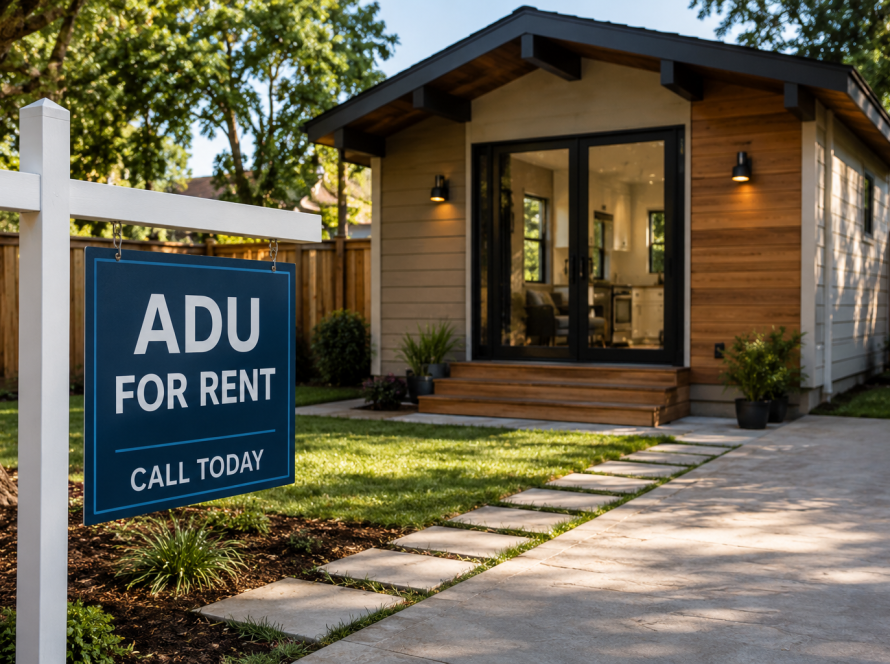
ADUs Increase Property Value
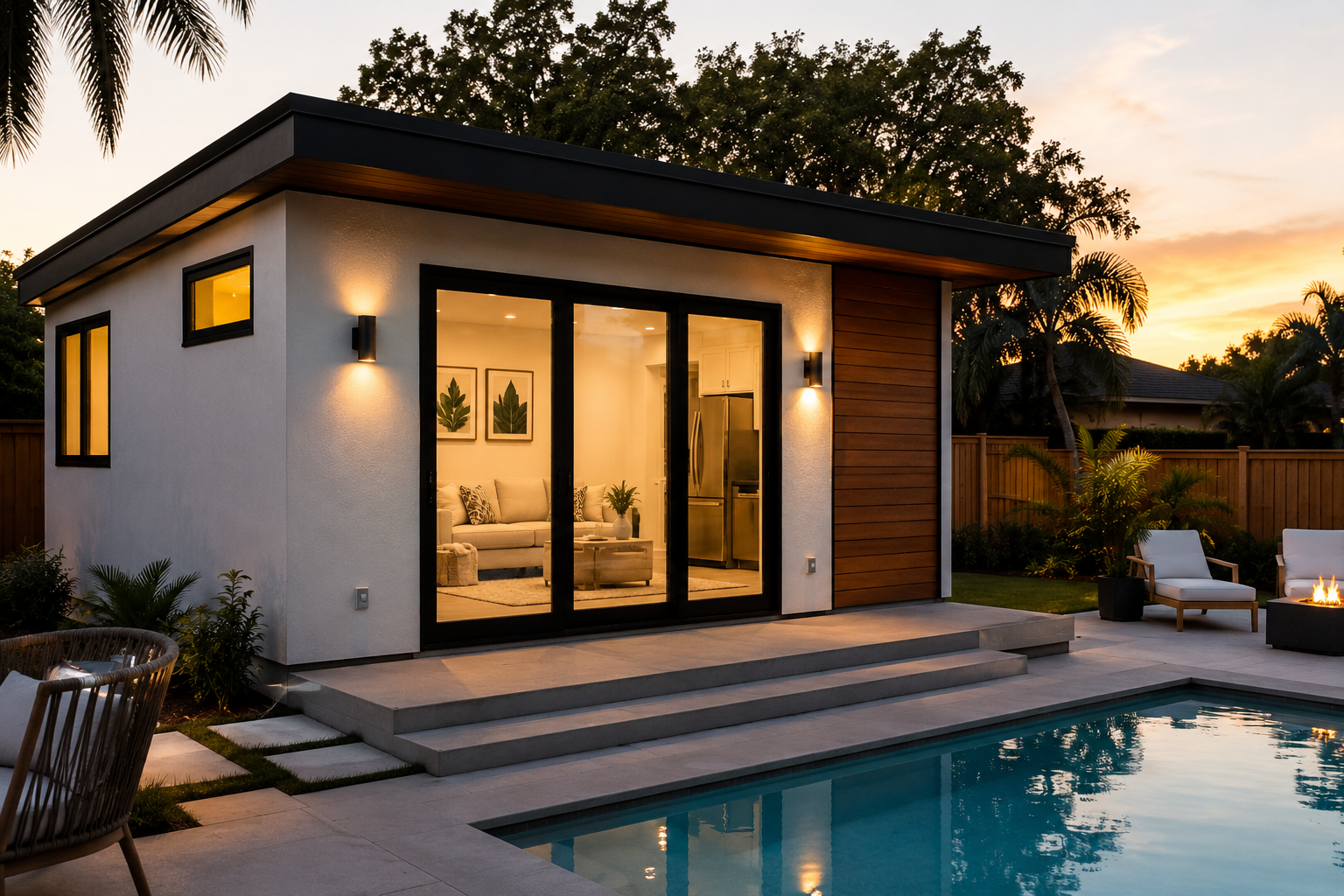
A Florida homeowner is seriously considering building an ADU, they’ve done some research on costs and timelines, and then someone — a neighbor, a family member, a financial-minded friend — asks the question that cuts to the heart of it: is this actually worth doing? Will it make your property more valuable, or are you just spending money on something that doesn’t pay back?
It’s a fair question, and it deserves a serious answer rather than the enthusiastic hand-waving that too much real estate content defaults to. So let’s actually work through it — the mechanisms by which ADUs create value, the data behind the numbers, what the return on investment picture looks like in 2026, and where the honest limits of these projections sit.
The short answer is yes, a well-built ADU almost always increases property value in Florida. But the more useful answer is understanding why that’s true, how much value it adds, and how that value materializes — because the specifics matter enormously for making a good investment decision.
Why an ADU Is Treated as Real Estate, Not a Temporary Structure
This distinction is more important than it might seem at first. Florida has a significant market in prefabricated structures, portable buildings, and temporary housing solutions that get placed on residential properties without going through the full permitting and construction process. These structures have their place, but they are not treated as real property by appraisers, lenders, or buyers. They don’t add to the appraised value of the parcel in any meaningful way, and they often create complications rather than value at sale time.
A block-built ADU constructed to the Florida Building Code and permitted through the local building department is a completely different category. It’s permanent construction on a slab foundation, built to the same structural and safety standards as the primary home, and it appraises as part of the real property. When an appraiser values a parcel that includes a permitted, code-compliant ADU, that ADU square footage and income potential are factored into the valuation methodology.
This is the foundation of the ADU value story in Florida, and it’s what separates a properly built ADU investment from alternatives that might look cheaper in the short run but don’t translate into lasting property value.
EcoLife Homes builds every ADU on block construction with slab foundations specifically because this approach produces a structure that performs well in Florida’s climate and qualifies as permanent real estate — contributing to the property’s appraised value from day one.
The Equity Boost: How ADUs Add Appraised Value
When an appraiser values a residential property, they’re typically using one or more of three approaches: the sales comparison approach (comparing the subject property to recent sales of similar properties), the income approach (capitalizing the income the property is capable of generating), and the cost approach (estimating what it would cost to replace the structure).
ADUs favorably affect all three of these approaches, though in different ways and to different degrees depending on the market and the property type.
The sales comparison approach benefits from buyer demand for properties with secondary units. In Florida’s current market, properties with permitted, income-producing ADUs routinely sell at premiums compared to otherwise similar properties without them. The premium varies by market — it’s more pronounced in areas with tight rental supply and strong investor demand — but the direction is consistently positive. Appraisers who are seeing this pattern in sales data incorporate it into their valuations of properties with ADUs.
The income approach is particularly relevant for ADUs because a secondary unit that generates documented rental income has a quantifiable value that can be directly capitalized. An ADU generating $2,000 per month in rent produces $24,000 in annual income. Applying a capitalization rate appropriate to the local market converts that income stream into a present value that contributes to the property’s overall appraisal. In markets where rental yields are strong and vacancy rates are low — conditions that describe much of Florida in 2026 — this income-based component of value is significant.
The cost approach adds value simply by reflecting what it would cost to build the ADU today. With construction costs at current levels, a well-built ADU represents real replacement value that gets included in the appraiser’s cost approach calculation.
The ROI Math: A Real Comparison
Abstract discussions of value are useful only up to a point. The more grounding question is: what does the return on investment actually look like for an ADU in Florida, and how does it compare to other ways of putting that capital to work?
Consider the following comparison, which reflects Florida real estate data from 2025 and 2026. A typical single-family home in Florida valued at $380,000 that rents for the market average of approximately $2,466 per month generates about $29,592 in annual gross rental income. That’s a gross yield of roughly 7.8% on the asset value — which is actually a respectable return by most investment standards, but it’s a return against a $380,000 asset.
Now consider an ADU built for $200,000 that rents for $2,000 per month. That generates $24,000 in annual gross income against a $200,000 construction investment — a gross yield of 12% on the capital invested. The ADU generates slightly less total income than the single-family home, but it does so on a significantly smaller capital base, producing a meaningfully higher return on the dollars actually spent.
This comparison captures something important about why ADUs work financially in Florida’s market. You’re not competing with a $380,000 single-family home — you’re adding a $200,000 income-producing asset to land you already own. The land cost is zero because you already own the lot. Every dollar of rental income the ADU generates is working against only the construction cost, not the total value of the land-plus-structure package.
For property owners who are sitting on appreciated Florida real estate, this dynamic is particularly compelling. You may own a lot that has become significantly more valuable over the years, but the lot itself doesn’t generate income. An ADU converts some of that dormant land value into an active income-producing asset without requiring you to sell the underlying property.
Rental Income in Florida’s Current Market
The rental market context matters enormously for evaluating ADU income projections, and Florida’s rental market in 2026 has characteristics that are broadly favorable for ADU investors.
Florida has experienced substantial population growth over the past several years, and that growth has created persistent demand for rental housing across many markets in the state. While the large-scale apartment construction that has come online in some markets has softened rents somewhat from the peak levels of 2022 and 2023, underlying demand remains strong in most Florida markets. Vacancy rates are low in established neighborhoods. Long-term rental demand is supported by a continuing influx of new residents. Short-term rental demand in markets with tourism or seasonal populations creates additional options for ADU owners in certain locations.
The $2,000 per month figure used in the comparison above reflects a realistic rent for a well-built, one-to-two bedroom ADU in a decent Florida location in 2026. In stronger markets — parts of South Florida, popular coastal communities, desirable urban neighborhoods — rents may be meaningfully higher. In smaller markets or more rural areas, they may be somewhat lower. But the general range is representative of what EcoLife Homes clients are achieving with their ADU rentals across Florida.
It’s worth noting that these are gross income figures — the income before expenses. A property owner managing an ADU also has to account for property taxes on the additional value, insurance, maintenance, occasional vacancy, and management costs if they’re using a property manager rather than self-managing. Net income after these expenses will be less than gross income. A reasonable assumption for ongoing expenses might be 20% to 30% of gross rents, leaving a net yield that’s still significantly stronger than most alternative investments but requires honest acknowledgment.
Buyer Demand: Why ADUs Change Who Wants Your Property
One of the most underappreciated aspects of ADU value in Florida is its effect on the pool of buyers who are interested in your property when you eventually sell. This matters more than many property owners realize.
A property without an ADU has a buyer pool that’s primarily owner-occupants who want to live in the primary home. The value to those buyers is almost entirely about the quality and size of the home and the desirability of the location. An investor looking at the same property sees a single-unit income property with a yield determined by the primary home’s rent — which is often not a compelling investment case.
A property with a permitted, income-producing ADU changes this calculation substantially. Owner-occupants who are also income-conscious — a large and growing segment of buyers in Florida’s market — see a property where the rental income from the ADU can offset a portion of the mortgage payment. In a market where affordability is genuinely challenging, the ability to live in a home while a tenant’s rent covers $1,500 to $2,000 per month of your housing cost is a meaningful differentiator. These buyers will often pay a premium for this feature because the financial benefit to them justifies it.
Investors see a different opportunity: a property with an established secondary unit and a documented rental history is a income-producing asset with characteristics they understand and can underwrite. Investor buyers often have more financing flexibility and a higher price ceiling than owner-occupants for the right asset.
Multigenerational families represent a third buyer segment that ADU properties attract particularly well. Florida has a large and growing population of families managing multigenerational living arrangements — adult children with their own households, elderly parents who want independence but need proximity. A property with a self-contained secondary unit perfectly addresses this need, and these buyers are often motivated and not particularly price-sensitive when they find a property that solves their problem.
The net effect of this expanded buyer pool is both a higher sale price and a faster sale when you’re ready to exit. Properties that appeal to multiple buyer segments simply perform better in any market condition.
The Appreciation Multiplier Effect
There’s another dimension to ADU value that’s less often discussed but compounds significantly over time: the appreciation multiplier effect.
When an ADU adds $150,000 to $200,000 in appraised value to a property, that value appreciates along with the underlying property. If Florida real estate in a given market appreciates at 4% annually — a modest assumption relative to recent history — that ADU value grows by $6,000 to $8,000 per year simply from appreciation, before a single dollar of rent is collected. Over a ten-year ownership period, the appreciation on the ADU value alone can be substantial.
This compounding effect is part of what makes ADU investment in Florida’s real estate market particularly attractive for property owners who have a medium to long-term horizon. The income it generates in year one is valuable. The income it generates in year seven, inflated by rental market appreciation, is more valuable. And the value it has added to the underlying asset over a decade of compound appreciation is significant by any measure.
Looking ahead to 2027 and beyond, the fundamental conditions that support ADU value appreciation in Florida — population growth, housing demand, rental market strength, land scarcity in established areas — show no signs of reversing. The long-term case for ADU investment in Florida is as strong in 2026 as it has been at any point in recent history.
What Affects How Much Value Your ADU Adds
Not all ADUs create equal value, and understanding what drives the variation helps you make better decisions about the project.
Quality of construction matters significantly. An ADU built with durable materials, proper Florida-specific construction methods, and finishes that will hold up over time adds more appraised value and commands higher rents than a cheaply built unit that shows its age quickly. The difference in construction cost between a well-built ADU and a cheaply built one is often smaller than the difference in the value and income they produce over time.
Design quality and livability affect both rental income and resale value. An ADU with a well-thought-out floor plan, adequate natural light, efficient use of space, and appealing finishes rents faster, rents for more, and appeals to more buyers than one that was designed as an afterthought. This is an area where working with experienced designers who have specifically thought about what makes a secondary unit function well in Florida’s lifestyle context produces a meaningful return.
Location within the property matters for tenant experience and therefore for rental income and resale value. An ADU with its own clearly defined outdoor space, private parking, and an entry that doesn’t feel like an awkward attachment to the main home’s front door is a more attractive rental than one that feels secondary in every sense of the word.
Permit status is non-negotiable for full value realization. An unpermitted ADU creates problems at sale time — lenders won’t lend on it, appraisers can’t fully credit it, and buyers who understand what they’re looking at will discount the price to account for the risk and cost of bringing it into compliance. Every ADU EcoLife Homes builds is fully permitted and code-compliant, specifically because the full value story only works with a properly permitted structure.
Timing the ADU Investment in 2026
The timing question comes up frequently, and it’s worth addressing directly. Should you build now, or wait to see how the market develops?
Construction costs have stabilized considerably from the peak escalation period of 2021 and 2022. The supply chain disruptions that drove materials costs sharply higher have largely resolved, and labor costs, while still elevated relative to pre-pandemic levels, have settled into a more predictable range. There’s no compelling evidence that waiting for a significant construction cost reduction is a productive strategy — and there’s meaningful cost to delay in the form of rental income foregone during a period of strong rental demand.
On the income side, Florida’s rental market continues to perform well across most markets heading into 2026. Waiting for a better rental market is not a persuasive argument in an environment where well-located, well-built ADUs are already producing the kind of yields the comparison above illustrates.
The strongest argument for moving forward in 2026 rather than deferring to 2027 is simply the time value of the income stream. Every month a completed ADU would have been generating rent is a month of income that can’t be recovered. For a unit generating $2,000 per month, that’s $24,000 per year of income that doesn’t exist until the project is done. Starting the process earlier means the income starts earlier, the appreciation clock starts earlier, and the property value is enhanced earlier.
The EcoLife Homes Approach to ADU Value
The team at EcoLife Homes thinks about ADU projects from an investment perspective because that’s how Florida property owners should think about them. The construction cost matters, the rental income matters, the appraised value addition matters, and the long-term appreciation matters — and all of these need to be discussed honestly rather than inflated to close a sale.
What the honest picture shows is compelling: a well-built ADU in Florida in 2026 generates returns that compare favorably to most investment alternatives, adds meaningful appraised value to the underlying property, broadens the buyer pool at sale time, and provides the flexibility for multigenerational living arrangements that an increasing number of Florida families need.
The ROI comparison — 12% gross yield on ADU construction cost versus 7.8% on a single-family home purchase — isn’t a marketing exaggeration. It’s arithmetic applied to realistic market conditions. And the arithmetic holds up under scrutiny, which is the standard any good investment case has to meet.
If you’re a Florida property owner who has been on the fence about an ADU project, the value case in 2026 is as strong as it has been. The question isn’t really whether an ADU adds value — it does, and the evidence is clear. The question is what the right ADU looks like for your specific property, your specific goals, and your specific market.
That’s a conversation worth having, and it’s one EcoLife Homes is equipped to have with property owners across Florida, from the initial ROI analysis through the finished, rented unit.
Curious what an ADU could add to your Florida property’s value and income? EcoLife Homes offers a free consultation that includes a realistic ROI projection, rental income estimate, and appraised value analysis specific to your property. See the real numbers before you decide.