What’s Included in a Park Model Home?

One of the most common points of confusion for first-time park model buyers is figuring out exactly what they’re getting for their money. The purchase price sounds straightforward — until you start asking questions and realize that “what’s included” varies considerably from one manufacturer to the next, that some features you’d assume are standard are actually upgrades, and that the gap between a fully outfitted unit and a base-price unit can involve a long list of decisions that nobody warns you about upfront.
This piece gives you a clear picture of what quality park models typically include as standard features, what’s commonly offered as an upgrade, and what you’ll need to source separately regardless of what you buy. It’s written with Florida buyers in mind, because the climate and usage patterns here create specific expectations around insulation, HVAC, and outdoor living that don’t apply the same way in other markets.
Understanding this before you sit down with a manufacturer or a sales rep puts you in a much stronger position — you’ll know which questions to ask, you’ll recognize when a “standard” feature at one builder is a paid upgrade at another, and you’ll be able to do a genuine apples-to-apples comparison across the options you’re evaluating.
The Structural Shell: What’s Always Included
Every park model, regardless of manufacturer or price tier, arrives built on a steel trailer chassis with a completed exterior shell. That much is the baseline. What varies is what that shell is made of and how well it performs.
The chassis is the steel frame and running gear that the unit travels on. It includes the hitch coupler, the axles, the wheels, and the structural steel that forms the foundation of the floor system above. In a quality unit, the chassis steel is properly gauged for the unit’s weight and finished with a corrosion-resistant coating system. In entry-level units, the specifications are often lighter and the coating less robust — a difference that matters more in Florida’s humidity than it would in a drier climate.
Above the chassis, the floor system typically consists of engineered wood joists, a plywood or OSB subfloor, and whatever flooring finish material is selected. The walls are framed with wood or metal studs, sheathed, and finished with exterior cladding. The roof is framed with trusses, sheathed, and covered with either asphalt shingles or metal roofing. All of this is structural — it comes with every unit — but the quality of the materials and the care of the installation vary in ways that affect long-term performance.
What you’re evaluating in this category isn’t just whether the components are present but whether they’re the right components for Florida’s specific environment: the insulation system’s suitability for Florida’s heat and humidity, the exterior cladding’s resistance to UV degradation and moisture, and the roofing material’s durability under Florida’s sun and storm conditions. These are questions worth asking explicitly rather than assuming the defaults are appropriate for where you’re placing the unit.
Insulation: The Feature That Matters Most and Gets Discussed Least
Insulation doesn’t photograph well and it doesn’t come up naturally in a showroom conversation, which is exactly why buyers who don’t ask about it specifically often don’t get the information they need until they’re living with the consequences.
Most park model manufacturers include some form of wall, roof, and floor insulation as standard. What varies enormously is the type, the depth, and the quality of installation — all of which directly affect both comfort and energy costs in a Florida climate.
Entry-level manufacturers typically use fiberglass batt insulation — the pink or yellow rolls that most people recognize from hardware stores. Batt insulation, when installed carefully with no gaps or compression, provides adequate performance. When installed quickly by production crews working on volume timelines, it accumulates the voids and imperfect fits that reduce its effective performance and create pathways for moisture infiltration. In Florida’s climate, where moisture management is critical to long-term building health, those installation quality issues matter.
Quality manufacturers — and this is the standard EcoLife Homes builds to — use closed-cell spray foam insulation in the walls, roof cavity, and floor system. Spray foam fills irregular cavities completely, creates both a thermal barrier and an air and moisture barrier in a single application, and adds structural rigidity to the wall assembly. In Florida’s climate specifically, the difference in both comfort and energy efficiency between a well-spray-foamed unit and a batt-insulated unit is not subtle. Ask any manufacturer you’re evaluating exactly what insulation system they use and where. The answer tells you a great deal about their priorities.
HVAC: What’s Included and What to Look For
Air conditioning is not optional in Florida, and every park model sold in this market includes some form of HVAC system as standard. What varies is the type, the brand, and the sizing.
The current standard for quality park models in Florida is a mini-split system — a ductless heat pump that provides both cooling and heating through wall-mounted air handlers connected to an exterior compressor. Mini-splits are significantly more energy-efficient than older window unit or packaged terminal approaches, they provide better humidity control, they operate more quietly, and they allow precise temperature management in different zones of the unit if multiple air handlers are installed.
When evaluating what’s included, ask specifically about the brand of the mini-split equipment. There is a meaningful difference between units from established manufacturers — Mitsubishi, Daikin, LG, Fujitsu — and generic or lower-tier brands. Established brands have demonstrated reliability, available parts, and service networks built over decades. The HVAC system is something you’ll run almost every day in Florida for the life of the unit, and the brand decision matters over a fifteen to twenty year ownership horizon.
Also ask about sizing — whether the system is properly sized for the specific floor plan you’re purchasing. An undersized system will run constantly and still fail to maintain comfortable temperatures during Florida’s hottest months. An oversized system will short-cycle, which reduces its ability to dehumidify properly — a real problem in Florida’s humid environment. Proper sizing is a technical calculation based on the unit’s insulation values, window area, and climate zone. Quality manufacturers do this calculation. Others size by rule of thumb and hope for the best.
Kitchen: Standard vs. Upgrade Features
The kitchen is the feature that most buyers spend the most time evaluating visually, and it’s also the area where the gap between standard inclusions and what you actually want is most likely to require careful navigation.
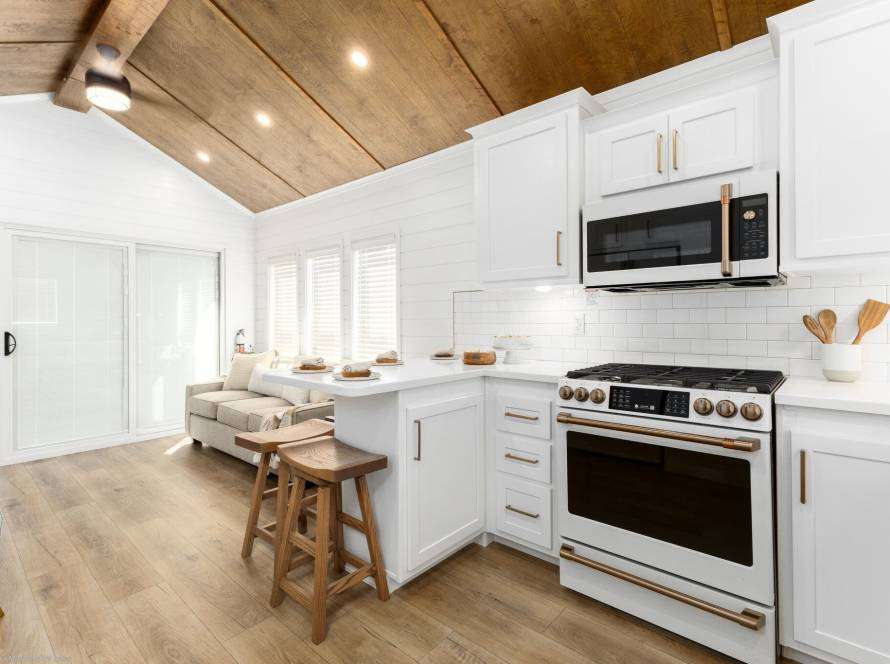
Standard kitchen inclusions in most mid-range and above park models include a full-size or apartment-size refrigerator, a range or cooktop with oven, a built-in microwave, a kitchen sink with faucet, and base and upper cabinetry. The question is the quality level of each of those components and whether the layout works for how you actually cook.
Refrigerator size is one of the more meaningful practical considerations. Some park model floor plans include a full-size refrigerator (18 to 22 cubic feet) while others are designed around an apartment-size unit (12 to 16 cubic feet). For occasional vacation use, the smaller unit may be adequate. For full-time living or for a rental property where you want guests to feel comfortable, the full-size option matters.
Countertop material is often a standard vs. upgrade decision. Laminate countertops are common at standard specification. Quartz or solid surface countertops are typically an upgrade — and a worthwhile one, both for aesthetics and for durability in a space where the kitchen is a focal point rather than a peripheral room. For rental properties specifically, quartz countertops show up in listing photographs in a way that laminate doesn’t, and that visibility directly affects booking performance.
Cabinetry quality varies significantly across the market. Stock cabinets with basic hardware are the standard entry point. Semi-custom cabinetry with soft-close hinges and drawer glides is a common upgrade that makes a meaningful difference in the feel of daily use. In a small kitchen where every cabinet gets opened and closed many times per day, the quality of the hardware is something you notice constantly.
Dishwashers are included as standard in some floor plans and are an optional upgrade in others — worth clarifying early if it matters to you. Garbage disposals are similarly variable. Pantry storage configuration is worth asking about specifically, because the difference between a floor plan with generous pantry space and one without it becomes apparent quickly in full-time living.
Bathroom: What to Expect and What to Ask About
Park model bathrooms are compact by design, but quality manufacturers make those compact spaces function well through thoughtful fixture selection and layout decisions.
Standard bathroom inclusions in most quality park models include a toilet, a vanity with sink and faucet, a shower or shower/tub combination, and a medicine cabinet or mirror. The shower configuration is worth examining carefully — both the size of the shower footprint and the quality of the shower surround material. Acrylic or fiberglass surrounds are standard and perform well. Tile surrounds are typically an upgrade and require more maintenance but offer a higher-end appearance that works well in rental applications.
Water heater type is an important specification that’s often buried in the fine print. Traditional tank water heaters are standard in many units — they’re less expensive upfront but have a shorter service life in Florida’s conditions and use more energy than alternatives. Tankless (on-demand) water heaters are increasingly offered as standard in quality park models and are a meaningful upgrade in terms of both energy efficiency and longevity. Tankless units produce hot water continuously without the tank’s recovery time, which matters in full-time living and in rental situations where guests may arrive after a long drive and want a hot shower immediately.
Exhaust ventilation in the bathroom is a specification detail that affects moisture management — particularly important in Florida’s humid climate. Proper bathroom exhaust ventilation prevents the moisture accumulation that leads to mold and finishes deterioration over time. Quality manufacturers specify and install adequate ventilation as a standard feature. Others treat it as an afterthought.
Electrical and Plumbing Systems
These systems are standard inclusions in every park model — you’re not buying them à la carte — but their specifications vary in ways that matter.
Electrical systems in park models are built to connect to standard 30-amp or 50-amp service, the same service standards used in RV parks and campgrounds. Most Florida land-lease communities provide 50-amp service as standard. The wiring within the unit should be copper conductors, properly sized circuit breakers, and GFCI protection in appropriate locations. These are code requirements, not optional features, but verifying that the work was done correctly — particularly in units from manufacturers with less rigorous quality control — is worth the attention.
USB outlets and modern electrical conveniences are standard in current-year builds from quality manufacturers and reflect the reality of how people actually live with their devices. Older units or entry-level manufacturers may not include these features and would require aftermarket additions.
Plumbing systems in quality park models use PEX tubing for supply lines — a flexible, durable, corrosion-resistant material that is the current industry standard for good reason. Drain lines are PVC. All supply lines should be insulated against temperature extremes, which matters less in Florida’s warm climate than in northern markets but is still good practice. The water heater connection, the washing machine hookup provision (if included), and the outdoor hose bib configuration are all worth confirming against your specific usage plans.
Windows and Doors: More Important Than They Look
Windows and doors affect three things simultaneously: comfort, energy efficiency, and aesthetic quality. They’re also an area where the gap between standard specifications and better-performing alternatives is meaningful in Florida’s climate.
Standard windows in mid-range park models are typically single-pane or basic double-pane vinyl units. Double-pane windows with low-E glass coatings significantly reduce solar heat gain — a meaningful efficiency benefit in Florida’s intense sun — and are worth specifying if they’re not standard in the unit you’re evaluating. The difference in cooling costs over a decade of Florida ownership is not trivial.
Window sizing and placement affect both natural light and cross-ventilation. Quality manufacturers design window placement to take advantage of Florida’s breezes when windows are open and to control solar gain when they’re not. Larger windows on north-facing elevations and carefully managed window area on west-facing walls (where afternoon sun is most intense) are design decisions that experienced Florida-oriented manufacturers build into their floor plans. Generic manufacturers use window placement that looks good in a showroom without necessarily performing well in the field.
Exterior doors should be solid-core or insulated — not hollow-core — for both security and thermal performance. Door hardware quality, including locks and weatherstripping, affects both security and the long-term seal integrity that keeps Florida’s heat and humidity where they belong: outside.
What’s Typically Not Included
Understanding what park models don’t include as standard is as important as understanding what they do, because the list of items you’ll need to source separately can represent significant additional cost if you haven’t planned for it.
Furniture and Furnishings
With very rare exceptions, park models are delivered unfurnished. The unit includes built-in cabinetry, fixed bathroom fixtures, and appliances — but not sofas, beds, dining tables, chairs, bedding, window treatments, or any of the movable items that make a space livable. Budget $6,000 to $15,000 for a functional owner-occupied setup and $10,000 to $18,000 for a short-term rental setup where presentation quality drives revenue.
Outdoor Structures
Porches, decks, screen enclosures, and carports are almost universally not included in the base unit price and are either purchased as add-ons from the manufacturer or sourced separately after delivery. In Florida, a covered porch or screened lanai is not a luxury — it’s a functional extension of the living space that makes full-time or part-time living dramatically more comfortable for most of the year. Budget this separately and plan the outdoor space as intentionally as the interior.
Skirting
The gap between the unit’s floor system and the ground needs to be enclosed with skirting — both for aesthetics and to protect the underside of the unit from moisture, pests, and debris accumulation. Some manufacturers offer skirting as a package; others leave it to the buyer. Vinyl skirting is the most common and cost-effective option in Florida, typically running $1,500 to $3,500 installed depending on the perimeter dimension.
Steps and Entry Structures
The unit arrives on a trailer chassis at a height above grade that requires steps or a ramp for entry. Landing steps — typically a simple stair structure at the entry door — may or may not be included depending on the manufacturer. Verify this before delivery and have it resolved before move-in day.
Site Utilities
Water, sewer, electrical, and any cable or internet connections are not part of the unit itself. In established communities, utility hookups are the buyer’s or the community’s responsibility depending on what the lot lease covers. On private land, utility development is entirely the buyer’s project and cost.
The EcoLife Homes Standard Approach
At EcoLife Homes, the conversation about what’s included starts differently than it does at manufacturers who lead with a base price and work up from there. We build with a standard specification that reflects what Florida buyers actually need — closed-cell spray foam insulation, quality HVAC equipment from established brands, full-size appliances, quartz countertops, LVP flooring, solid cabinetry with soft-close hardware — and then have an honest conversation about what customization looks like from that starting point.
The goal isn’t to get you into a unit that looks good in a showroom and then reveal the cost of making it livable. It’s to show you what a genuinely finished, ready-to-live-in park model costs, so that the number you’re planning around is the number that reflects reality.
That approach takes a little longer in the early stages of the conversation. But it produces buyers who move into their units without unpleasant surprises — which is exactly how a good purchase experience should work.
If you want to walk through a specific floor plan and understand exactly what comes standard, what’s available as an upgrade, and what you’ll need to add after delivery, that conversation is one we’re glad to have at any point in your research process. In 2026 and 2027, with more buyers than ever exploring the park model category for the first time, getting clear on what’s actually included is one of the most valuable things you can do before you make any commitments.