Are Park Model Homes Energy Efficient?
The energy efficiency question comes from two different places depending on who’s asking. Some people want to know about monthly utility costs — how much will it actually cost to run this thing, specifically in Florida’s heat. Others are asking from a values standpoint — they care about environmental impact, carbon footprint, and whether choosing a smaller home is a meaningfully better choice from a sustainability perspective.
Both questions deserve real answers, and the good news is that those answers point in the same direction. A well-built park model in Florida, operated thoughtfully, is genuinely energy-efficient by almost any measure — cheaper to run than a traditional home, considerably lower in its lifetime carbon footprint, and capable of being upgraded to near-zero operating energy with solar and battery systems that pencil out reasonably well in Florida’s solar-rich environment.
The caveats are real too. Not every park model is well-insulated. Not every installation takes full advantage of the passive efficiency opportunities that Florida’s climate offers. And the efficiency of any structure depends partly on how it’s operated, not just how it’s built. Understanding the full picture — what drives efficiency in a park model, what the Florida-specific factors are, and what buyers should look for when evaluating a unit — is what this piece delivers.
Why Small Homes Are Inherently More Efficient
Before getting into park model specifics, the baseline math is worth stating plainly. Energy use in a home is fundamentally a function of the volume of conditioned space — the air that needs to be heated, cooled, and dehumidified — and the surface area of the building envelope through which energy is lost or gained. A smaller home conditions less air and has less envelope area than a larger one, all else being equal.
A 380-square-foot park model with 9-foot ceilings encloses roughly 3,400 cubic feet of conditioned air. A 2,000-square-foot conventional home with 9-foot ceilings encloses approximately 18,000 cubic feet. The park model’s HVAC system is managing roughly one-fifth the air volume — and doing so with a modern, highly efficient mini-split system rather than the older central air equipment that’s common in much of Florida’s existing housing stock.
The surface area comparison runs similarly. A park model’s roof, walls, and floor — through which solar heat gain and thermal transfer occur — are a fraction of those in a conventional home. Even with identical insulation values, the smaller envelope means less total energy transfer in or out of the conditioned space per hour, per day, and per year.
This is the structural efficiency advantage of small-home living, and it doesn’t depend on any particular technology or building technique. It comes from the physics of scale, and it’s one of the most honest arguments for the park model lifestyle that can be made.
Insulation: Where the Efficiency Spread Is Widest
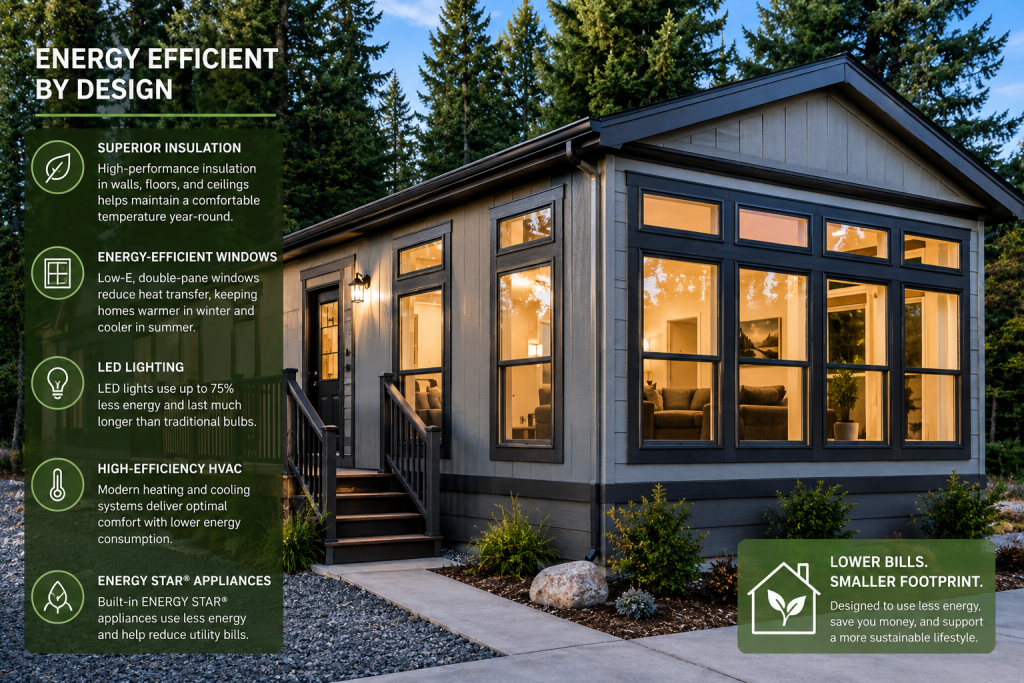
Within the park model category, insulation quality is the variable that most determines how efficiently a unit actually operates in Florida’s climate. Two park models of identical size, identical floor plans, and identical HVAC systems can have meaningfully different monthly utility costs based solely on the insulation system used in their construction.
Florida’s climate creates a specific insulation challenge that differs from northern markets. The primary energy load in Florida is cooling — managing heat gain from outside and from solar radiation — rather than heating. This means that the insulation system needs to be particularly effective at resisting heat gain through the roof (which receives direct solar radiation for much of the day) and through west-facing walls (which receive intense afternoon sun for much of the year). Moisture management is equally critical: Florida’s high outdoor humidity means that a building envelope that allows moisture infiltration creates both energy loss and the conditions for mold growth.
Closed-cell spray foam insulation addresses both requirements more effectively than any alternative at comparable cost. Applied to the walls, roof cavity, and floor system of a park model, it creates a continuous thermal and air barrier that eliminates the gaps and voids that diminish the effective performance of batt insulation. Its moisture-resistance properties prevent the vapor drive that Florida’s climate creates. And its R-value per inch — typically R-6 to R-7 per inch for closed-cell foam, compared to R-3.5 per inch for fiberglass batt — means that the insulation achieves higher thermal resistance in the constrained wall thickness of a park model than alternative products can provide.
The practical difference shows up in utility bills. A park model insulated with closed-cell spray foam throughout can achieve monthly electricity costs of $70 to $110 during Florida’s summer cooling season under normal occupancy. A comparable unit insulated with fiberglass batt — particularly if that insulation was installed quickly during production with the gaps and compression that hurried installation creates — might run $130 to $180 per month for the same occupancy and thermostat settings.
Over a ten-year ownership period, the difference in insulation quality translates to several thousand dollars in utility cost differential. For buyers who ask why a park model from a quality manufacturer costs more than a comparable unit from a volume producer, the insulation specification is often a significant part of the answer — and the long-term cost calculation often makes the quality unit the better financial choice even before accounting for its other advantages.
HVAC Systems and Efficiency Ratings
The mini-split HVAC systems that have become the standard for quality park models in Florida are among the most efficient refrigerant-based cooling and heating systems available. Their efficiency advantage over conventional central air systems stems from two primary factors: the elimination of duct losses and the use of variable-speed compressor technology.
Central air systems distribute cooled or heated air through ductwork — and that ductwork, even when properly insulated and sealed, loses energy through thermal transfer with the surrounding space. Estimates of duct system energy losses in conventional homes typically run 20% to 30% of total HVAC energy consumption — energy that’s paid for but never actually conditions the living space. Mini-splits have no ductwork. Every unit of cooling or heating energy produced goes directly into the conditioned space.
Variable-speed compressors — the technology that gives modern mini-splits their efficiency advantage — allow the system to modulate its output to match the actual cooling or heating load at any given moment rather than cycling on at full capacity and off repeatedly. In Florida’s climate, where the cooling load varies significantly between a sunny afternoon and a cloudy morning, variable-speed operation keeps the system running efficiently across the full range of conditions rather than overshooting and cycling off repeatedly in a pattern that wastes energy and creates temperature swings.
The efficiency of a mini-split is expressed as its SEER (Seasonal Energy Efficiency Ratio) for cooling and HSPF (Heating Seasonal Performance Factor) for heating. Quality mini-split systems installed in park models in 2026 from manufacturers like Mitsubishi, Daikin, and LG typically carry SEER ratings of 18 to 30 — significantly higher than the minimum federal standard of 15 SEER for new equipment and well above the SEER ratings common in Florida’s existing conventional central air housing stock.
The practical meaning of those SEER numbers: a 24-SEER mini-split uses roughly 60% as much electricity to produce the same amount of cooling as a 15-SEER conventional system. For a park model that runs its cooling system for eight months of the year, that efficiency differential translates to meaningful annual utility savings.
Windows and Solar Heat Gain in Florida
Windows are the point of the building envelope where the most energy can enter in the form of solar heat gain — particularly significant in Florida, where sunshine is abundant and intense for much of the year. A south-facing window allows passive winter warming — generally not what Florida residents are prioritizing — but also admits significant solar heat during summer if not managed with overhangs, shading, or low-solar-gain glass.
The key specification for windows in a Florida-climate park model is Solar Heat Gain Coefficient (SHGC) — a number between 0 and 1 that measures how much solar radiation a window admits into the conditioned space. Lower SHGC values mean less solar heat gain. For Florida’s cooling-dominated climate, the Department of Energy recommends windows with SHGC values of 0.25 or lower for maximum cooling efficiency.
Quality park model manufacturers specify windows with appropriate SHGC ratings for Florida conditions. Entry-level manufacturers often use windows with higher SHGC values — less expensive to purchase but more expensive to operate in Florida’s climate — that admit more solar heat and increase cooling loads proportionally.
Beyond SHGC, double-pane windows with low-emissivity (low-E) coatings provide significantly better thermal insulation than single-pane alternatives, reducing both heat gain in summer and heat loss on Florida’s occasional cool winter nights. The U-factor of the window assembly — its overall thermal conductance — works alongside SHGC to determine the complete energy performance of the glazing. Quality windows in Florida park model applications should have U-factors of 0.30 or lower and SHGC values of 0.25 or lower for optimal performance.
Orientation and Passive Efficiency Opportunities
Where and how a park model is positioned on its site affects its energy performance in ways that are easy to optimize and frequently overlooked. Florida’s solar geometry — the path the sun takes across the sky at this latitude — creates specific opportunities for passive efficiency that cost nothing to take advantage of and that compound over years of ownership.
A park model oriented with its long axis running east-west, with minimal window area on the west-facing wall, minimizes afternoon solar heat gain — the most intense and sustained heat load that Florida’s sun delivers. The west wall of a park model that faces full afternoon sun accumulates heat through the afternoon in a way that drives up cooling loads during the early evening hours when occupants typically want the interior to be comfortable.
Shade from trees — particularly on the west and southwest exposures — is one of the most effective and free energy-efficiency tools available for Florida park model placements. Mature trees providing shade to the roof and west wall of a park model can reduce cooling energy consumption by 15% to 25% compared to an unshaded placement in full sun. For buyers choosing a community site, requesting a site with existing tree canopy over the unit’s western exposure is worth doing explicitly rather than accepting whatever site is offered.
Extended roof overhangs on the south and east exposures shade the wall surface and windows during summer when the sun is high, while allowing winter sun to reach the wall surface when the sun is lower. Park models designed with extended overhangs built into the roofline take advantage of this geometry automatically.
Water Heating Efficiency
Water heating accounts for a meaningful portion of residential energy consumption — typically 15% to 20% of total home energy use — and the water heater type in a park model directly affects both monthly costs and the unit’s overall energy performance.
Tankless water heaters — also called on-demand or instantaneous water heaters — have become the preferred specification in quality park models for several efficiency-related reasons. Unlike tank water heaters that maintain a stored volume of hot water at temperature continuously — using energy even when no hot water is being used — tankless units heat water only when it’s called for. This eliminates the standby heat loss that makes tank water heaters less efficient in actual use than their rated efficiency suggests.
In Florida’s climate, where the incoming water temperature from the supply is relatively warm year-round compared to northern markets, tankless water heaters operate particularly efficiently — they’re raising water from a starting temperature of 70°F or above rather than from 50°F or below as they would in a cold-climate installation. This reduces the energy required per gallon of hot water delivered and extends the comfort range within which a given tankless unit can serve an occupant’s hot water needs.
Electric tankless units are the most common specification in park models connecting to shore power or grid electricity. Propane tankless units are an alternative where propane service is available, and they can provide hot water during electrical outages — relevant in Florida’s storm-active environment.
Solar Power and the Path to Near-Zero Operating Energy
Florida’s solar resource is exceptional. The state consistently ranks among the top three in the nation for solar energy potential, and the combination of high annual sunshine hours, falling solar equipment costs, federal tax incentives, and Florida’s net metering policies has made solar ownership financially rational for a broad range of park model owners in 2026 and 2027.
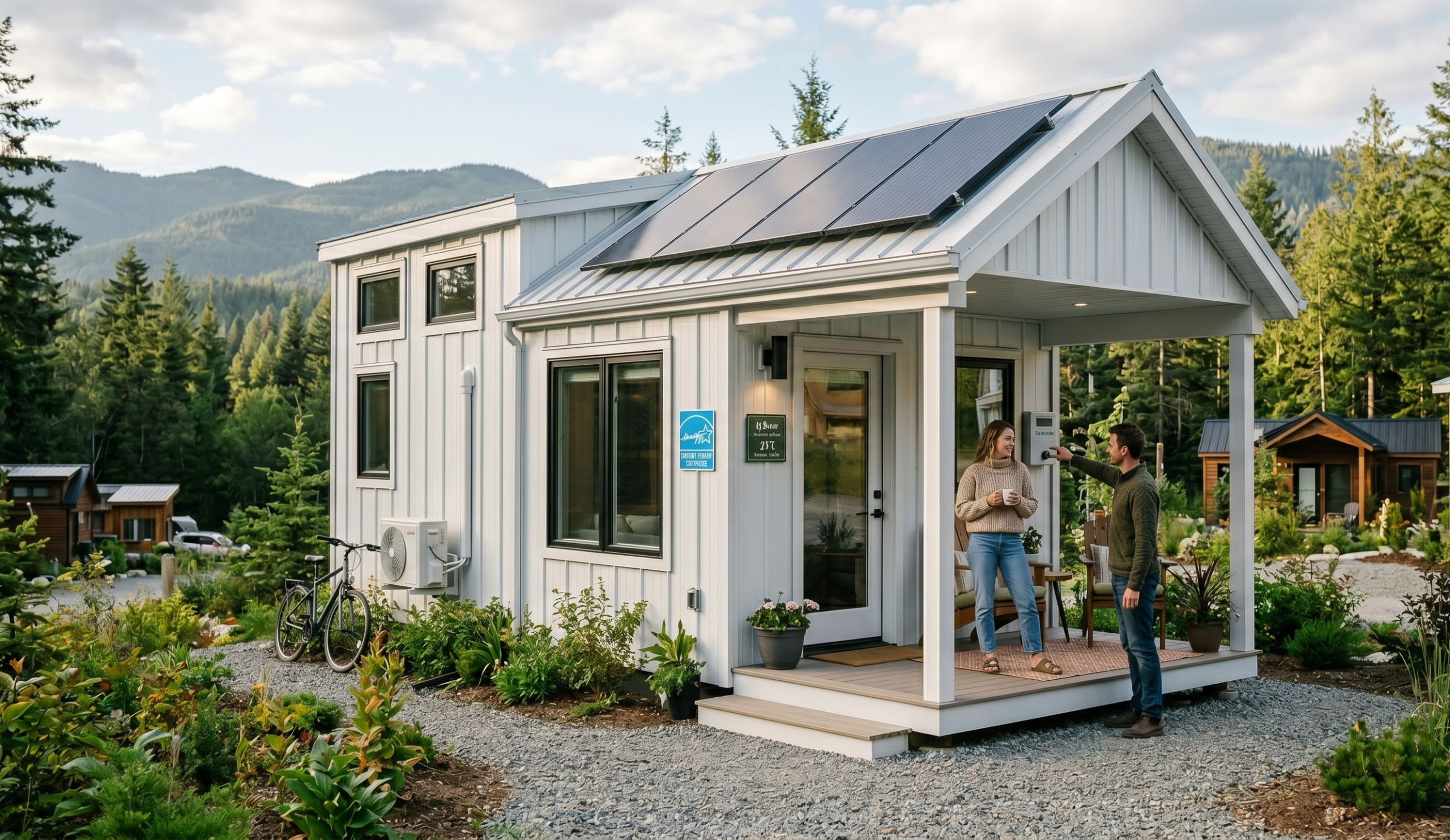
A properly sized solar system on a park model can offset the majority of the unit’s electricity consumption — in some configurations, covering 80% to 100% of annual electrical use. Adding battery storage to a solar system creates resilience against grid outages that in Florida’s hurricane environment is a genuinely valuable capability, not just a theoretical one.
The economics have improved significantly from where they were five years ago. Federal Investment Tax Credit (ITC) provisions allow a 30% credit against the cost of solar installation for qualifying taxpayers. Equipment costs have declined substantially. The combination of lower upfront cost, tax incentives, and rising utility rates in Florida has shortened payback periods to the range of 6 to 10 years for well-designed systems on park models — a time horizon that makes financial sense for buyers who expect to occupy the unit for a decade or more.
A solar system appropriate for a mid-range park model in Florida — sized to cover most electrical consumption including HVAC — typically involves 8 to 16 solar panels (24 to 48 kW of capacity) and a grid-tied inverter. With battery storage, the system adds a storage unit of 10 to 20 kWh capacity. All-in costs before tax credits run $12,000 to $24,000 for a system of this scale, with the 30% federal credit reducing the net cost to $8,400 to $16,800 for qualifying buyers.
For short-term rental investors in particular, solar makes strong business sense. A rental property with solar eliminates or dramatically reduces the utility cost that otherwise flows through as an operating expense, directly improving net operating income. The system is a depreciable business asset, and MACRS accelerated depreciation further improves the tax treatment for qualified business owners.
The Sustainability Dimension Beyond Energy Bills
The environmental case for park models extends beyond operating energy to encompass the full lifecycle of the structure — materials used in construction, the land footprint of the dwelling, and the carbon implications of the lifestyle choices that park model living typically supports.
Factory construction is inherently more materials-efficient than site-built construction. A factory production environment allows precise material cutting that minimizes waste, enables just-in-time material delivery that eliminates jobsite spoilage, and allows the reuse of offcuts and material remnants across multiple units in ways that aren’t practical in site-built construction. Studies of factory-built versus site-built construction consistently find lower material waste — sometimes 50% or more reduction in construction waste — in the factory setting.
The land footprint of a park model is dramatically smaller than a conventional home. A 380-square-foot park model with a 200-square-foot porch occupies less than 600 square feet of land — compared to the 2,000-plus square feet that a conventional home of average size occupies, plus the associated driveway, lawn, and landscaping that accompanies it. At a time when land preservation and habitat protection are increasingly recognized as environmental priorities, the reduced land consumption of small-home living carries genuine ecological value.
The lifestyle patterns associated with park model living — particularly in community settings — tend toward lower overall consumption: smaller spaces require fewer possessions, community amenities reduce the need for individual ownership of everything from pools to fitness equipment to outdoor tools, and the financial flexibility that lower housing costs provide can support more deliberate purchasing decisions. None of this is automatic, but the structural conditions that park model living creates are more conducive to lower-consumption lifestyles than those of conventional suburban homeownership.
What to Look for When Evaluating Energy Efficiency in a Park Model
For buyers who want to make an informed efficiency comparison across the park models they’re considering, a short list of specific questions produces the most useful information:
What insulation type and R-value does the manufacturer use in the walls, roof cavity, and floor? Closed-cell spray foam with R-values of R-21 or higher in walls and R-30 or higher in roof cavities indicates a serious commitment to thermal performance.
What SEER rating does the installed HVAC equipment carry, and what brand? SEER 18 or above from an established manufacturer is the quality threshold. Below SEER 15 from a no-name brand is a red flag.
What are the window SHGC and U-factor ratings? For Florida, SHGC 0.25 or below and U-factor 0.30 or below are the targets.
Is solar pre-wiring or conduit included in the electrical system? Manufacturers who anticipate that buyers will want to add solar are positioned for it from the beginning — conduit runs, appropriately sized electrical panels, and roof mounting points that don’t require retrofitting.
What does monthly utility cost look like for actual owners of this floor plan in Florida? Owner experience data is the most reliable efficiency indicator available, and manufacturers confident in their product’s performance will point you toward owners you can ask directly.
EcoLife Homes builds to the standards that the answers to those questions should reflect — not as a marketing claim but as a measurable specification that we’re comfortable putting in writing and that our owners’ utility bills confirm over time. If energy efficiency is a priority in your park model decision — whether for cost, values, or both — it’s a conversation worth having in detail before you choose a manufacturer or a unit.