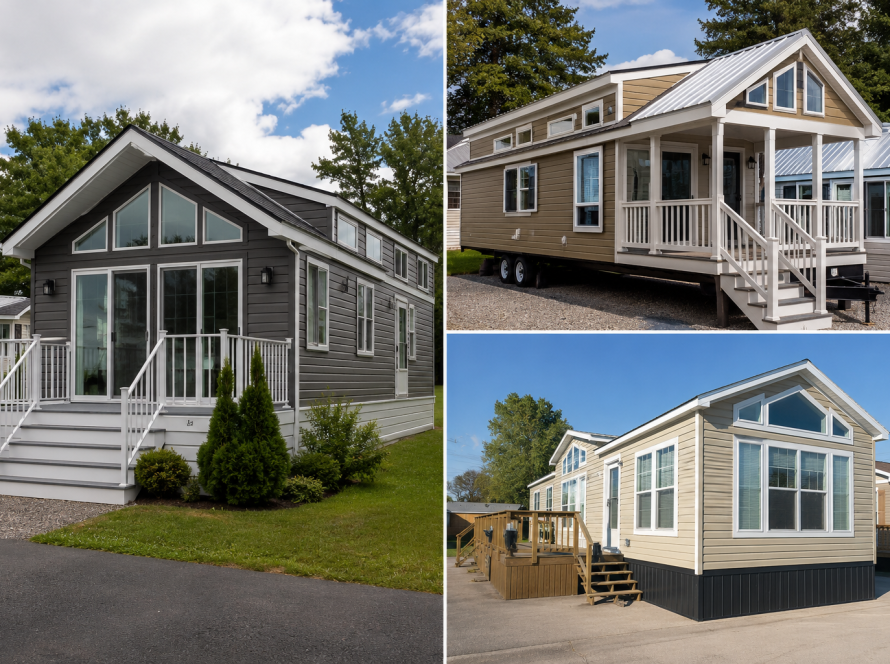
Park Model Tiny House
Park Model Tiny House: The Smarter Housing Decision Nobody Is Talking About Enough
Something interesting is happening in Florida’s housing market, and it has nothing to do with luxury condos, bidding wars, or the latest downtown high-rise development. It’s happening in quiet resort communities, on the edges of oak-shaded campgrounds, beside lakes nobody made famous, and in neighborhoods so unhurried they feel like a different country from the rest of America.
People are choosing to live smaller — not because they have to, but because they’ve done the math, looked honestly at how they actually spend their time, and concluded that a park model tiny house in Florida makes more sense than almost anything else available to them right now.
This isn’t a fringe movement anymore. It’s a deliberate lifestyle choice backed by real numbers, and the families, retirees, and investors embracing it are some of the most financially clear-eyed people in the state. If you’ve been curious about what a park model tiny house really is, whether Florida is the right place for one, and how to go about finding yours, this guide covers it all — including why builders like ecolifehomes.com are setting a new standard for what this category of home can look and feel like.
The Honest Definition Nobody Gives You
A park model tiny house sits at an interesting intersection. It’s not quite a traditional tiny home on wheels, not quite an RV, and not quite a conventional manufactured home. It exists in its own category — and that category happens to be ideally suited to Florida’s regulatory framework, climate, and community infrastructure.
Technically, a park model tiny house is a factory-built dwelling constructed on a permanent steel chassis, certified to the ANSI A119.5 standard, and classified as a recreational vehicle. In most of the country, these homes are capped at 400 square feet of living space. In Florida, a special HUD Park Model designation extends that ceiling to 499 square feet — a detail that matters more than it sounds when you’re designing a full kitchen, a real bathroom, dedicated sleeping areas, and usable outdoor living space into a single compact structure.
The “tiny house” label fits because the philosophy is the same: deliberate use of space, thoughtful design, reduced overhead, and a lifestyle that prioritizes experience over accumulation. But unlike many DIY tiny homes built on shoestring budgets with varying quality control, a park model tiny house is factory-built to consistent standards, arrives ready to occupy, and comes with the plumbing, electrical, HVAC, and appliances already installed and inspected.
What’s often missed in the tiny home conversation is that park models offer something arguably more important than trendy aesthetics: a real, livable structure at a fraction of the effort and time. You’re not paying for someone else’s vision of minimalist cool. You’re paying for a genuinely functional home that was engineered to last.
Why Florida Changes the Equation
Every state has its own relationship with park model tiny houses, but Florida’s is unusually favorable — and that favorability compounds across multiple dimensions simultaneously.
Start with the climate. Florida’s subtropical weather means your home works year-round without the seasonal carrying costs that burden owners in northern states. No winterization. No months of vacancy. No utility bills to maintain minimum heat in an empty house through January and February. Your investment earns its value every single month of the year, which fundamentally changes the economics of ownership.
Florida’s population grew 1.9 percent in 2024 — its fastest pace since 1957 — while the median single-family home runs about $410,000 and average rent sits near $2,350 a month. Against those numbers, a park model tiny house purchased for $90,000 to $140,000 with monthly lot rent of $400 to $700 represents a genuinely different financial reality. The gap between what traditional housing costs and what park model tiny house living costs isn’t a rounding error. It’s a life-changing margin.
Then there’s the regulatory framework. Florida adopted Appendix Q of the Florida Building Code in January 2020, establishing clear construction standards for homes under 400 square feet. After Florida adopted Appendix Q and many counties eased minimum-size rules, builders began converting RV parks and ranchland into pocket neighborhoods. The result is a steadily expanding network of legal, well-managed communities designed specifically for tiny home and park model residents — communities with utilities, amenities, professional management, and active social programming.
Florida lists at least 11 legal tiny-home communities as of November 2025, with more in various stages of development. That number will continue to grow as zoning frameworks evolve and demand increases.
What Living in a Park Model Tiny House Actually Looks Like
The most effective way to dispel the “it must be cramped” assumption is to describe what a well-designed park model tiny house in Florida actually contains.
The kitchen in a quality park model tiny house is a real kitchen. Not a camper kitchenette with a two-burner cooktop and a bar fridge, but a full cooking environment with apartment-size or full-size appliances, adequate counter space, solid surface or quartz countertops, real cabinetry with thoughtful organization, and proper ventilation. You can cook a full Thanksgiving dinner in one of these kitchens. People do.
The bathroom is a full bathroom — walk-in shower with tile surround, vanity with storage, quality fixtures. Some premium models include a soaking tub. The bathroom in a park model tiny house from a quality builder is indistinguishable, in function or finish, from the bathroom in a $300,000 site-built home.
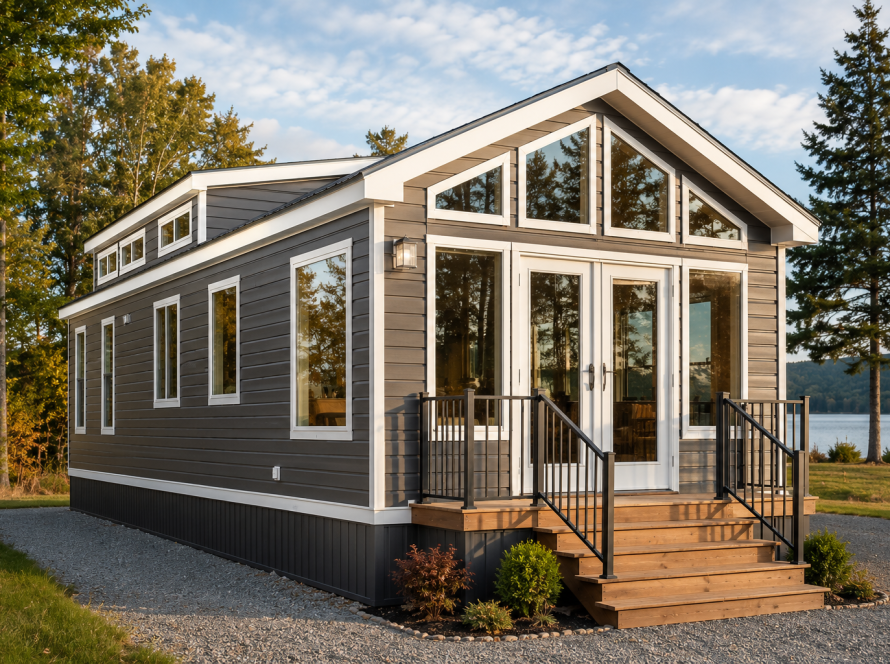
The living area is where thoughtful design earns its keep most visibly. Vaulted ceilings — standard in most park model tiny houses — create a sense of vertical spaciousness that counters the limited footprint effectively. Large windows flood the space with natural light. Open floor plans with an emphasis on natural light, large windows, glass doors, and skylights are being incorporated to make small spaces feel larger and more inviting. When the screened porch or lanai extends the living area outward into Florida’s outdoor environment, the effective living space grows substantially beyond what the square footage suggests.
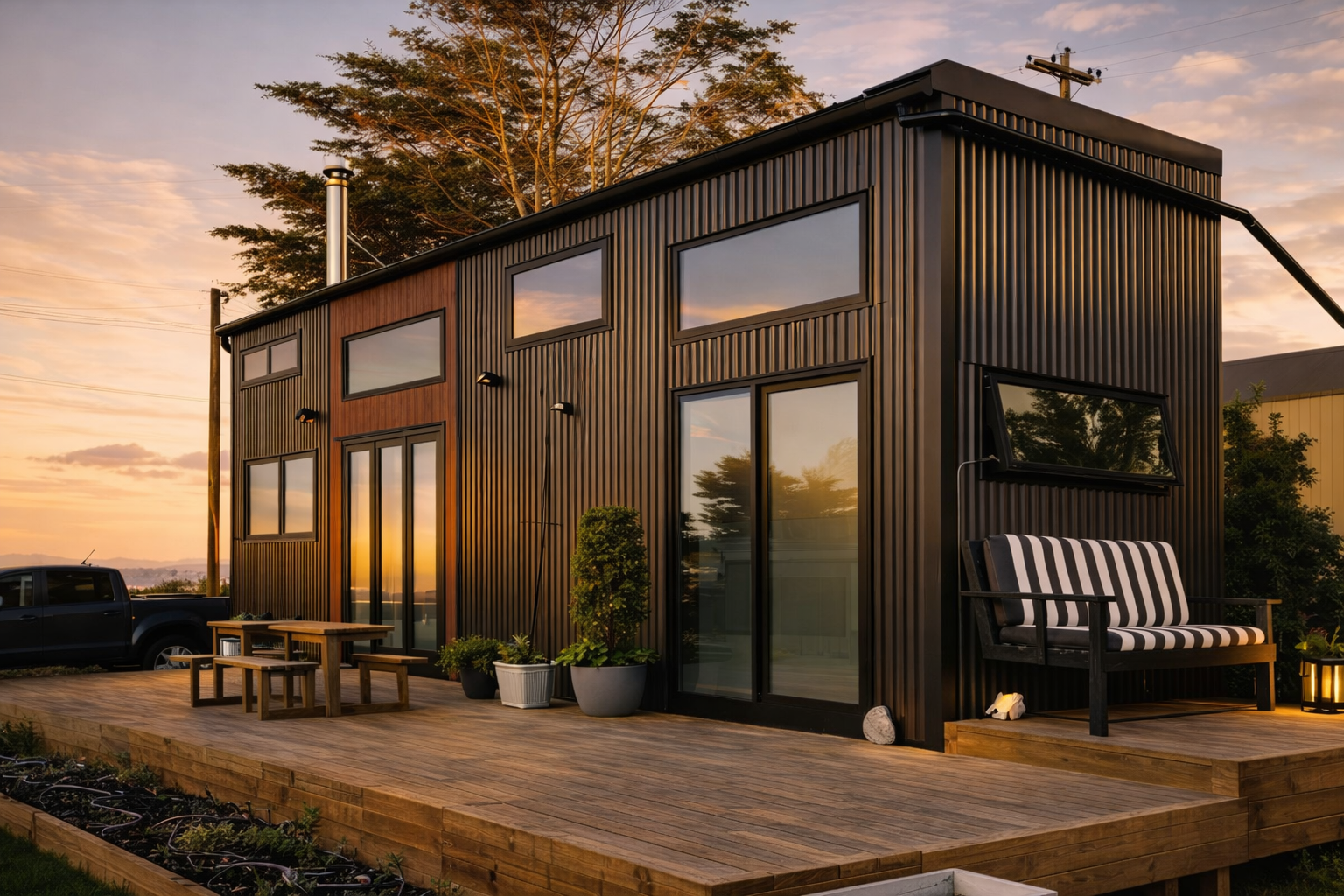
The design trends of 2025 are proving that even the smallest of spaces can be filled with personality, charm, and elegance. Today’s park model tiny houses reflect this shift — with warm moody tones, custom built-ins, statement tile work, and curated material selections that make them feel like intentional homes rather than compromises.
The Financial Architecture of Park Model Tiny House Ownership
Understanding the full financial picture of park model tiny house ownership in Florida requires looking beyond the purchase price to the total cost of occupancy — and then comparing that honestly to the alternatives.
A quality park model tiny house in Florida in 2025 ranges from approximately $65,000 on the entry end to $165,000 for fully eco-integrated premium models. The middle of the market — a well-specified, move-in-ready unit with quality finishes and energy-efficient systems — sits in the $90,000 to $130,000 range.
Add lot rent, which varies from around $375 per month at intimate lakeside communities like Gracious Tiny House Park on Lake Okeechobee to $450 per month at Simple Life communities near Ocala that include water, cable, trash, and landscaping, up to $700 to $1,200 per month in higher-amenity Gulf Coast resort settings. RV loan financing at current rates over a 15-year term on a $100,000 purchase produces a monthly payment in the $800 to $950 range. Total monthly housing cost for a park model tiny house owner in Florida, all-in, typically falls between $1,200 and $1,800.
Compare that to the $3,000 to $4,500 monthly carrying cost of a traditionally financed Florida home in the same geographic vicinity. The difference — $1,200 to $2,700 per month — is real money that stays in your pocket, funds your retirement, pays for experiences, or sits in investments compounding quietly in the background.
Park model homes hold value well in demand areas, depreciating less than standard RVs, and market trends show appreciation in popular resort zones. In Florida’s resort communities, where inventory is limited and demand is structural rather than speculative, well-maintained park model tiny houses in desirable settings have shown consistent value stability and in many cases appreciation over the past decade.
For investors, the income potential is substantial. Florida’s tourism economy generates extraordinary demand for unique, well-designed short-term rental accommodations. A park model tiny house placed in a well-located Florida resort community, listed appropriately on vacation rental platforms, can generate gross annual income that covers carrying costs and produces meaningful net return.
Sustainability as a Design Principle, Not a Marketing Line
The tiny house movement has always had sustainability at its philosophical core — the idea that living with less space means using fewer resources, generating less waste, and leaving a lighter footprint on the landscape. Park model tiny houses make that philosophy tangible and practical in ways that larger homes simply cannot.
Builders are prioritizing sustainable materials like reclaimed wood and recycled steel, while enhanced insulation and energy-efficient windows help reduce heating and cooling costs. Battery storage systems allow homeowners to store and use solar energy efficiently, and low-flow fixtures, composting toilets, and rainwater collection systems are becoming standard.
This is precisely where ecolifehomes.com distinguishes itself from the broader market. Eco Life Homes treats sustainability not as a package upgrade or a premium tier but as the baseline design assumption that every unit starts from.
In Florida’s context, this means solar-ready architecture engineered for the state’s average of 230+ sunny days per year. It means spray foam insulation and thermally broken framing that manages the state’s intense summer heat loads and humidity without overwhelming a standard HVAC system. It means low-VOC interior finishes and formaldehyde-free cabinetry that maintain indoor air quality in a climate where homes are often sealed against the heat. It means water-efficient fixtures and systems appropriate for a state that faces genuine freshwater pressures in its coastal and urban regions.
Tiny houses use less energy — the smaller the home, the less energy it uses. In addition, many tiny house models in Florida utilize solar panels to keep energy costs down. When you combine the inherent energy efficiency of a small, well-insulated structure with active solar generation, monthly utility costs can approach zero. That’s not a promotional claim — it’s arithmetic applied to physics, and Eco Life Homes has built its product line around making that arithmetic work for its owners.
Placement, Community, and the Social Dimension
One of the most underappreciated aspects of park model tiny house living in Florida is what happens socially when you choose the right community. The resort communities and RV parks that serve as home to Florida’s park model tiny house owners tend to be places with strong community cultures — neighborhoods where people know each other, where shared amenities bring residents together naturally, and where the rhythms of daily life involve more human connection than the average suburban subdivision.
For buyers who want resort-style amenities alongside compact living, options like Simple Life in Oxford and Punta Gorda offer park model cottages with swimming pools, clubhouses, fitness centers, and a full calendar of social events — a turnkey solution to simplified living.
On the more intimate end, communities like Circle Pond near Ruskin operate around permaculture principles, shared gardening, and neighbor-to-neighbor interdependence that makes them feel genuinely unlike anything in the conventional housing market. Evenings feature potlucks and pontoon rides, proving that lake life matches a leaner’s footprint.
For prospective buyers, researching community culture is as important as evaluating unit specifications. The physical home is where you sleep and cook and store your things. The community is where you actually live. Florida offers both ends of the spectrum — bustling resort communities with constant programming and quiet, nature-adjacent enclaves where the most scheduled event is a sunrise paddle — and every point in between.
Practical Considerations Before You Buy
Buying a park model tiny house in Florida with confidence requires working through a short list of practical questions that, once answered, remove most of the uncertainty from the process.
Know your classification before you shop. Park model tiny houses are registered as recreational vehicles through the Florida Department of Motor Vehicles. This affects how they’re financed, insured, taxed, and where they can be legally placed. Working with a builder or dealer who understands this framework thoroughly — like the team at ecolifehomes.com — saves significant time and avoids expensive surprises.
Verify community rules independently. Every RV park and resort community in Florida has its own policies on top of the state regulatory framework. Pet policies, subletting rules, occupancy duration, architectural standards, and age restrictions vary considerably from community to community. Read the lease agreement before signing anything.
Demand Florida-specific engineering. A park model tiny house built to generic national specifications may perform adequately in moderate climates but will struggle in Florida’s combination of heat, humidity, hurricane exposure, and year-round occupancy demands. Verify that any unit you consider has been engineered specifically for Florida’s wind zones, moisture conditions, and thermal loads.
Understand your financing options fully. RV loans, personal loans, chattel mortgages, and in some cases home equity products can all be used to finance park model tiny house purchases. Interest rates, terms, and down payment requirements vary significantly across these products. Shopping lenders with the same attention you give to shopping units is not optional — it’s essential.
Budget for total cost of occupancy, not just purchase price. A complete budget includes the unit price, transport and setup ($2,000 to $8,000 depending on distance and site complexity), site preparation ($3,000 to $10,000), first and last month’s lot rent, insurance, and a reasonable maintenance reserve. Builders who provide transparent all-in cost estimates — as Eco Life Homes does — make this process significantly more straightforward.
The Reason People Don’t Look Back
Ask someone who’s been living in a park model tiny house in Florida for two or three years whether they miss their old home, and the responses tend to follow a pattern. They don’t miss the maintenance. They don’t miss the mortgage. They don’t miss the rooms they rarely used and the things they accumulated to fill them. They do miss certain kitchen counter space, occasionally. They’ve mostly solved that with better organization.
What they gained — time, financial breathing room, community, outdoor access, and a daily life that matches their actual values rather than their aspirational ones — consistently outweighs whatever they gave up.
A 300-square-foot home feels less like a compromise and more like a reset. For many Floridians, tiny living isn’t a trend; it’s a smarter way forward.
That observation holds for park model tiny house owners throughout the state. The square footage adjustment takes about two weeks. The lifestyle adjustment — the slower pace, the lower overhead, the shift in what a good day looks and feels like — tends to feel natural almost immediately.
Where Eco Life Homes Fits Into This Picture
If you’ve followed this guide to this point and the park model tiny house conversation resonates with how you think about housing, lifestyle, and financial priorities, the next step is finding a builder whose values and execution align with yours.
ecolifehomes.com was built around the conviction that a park model tiny house should be more than a smaller-than-average dwelling — it should be a genuinely better one. Better engineered for the environment it will actually inhabit. Better designed for the lives that will actually be lived in it. Better for the planet those lives are being lived on.
Every unit Eco Life Homes produces reflects Florida-specific engineering expertise, genuine sustainability at the material and systems level, and the kind of finish quality that makes a 499-square-foot home feel abundant rather than constrained. Their team guides buyers through every step of the process — from initial design conversations and community selection to delivery coordination and occupancy — with the kind of transparency that makes a complicated process navigable.
Florida’s park model tiny house market is in the middle of a sustained expansion. Communities are filling. Values are rising. The case for this way of living, already compelling, grows stronger every year as traditional Florida real estate becomes less accessible to more people.
The smarter question isn’t whether a park model tiny house makes sense. It’s whether you’re ready to find yours.
Visit ecolifehomes.com to start the conversation.
Keywords: park model tiny house, park model tiny house Florida, tiny house park model, park model homes Florida, tiny homes Florida, eco-friendly tiny house Florida, ecolifehomes.com, park model RV Florida, tiny house communities Florida, affordable housing Florida, HUD park model, ANSI A119.5 tiny house