What Utilities Do Park Model Homes Need?
Utility infrastructure is one of those subjects that doesn’t generate much excitement during the browsing and dreaming phase of a park model search — but that becomes critically important the moment a buyer moves from browsing to actually planning a placement. The difference between a community site where utilities are already stubbed in and waiting versus a rural piece of raw land where every utility system needs to be developed from scratch isn’t just a cost difference. It’s a project management difference, a timeline difference, and sometimes a feasibility difference that determines whether a specific placement works at all.
Understanding what utilities a park model needs, how those needs are met across different placement scenarios, what the Florida-specific considerations are, and what realistic costs look like gives buyers the foundation to evaluate placement options honestly rather than discovering constraints after a commitment has already been made.
The Core Utility Requirements
Every park model that’s used as a full-time or part-time dwelling needs access to four essential utilities: electricity, water, wastewater disposal, and some form of climate control. Beyond those four, there are secondary utilities — propane, internet, cable — that affect comfort and convenience without being absolute prerequisites for habitation.
These requirements aren’t unique to park models. They’re the same basic infrastructure needs as any residential structure. What’s specific to park models is how those needs are met across different placement contexts, and how the connection process works for a factory-built structure on a trailer chassis rather than a structure built on a permanent foundation.
Electricity: The Non-Negotiable
Electricity is the foundational utility for a park model in Florida. It powers the HVAC system that makes the climate livable, the refrigerator that keeps food safe, the water heater if it’s a tankless electric system, lighting, and every electronic device that makes modern daily life function.
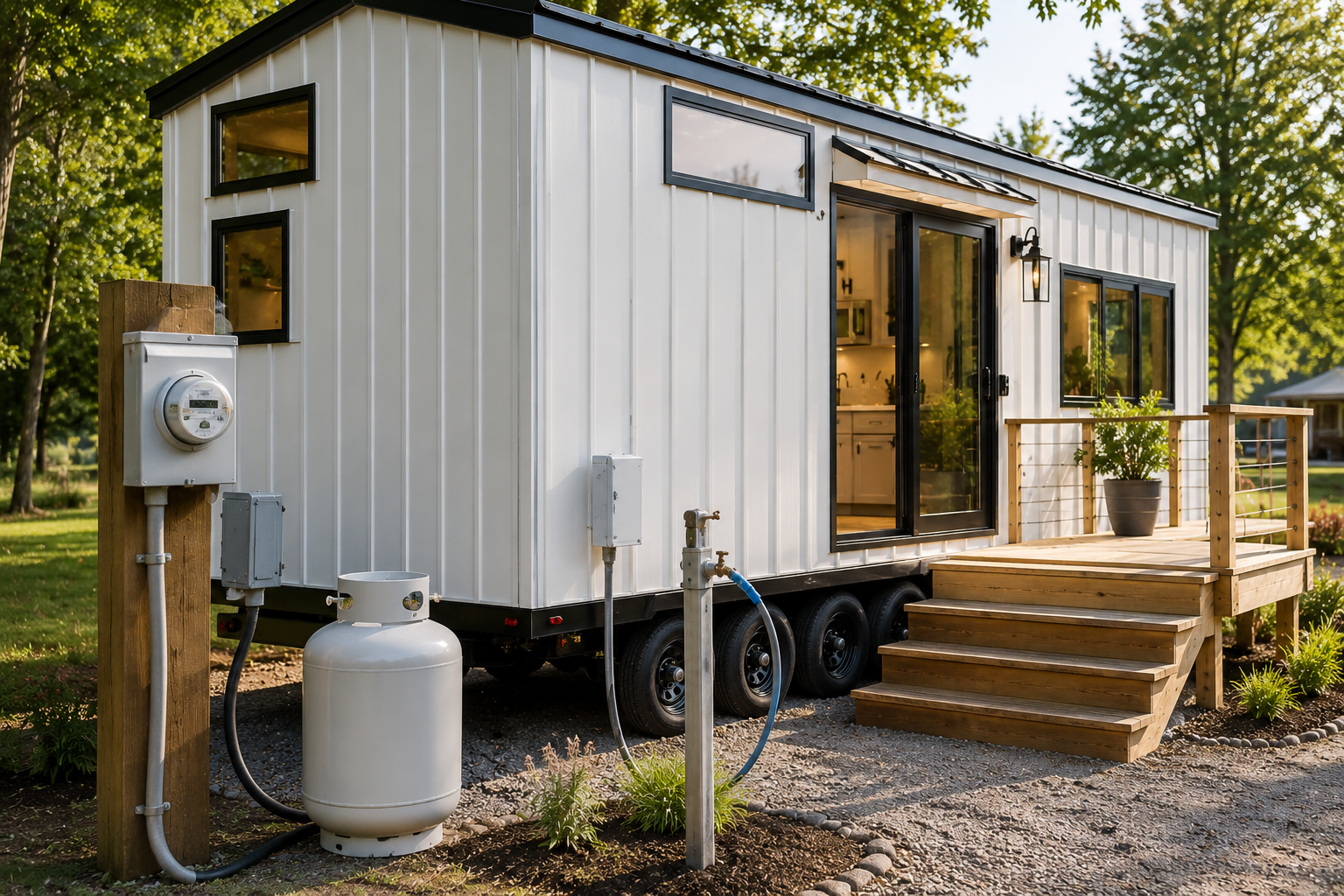
Park models are wired to connect to standard shore power — the same electrical connection system used by RVs at campgrounds and RV parks. The connection is made through a shore power inlet on the exterior of the unit, which accepts a twist-lock connector from the site’s power pedestal or service panel. Most park models in Florida are wired for 50-amp service, which provides enough capacity for the HVAC system, appliances, and general household loads to operate simultaneously without tripping circuits.
Community Placement Electrical Connection
In established land-lease communities, the electrical infrastructure is already in place. Each lot has a power pedestal — the utility connection post mounted at the site — with 50-amp service available. Connecting the park model to the pedestal is a straightforward process: run the shore power cord from the unit’s inlet to the pedestal’s outlet, verify the connection is secure, and the unit has power. The connection is typically completed during installation day by the installer or the community’s maintenance staff.
Electrical costs in a community setting are either billed through the community at a flat rate included in lot rent or metered individually and billed monthly by the utility or the community. Clarifying which billing arrangement applies is worth doing before you sign a lot lease, because it affects your monthly cost predictability.
Private Land Electrical Service
Placing a park model on private land where no electrical service currently exists requires bringing power to the site — a process that involves the local electric utility and a licensed electrician. The sequence typically works like this: the utility runs a service line to the property line or to a transformer location, a licensed electrician installs the meter base, service entrance, and main distribution panel, and then a feeder circuit is run from the panel to the service pedestal or direct connection point where the park model will connect.
The cost of this work varies significantly based on how far the utility’s existing infrastructure is from the placement site. A rural property where power lines already run along the road in front might require $3,000 to $6,000 to bring service to the site. A more remote property where the utility needs to extend lines over a meaningful distance can run $10,000 to $25,000 or more — the utility typically charges for line extension beyond a certain distance from existing infrastructure.
Underground service runs — burying the electrical conduit from the meter to the park model connection point — are the preferred approach for both aesthetics and protection from weather events. Expect $15 to $40 per linear foot for underground conduit work depending on soil conditions and local labor rates.
Solar and Off-Grid Electrical
A growing segment of park model owners, particularly those placing units on private land in Florida, are evaluating solar power as either a supplement to grid power or as a primary power source. Florida’s solar resource is excellent — the state receives among the highest annual solar irradiance in the continental United States, which makes solar economics genuinely favorable.
A grid-tied solar system on a park model reduces utility bills while maintaining the reliability of grid backup. A hybrid system with battery storage adds resilience against outages — increasingly relevant in Florida after the grid disruption events associated with major hurricane seasons. A fully off-grid system eliminates the grid connection requirement entirely, which simplifies rural private land placement but requires careful system sizing to ensure adequate capacity during Florida’s cloudiest periods.
Solar system costs for a park model-appropriate installation in Florida in 2026 typically run $12,000 to $28,000 depending on system size, battery inclusion, and installation complexity. Florida’s net metering policies, tax incentives, and the availability of federal tax credits make the economics of solar ownership meaningfully better today than they were five years ago, and better in Florida than in most other markets.
Water: Supply and Connection
Water supply for a park model comes from one of three sources: municipal water service, a private well, or a water delivery and storage system for truly remote placements. The source available for a specific placement depends entirely on the location.
Municipal Water in Community Settings
In established land-lease communities, municipal or community-supplied water is standard. The lot has a water stub-out — a threaded connection point where the park model’s water supply line connects — at a location near the unit’s water inlet. Connection is straightforward: run a water supply hose or rigid supply line from the unit’s inlet to the stub-out, install a pressure regulator if the community’s water pressure runs high (above 80 PSI, which can stress the park model’s plumbing), and the unit has running water.
Communities that provide water as part of lot rent — where the monthly fee includes unlimited water consumption — are simpler to budget around than communities that meter individual lots and bill for consumption. Both arrangements are common in Florida. If water consumption billing is separate, understand the rate structure before you commit, because a household that uses significant water for irrigation or that runs a hot tub or pool will face different billing implications than one with typical residential consumption patterns.
Well Water on Private Land
Rural Florida properties that lack municipal water access require a private well. Well drilling in Florida is a specialized process that accounts for the state’s specific geology — limestone aquifer systems underlie most of the peninsula, and the depth to productive water-bearing formations varies considerably across the state.
In areas with shallow water tables — common in Central and North Florida where the Floridan Aquifer system sits relatively close to the surface — productive wells can be drilled at 100 to 200 feet of depth at a cost of $3,500 to $7,000 including the pump system and pressure tank. In areas where depth to productive water requires drilling further — some coastal areas and South Florida locations where saltwater intrusion affects shallow aquifers — costs can reach $10,000 to $15,000 or more.
Beyond drilling cost, water quality testing is an essential step before connecting a new well to any residential water system. Florida groundwater quality varies by location and aquifer depth, and common issues include high mineral content (particularly iron and calcium), hydrogen sulfide (which produces the rotten egg smell sometimes associated with Florida well water), and in some coastal areas, varying degrees of salinity intrusion. Water treatment systems — whole-house filters, iron removal systems, water softeners, reverse osmosis systems for drinking water — add $1,500 to $4,500 to the project budget depending on what the water quality analysis reveals.
Water Pressure and Regulation
Regardless of water source, proper pressure regulation at the connection to the park model protects the unit’s plumbing system. Park model plumbing is designed to operate within a specific pressure range, and supply pressure that consistently exceeds 80 PSI accelerates wear on fittings, connections, and appliances. A pressure regulator installed at the water inlet — a $30 to $80 component that takes five minutes to install — prevents the slow damage that chronically high water pressure causes over years of use.
Wastewater: Sewer Connection and Septic Systems
Wastewater disposal is the utility category that creates the most complexity and cost for private land placements, because the options beyond community sewer connection involve significant site development that depends heavily on soil conditions, site topography, and local regulatory requirements.
Sewer Connection in Community Settings
Established communities have sewer infrastructure — either a connection to a municipal sewer system or a community-operated wastewater treatment system. The lot has a sewer stub-out at a specific location and height where the park model’s drain outlet connects. This connection is made during installation, typically by the installer or a licensed plumber, and involves running the park model’s drain line to the stub-out with appropriate slope for gravity drainage.
In Florida, most community sewer connections use a 3-inch or 4-inch ABS or PVC drainpipe that connects to the community system at the stub-out. The connection includes a cleanout fitting that allows the drain line to be accessed for maintenance if needed. Sewer cost is typically included in lot rent in Florida communities rather than billed separately.
Septic Systems on Private Land
Private land placements without access to community or municipal sewer require a septic system — an on-site wastewater treatment and disposal system that treats household sewage through a combination of a septic tank and a soil absorption field.
Florida’s geology and hydrology create specific constraints for septic system design that make the state’s requirements more complex than those of many other markets. High water tables — common across much of South and Central Florida — limit the depth at which soil absorption can occur and often require alternative system designs that treat wastewater to a higher standard before soil absorption. Areas near water bodies, wetlands, and environmentally sensitive lands face additional restrictions on wastewater discharge that affect system design and cost.
The main system types used in Florida for park model placements:
Conventional gravity septic: The traditional system, using a buried septic tank followed by a drainfield of perforated pipes in gravel trenches. Where soil conditions support adequate percolation and water table depth is sufficient, this is the least expensive option at $6,000 to $10,000 installed. Many Florida properties — particularly in well-drained sandy soils — can support conventional systems. A soil percolation test, required as part of the permit process, confirms whether the site qualifies.
Mound or raised drainfield systems: Where the seasonal high water table is too close to the surface for conventional drainfield depth, a raised system elevates the drainfield above natural grade using imported fill material. More land area is required, and the system is visually prominent on the site, but it provides compliant disposal where conventional systems aren’t possible. Cost ranges from $10,000 to $18,000 depending on system size and fill requirements.
Advanced treatment units (ATUs): Where conventional and mound systems aren’t appropriate — typically in areas with very high water tables, proximity to sensitive water bodies, or poor soil percolation — advanced treatment systems that provide biological treatment of wastewater before soil absorption are required. These systems include mechanical components that require periodic maintenance contracts and cost $15,000 to $25,000 installed.
Septic system permitting in Florida is handled by the county health department and involves a site evaluation, percolation testing, system design approval, and installation inspection. Timeline from permit application to installed system typically runs four to eight weeks in most Florida counties, which needs to be factored into project planning.
Propane: Optional but Widely Used
Propane isn’t a utility that every park model requires, but it’s widely used in Florida park model settings for cooking ranges, backup heating (less critical in Florida’s climate than in northern markets), outdoor grills and fire features, and in some configurations for water heating.
The advantages of propane appliances in a park model context are real: propane ranges and cooktops provide more precise heat control than electric alternatives, propane water heaters recover more quickly than electric tank units, and having a propane cooking option provides backup capability if the primary electrical service is interrupted — relevant in Florida’s storm-active environment.
Propane supply for a park model is typically provided either through a buried tank that’s filled periodically by a local propane supplier or through above-ground cylinder exchange at a community exchange point. Buried tanks — which range from 120-gallon to 500-gallon capacity — are more convenient for full-time residents because refill frequency is lower and the supplier typically provides automatic delivery monitoring. Above-ground cylinders are simpler for seasonal or occasional-use properties.
Many Florida land-lease communities have propane infrastructure that supplies community-wide service through a central tank system, with individual metering and billing. This eliminates the need for any on-site propane storage and simplifies the connection process to a single hookup at the unit’s gas inlet.
Internet and Communications: The Modern Essential
For most park model residents in 2026 — particularly remote workers, retirees who stay connected with family, and short-term rental investors whose business depends on reliable connectivity — internet access has moved from optional to essential.
In established Florida communities, internet service is typically available through cable or fiber providers that have run infrastructure to the community. Connection is straightforward — a service call from the provider, a modem and router installation, and the unit has reliable broadband. Many Florida communities offer community-wide internet as an amenity included in lot rent, which eliminates the need for individual service contracts.
Rural private land placements present more variable connectivity. Properties near populated areas with existing cable or fiber infrastructure can often get standard broadband service. Properties in more remote rural areas may have limited options — slower DSL service, cellular internet through a mobile hotspot, or satellite internet.
Starlink, SpaceX’s satellite internet service, has transformed connectivity options for rural Florida properties that previously had no viable high-speed internet option. Starlink provides download speeds of 100 to 300 Mbps with latency that’s workable for video calls, streaming, and most remote work applications. Equipment cost is approximately $500 for the satellite dish and hardware, with monthly service around $120. For a park model investor developing a rental property on rural land in Florida in 2026, Starlink has become the default connectivity solution in areas outside cable and fiber reach.
Utility Costs as Part of the Monthly Budget
Bringing the utility picture into the budget context: a full-time park model resident in a Florida community paying for utilities individually — not included in lot rent — typically spends:
Electricity: $80 to $160 per month averaged annually, reflecting Florida’s air conditioning demands in summer and the relatively mild winter that reduces heating costs. A well-insulated park model with an efficient mini-split system lands toward the lower end of this range. A less insulated unit or one in an area with extreme summer heat lands higher.
Water and sewer: $35 to $75 per month for typical household consumption if billed separately from lot rent.
Propane: $30 to $80 per month for households using propane for cooking and water heating, with seasonal variation.
Internet: $50 to $120 per month depending on provider and service tier, or included in lot rent at many communities.
Total monthly utility cost for a full-time Florida park model resident: approximately $200 to $430 per month, placing the complete monthly housing cost — including lot rent, utilities, and insurance — in the range that makes park model living financially compelling compared to virtually every alternative in Florida’s current housing market.
Understanding what utilities a park model needs, and how those needs are met in different placement scenarios, is part of making a placement decision that works from day one. EcoLife Homes helps buyers think through the utility picture for their specific situation — community versus private land, connection versus development — as part of the broader project planning process. The utility infrastructure question has good answers for most placements. Finding the right answer for yours is where the conversation starts.