Tiny Home Communities in Florida
Finding the Right One for How You Actually Want to Live
There is a moment that happens for a lot of people who start researching tiny home living in Florida. They spend weeks looking at floor plans, comparing prices, reading about zoning rules, and watching videos of beautiful compact interiors. And then they realize that the home itself is only half the decision. The other half is where that home is going to sit, who the neighbors are going to be, what the community actually feels like on a Wednesday afternoon in July when the novelty has worn off and real life is fully underway. That second half of the decision is every bit as important as the first, and it does not get nearly as much attention.
Florida’s tiny home community landscape has grown and matured considerably over the past several years. What was once a scattered handful of informal arrangements has developed into a real market with meaningful diversity. There are resort style communities with pools and clubhouses and packed social calendars. There are quiet, nature-focused communities built around shared gardens and sustainable living values. There are urban adjacent communities that put you ten minutes from downtown without the downtown price tag. There are waterfront communities where your morning coffee comes with a view of the water. And there are everything-in-between communities that blend elements of several of those things into something that suits people who do not fit neatly into any one category.
Choosing among all of those options requires understanding what each type of community actually delivers, what it costs, and what kind of lifestyle it produces. This guide is written to help you think through that choice clearly so that when you land somewhere, you land somewhere right.
Why Community Selection Matters as Much as Home Selection
People who are new to tiny home living sometimes underestimate how much the surrounding community shapes the experience of living in a small home. In a traditional house, your relationship with the neighborhood is relatively casual. You might wave to a few neighbors, attend the occasional block party, but mostly you live inside your house and the neighborhood is background. In a tiny home community, that dynamic is different.
The physical proximity of tiny home living, combined with the shared outdoor spaces that most communities incorporate, naturally creates more interaction between residents. That can be a wonderful thing when the community is the right fit and the people around you share values and a general approach to life that works for you. It can be genuinely difficult when there is a mismatch between what you expected and what the community actually is.
Community rules also shape daily life in ways that matter. Some communities are quiet and structured, with strict noise policies, visitor restrictions, and rules about exterior decorating and landscaping that keep everything looking cohesive. Others are loose and flexible, with a live and let live culture that tolerates a lot of individual expression but also means you have less predictability about your environment. Neither approach is inherently better. But if you are someone who needs peace and quiet to work from home and you land in a community with a party-friendly culture and a busy social calendar, you are going to have a difficult time regardless of how beautiful your tiny home is.
The financial structure of the community also has long-term implications that are easy to overlook when you are focused on finding the right home. Lot rent, how it is set, how it has historically increased, and what it actually covers varies enormously. A community with lot rent that has been climbing five to eight percent annually for several years is a very different long-term financial commitment than one with stable, modest lot rent that has not changed dramatically. Understanding those dynamics before you commit is part of making an informed decision.
Dedicated Tiny Home & Park Model Communities (by lot/site count)
- Peace Wind at Braveheart Properties (Cocoa, Brevard County) — 84 sites spread across 35 acres, accepting both THOWs and 400 sq ft cottages, with a rare lot purchase option available. Pinuphouses
- Simple Life Oxford / Punta Gorda — 223 thoughtfully designed cottage homes ranging from 585 to 1,085 sq ft, making it one of the largest premium park model communities in Florida. Tiny House
- Orlando Lakefront at College Park (Orlando) — 50 legal tiny home pads on the shores of Lake Fairview, with lot leases ranging from $350 to $650 per month. Pinuphouses
- The Outpost (St. Cloud) — A modern, purpose-built community catering to both long-term tiny home residents and transient RV travelers, with spacious lots and quality amenities near Orlando. Clever Tiny Homes
- ESCAPE Tampa Bay / The Oaks (Tampa) — A professionally landscaped, purpose-built tiny village with underground utilities, fast internet, and ESCAPE-brand homes. Historical lot rents reported in the $595 to $725 range. Littlehousesforsale
- Ocean Breeze Resort (Jensen Beach) — A 55-plus marina community with park model tiny home lots along the Intracoastal Waterway, with lot rent running $770 to $790 per month. Pinuphouses
- Gracious Tiny House Park (northern tip of Lake Okeechobee) — Waterfront lots with full hookups including 30 and 50 amp electrical, with the majority of residents living full time on site. Gracioustinyhousepark
- Circle Pond Tiny Community (Ruskin) — A nearly five-acre sustainability-focused community built around a spring-fed pond with 24 lots total. Consistently operates at full capacity with a waitlist. Littlehousesforsale
- Cross Creek Village (Leesburg) — A waterfront tiny home community with lake view lots that draws nature-oriented residents to Central Florida’s lake district.
- Tiny House Siesta (Sarasota) — Located five minutes from Siesta Key Beach, this community focuses on short and mid-term rental stays in a tropical setting.
Large Resort Communities Accepting Park Model Homes
Gulf Waters RV Resort — A beachfront Gulf Coast community with a heated pool, tiki bar, and regular planned activities, offering one of Florida’s most scenic park model settings.
Sunkissed Village RV Resort (Summerfield) — 208 RV sites and 59 dedicated park model suites, partnered with Chariot and Champion manufacturers for on-site home sales. Sunkissedvillage
Morningside RV Estates (Dade City) — An established community with an active park model sales and rental operation, known for well-maintained grounds and a welcoming atmosphere.
Upriver RV Resort (North Fort Myers) — Canal-front lots with private boat dock access along the Caloosahatchee River corridor, a long-standing destination for park model buyers.
Sun Outdoors Florida (multiple locations) — A large-scale resort chain known for luxury amenities and vibrant community programming across several Florida properties.
Encore RV Resorts Florida (multiple locations) — A well-established resort group with pools, clubhouses, and a full schedule of organized events across multiple Florida sites.
Crystal Lake RV Resort — Features two heated pools, three clubhouses, and active programming including tennis and bocce ball, popular with seasonal park model residents.
Blueberry Hill RV Resort — Offers a heated pool, fitness center, and multiple sport courts with a full community activity calendar throughout the season.
Sunshine Key RV Resort and Marina (Ohio Key, near Key West) — A 75-acre island community combining RV and tiny home sites with an attached marina, one of Florida’s most distinctive waterfront communities.
Paradise Oaks RV Resort — Known for spacious sites, pickleball courts, and a well-equipped clubhouse with a relaxed and social community atmosphere.
The Major Types of Tiny Home Communities in Florida
Florida’s tiny home community market does not fit into a single mold. Understanding the broad categories helps you filter quickly toward the type that matches what you are looking for.
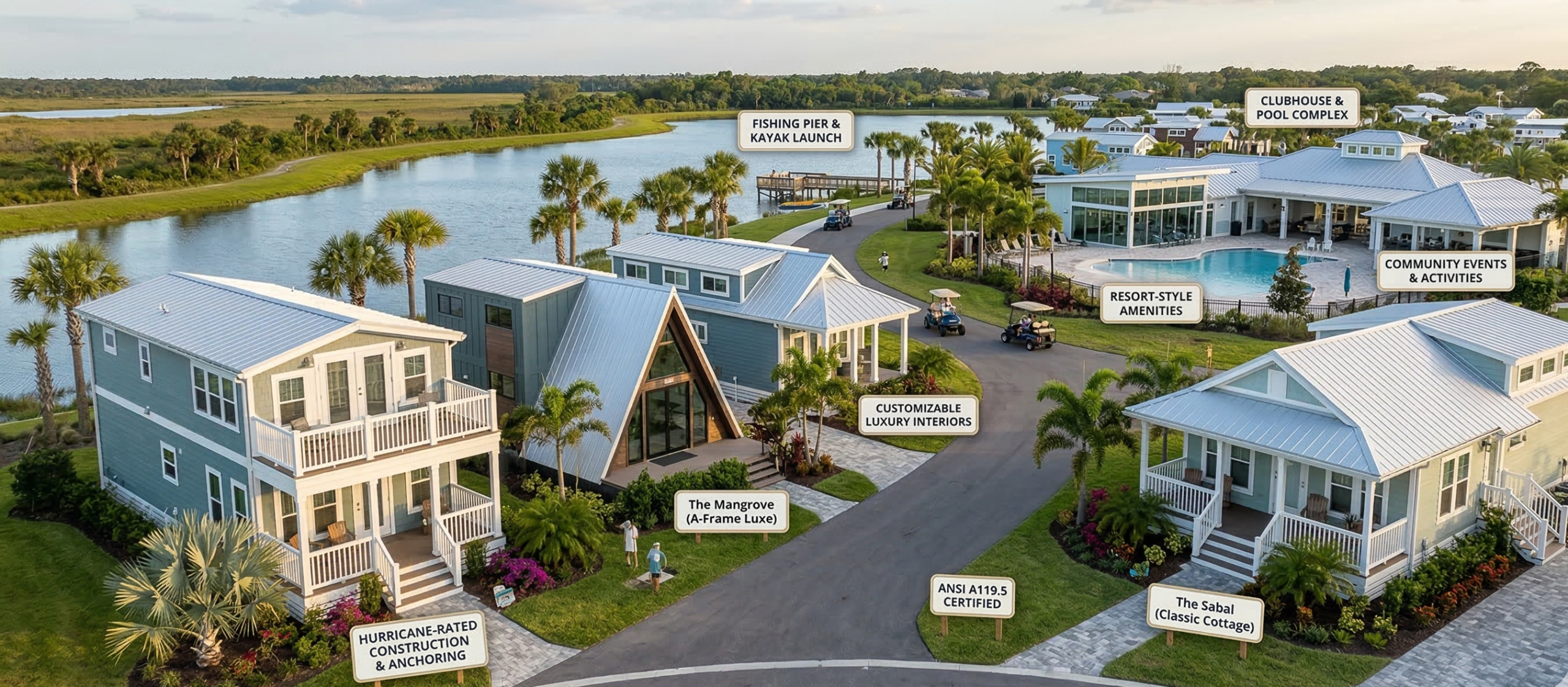
Resort style communities represent one end of the spectrum. These are fully developed environments designed around amenity-rich living, with swimming pools, hot tubs, fitness centers, clubhouses, organized social events, on-site management, and well-maintained common areas. They tend to have higher lot rents reflecting the cost of maintaining those amenities, and they attract buyers who want a social, active community experience rather than a quiet or solitary one. Many of these communities have a strong snowbird culture, meaning they are significantly more lively in the winter months and quieter in summer. If you are considering a resort style community as a full-time residence, understanding that seasonal rhythm is important.
Nature-focused and sustainable communities occupy a different point on the spectrum. These communities are typically built around values of environmental stewardship, community self-sufficiency, and intentional living. Shared gardens, permaculture principles, composting programs, rain collection systems, and solar energy installations are common features. The social culture tends to be more collaborative and less event-driven than resort style communities. Lot rents are often lower. The tradeoff is that amenities in the traditional sense are minimal, and the community culture requires a genuine commitment to the shared values rather than just proximity to them.
Urban adjacent communities have grown in Florida as tiny home living has attracted younger buyers who want to live affordably near city centers. These communities put residents within easy reach of employment, restaurants, cultural institutions, and the full infrastructure of urban life while offering a housing cost that is dramatically lower than what urban market-rate apartments or homes demand. The communities themselves are often smaller and less amenity-rich than resort-style alternatives, but their location is the amenity. For remote workers, young professionals, and people who want city access without city housing costs, these communities offer a compelling combination.
Waterfront and coastal communities exist throughout Florida and attract buyers who want water access as part of their daily life. These communities sit on lakes, rivers, bays, or in some cases directly on the coast, and they offer boat docks, fishing access, kayaking, and the kind of water-adjacent lifestyle that draws people to Florida in the first place. Lot rents in waterfront communities tend to be meaningfully higher than inland alternatives, but for buyers who genuinely use the water access regularly, the premium reflects real value.
Investor-friendly communities have emerged as a distinct category driven by Florida’s strong short-term rental market. These communities actively facilitate owner rentals, have management infrastructure in place to support it, and attract buyers who want to generate income from their property rather than or in addition to using it personally. The community culture in these places is often less cohesive from a permanent resident standpoint because occupancy turns over regularly, but the income potential for owners who manage their rentals well can be meaningful.
Florida Regions and What Each Offers for Tiny Home Community Living
Where in Florida a tiny home community is located shapes the experience in fundamental ways beyond just the community itself. The regional characteristics of Florida vary enough that what works beautifully for one buyer’s priorities might not work at all for another’s.
Central Florida is the most active region for tiny home community development in the state. The area around Orlando and extending into surrounding counties has a well-developed RV and resort community infrastructure, a strong tourism economy that supports short-term rental income, relatively affordable land compared to coastal markets, and county governments that have generally been receptive to small-home development. The climate is inland and somewhat less humid than coastal South Florida, though summers are still hot. For buyers who want community access and investment potential without coastal price premiums, Central Florida offers the widest selection of established communities.
The Gulf Coast from Tampa Bay south through Sarasota, Fort Myers, and Naples is one of Florida’s most desirable regions and its tiny home communities reflect that desirability. Communities in this corridor tend to be well-established, well-maintained, and popular with snowbirds who want access to the Gulf’s famously calm, warm water. The natural beauty of this coastline is real and communities that sit near it command genuine premium. Lot rents are higher than inland alternatives, but so is the quality of the experience for people whose priority is the Gulf Coast lifestyle.
The Atlantic Coast from Brevard County through the Treasure Coast into Palm Beach County offers a different coastal character. Several counties in this region have been notably progressive in their approach to small-home development and zoning accommodation. Brevard County in particular has established frameworks that have enabled genuine tiny home community development. The beaches are beautiful, the communities are diverse, and the cost of living in this corridor tends to be somewhat lower than comparable Gulf Coast locations.
North Florida, including the Panhandle, Tallahassee area, and the Nature Coast, offers the most affordable land and lot rents in the state and a noticeably different pace of life from South Florida. The Panhandle’s beach communities have seen growing short-term rental demand driven by their stunning white sand beaches. The interior of North Florida has attracted buyers who want a rural or small-town environment with lower costs and a quieter lifestyle. The tiny home community infrastructure in North Florida is less developed than in Central or South Florida, but it is growing and the cost advantage is substantial for buyers whose priorities include affordability above coastal access.
What to Actually Evaluate When You Visit a Tiny Home Community
Reading about a community and visiting it in person are two very different experiences, and the visit is where the real evaluation happens. Going in with a clear framework for what to assess makes the process more productive.
Start with the physical infrastructure. Look at the roads within the community, the utility hookups, the drainage, and the overall maintenance level of common areas. A well-maintained community with good roads and clean common spaces usually reflects management that pays attention to ongoing upkeep rather than just initial development. Deferred maintenance is a warning sign worth taking seriously.
Walk the community at different times if you can. A Saturday afternoon visit gives you one picture. A Tuesday morning gives you another. The way the community feels at different times of week and in different seasons tells you more about what daily life there actually looks like than any brochure or website.
Talk to residents, not just management or sales staff. Ask them what they like about the community and what they would change. Ask them how management handles maintenance requests and disputes. Ask them how the community has changed since they arrived. People who live in a place have a perspective on it that is simply not available anywhere else, and most people are genuinely willing to share it with someone who is considering buying into their community.
Review the community’s rules and lease agreement in detail before you get too attached to the idea of being there. Rules about pets, guests, vehicles, exterior modifications, subletting, and short-term rentals vary enormously and any one of those areas can be a dealbreaker depending on your situation. Better to discover a dealbreaker before you are emotionally committed to a specific place than after.
Ask specifically about lot rent history. Request documentation showing what lot rent has been for the past five years. A community where lot rent has been increasing modestly and predictably is a different financial proposition from one where lot rent has jumped significantly, or where it has been held artificially low during a lease-up phase and is expected to increase once the community is fully occupied. Understanding the trajectory rather than just the current rate is important.
Assess the community’s age and ownership structure. A community that has been under stable ownership for many years and has an established track record is generally lower risk than a newly developed community or one that has recently changed ownership. New ownership in particular can bring significant changes to lot rent, rules, and community character that existing residents did not anticipate.
The Financial Realities of Community Living in Florida
The economics of tiny home community living in Florida are worth laying out clearly because the ongoing costs are a bigger part of the total picture than many buyers initially appreciate.
Lot rent is the single largest ongoing cost for most park model home owners in Florida communities. Across the state, lot rents range from under 400 dollars per month in basic inland parks to over 1,200 dollars per month in premium coastal resort communities. That range has a massive impact on the long-term economics of ownership. A 400 dollar per month differential in lot rent represents nearly 5,000 dollars per year in ongoing cost difference. Over ten years, that is 50,000 dollars, which is more than the purchase price of a basic park model home. Lot rent is not a footnote in the financial analysis. It is a central variable.
What lot rent typically covers also varies. In some communities, lot rent includes water, sewer, trash, basic cable, and community amenity access. In others, it covers only the right to occupy the lot and everything else is billed separately. Getting a clear picture of the all-in monthly cost rather than just the lot rent figure is essential for accurate budgeting.
Community fees beyond lot rent are a reality in some developments. HOA-style fees, amenity fees, or special assessment levies can add meaningful cost that is not visible in the advertised lot rent figure. Ask specifically about all fees and charges before finalizing your community selection.
Property taxes on park model homes in Florida communities are generally lower than on traditional real estate because park models are classified as personal property rather than real estate. This is a meaningful advantage for buyers coming from a traditional real estate ownership background, though the specifics vary and are worth confirming with a local tax professional for your specific situation.
The Social Dimension of Tiny Home Community Living
The lifestyle dimension of tiny home community living in Florida is something that buyers either discover as a wonderful surprise or struggle with as an unexpected challenge. It is worth thinking about honestly before you commit.
Tiny home community living is inherently more communal than living in a traditional neighborhood. Shared spaces, physical proximity, and the culture of many communities create more regular interaction with neighbors than most people are accustomed to in conventional housing. For people who are naturally social, who enjoy a sense of community, and who welcome the spontaneous conversations and connections that come with living in a more communal environment, this is one of the genuine pleasures of the lifestyle. For people who are more private, who need clear separation between their personal space and shared space, and who recharge through solitude rather than social interaction, it requires adjustment and thoughtful community selection.
The culture match between you and a community is something that is genuinely hard to assess from the outside and genuinely important to get right. A community where most residents are retired and have been there for years has a social dynamic that is very different from a community that attracts a mix of ages, remote workers, and people new to tiny home living. Neither is better, but the fit with your own personality and life stage matters.
Many tiny home communities in Florida have active organized social programming, from potluck dinners and game nights to group outings and community projects. If that kind of organized social life appeals to you, it is one of the more distinctive and positive aspects of community living at its best. If it sounds exhausting rather than appealing, communities with a more independent culture and less organized programming are worth specifically seeking out.
New Developments Worth Watching in Florida’s Tiny Home Community Market
The Florida tiny home community market is genuinely evolving, and several developments are worth watching for buyers who are still in the research phase and willing to wait for the right opportunity.
Land ownership models within tiny home communities are growing slowly but steadily. A small number of Florida developments have created frameworks where buyers purchase their lot rather than paying indefinite lot rent. This changes the economic and psychological relationship with the community dramatically. Equity accumulation, control over your space, and freedom from rent increases are all real advantages. These opportunities are not yet common but they are growing, and buyers for whom land ownership is a priority should specifically search for communities that offer it.
Mixed-use tiny home communities that combine residential living with short-term rental flexibility are another emerging model. These developments are designed from the ground up to support owners who want the flexibility to live in their home part of the year and rent it out during periods they are not there. The infrastructure, management support, and community rules are specifically built for that dual use model in ways that traditional RV parks were not designed for.
Purpose-built workforce housing communities using park model homes are beginning to appear in some Florida counties that are actively trying to address housing affordability for essential workers. These developments, supported in some cases by county governments or workforce housing initiatives, offer below-market lot rents in exchange for occupancy requirements. For buyers whose income qualifies them for workforce housing programs, these can represent genuinely exceptional value.
Florida Small-Home Communities By Region
Florida’s tiny-living map falls into five distinct zones: the Panhandle, Central Florida, the Gulf Coast, the Atlantic/Space Coast, and the Keys. Each area offers its own blend of cost, climate, and zoning rules. Review the summary here, then explore the detailed profiles that follow.
Panhandle & North Florida: Emerging Tiny-Home Scene
Cross I-10 and the landscape changes: pine forests replace palms, and rural land costs 25 %–30 % less per acre than the state median. Planners from Pensacola to Tallahassee are testing smaller footprints.
Pensacola – Phoenix Project. Non-profit AMR plans 14 pocket neighborhoods of about 12 homes each, totaling 168 units, on scattered infill lots across Escambia County. The pilot site, Fresh Start Village, framed its first seven cottages in 2024 and serves youth aging out of foster care.
Tallahassee – The Dwellings. On 24 wooded acres west of town, this supportive village finished its 130th unit in 2019 and now houses about 80 adults with on-site case management. Local officials cite the project as proof that sub-500-sq-ft dwellings can meet code and change lives.
Milton – Sunny Shores. This low-key park outside Pensacola lists roomy pads for about $400 a month and offers a pool, toolshed, and weekend fish-fries under the oaks. The setting shows that private options extend beyond headline projects.
Zoning in the Panhandle remains uneven, so confirm county rules before towing in a trailer. Even so, falling land costs, city-backed pilots, and success stories like The Dwellings point to steady growth for North Florida’s tiny-home market. For on-the-ground help, a Florida real-estate brokerage like SquareFoot Homes helps buyers sanity-check county allowances for sub-400-sq-ft homes and get current lot-rent ranges before they tour.
Central Florida: Orlando Energy, Ocala Ease, And Lake-Country Calm
Rolling pastures and spring-fed lakes make Central Florida the state’s tiny-home hub. Land sits on higher ground, lot rents stay moderate, and counties such as Orange, Marion, and Lake already welcome houses under 400 sq ft.
Orlando – Orlando Lakefront at College Park. This revitalized 1950s RV park hosts 50 legal tiny-home pads on Lake Fairview. Lot leases range from $350–$650 a month, roughly half the city’s median apartment rent. Spaces fill fast because residents enjoy lake access and a seven-minute drive to downtown.
Ocala – Simple Life cottages. West of town in horse country, Simple Life offers cottages under 400 sq ft with a saltwater pool, fitness studio, and dog park. Homes start at about $125,000, and lot fees average $350–$450 a month, covering water, cable, trash, and landscaping.
Lake Okeechobee – Gracious Tiny House Park. This 1.5-acre enclave on the Rim Canal leases 21 lots, including 10 waterfront sites, for $375 a month with utilities and Wi-Fi included. Evenings feature potlucks and pontoon rides, proving lake life matches a leaner’s footprint.
These communities share three advantages: inland elevation that dodges coastal surges, zoning friendly to both wheels and foundations, and housing costs within reach for teachers, tech pros, and retirees. For variety, legality, and year-round breezes without beach-front premiums, Central Florida is the sweet spot.
Gulf Coast: From Tech-Savvy Tampa To Eco-Chic Sarasota
Florida’s west rim blends salt air with startup energy, and three tiny-home hot spots highlight the mix.
Tampa – Escape Tampa Bay: The Oaks. On three shaded acres, this village tucks more than 40 wood-clad cottages (all under 400 sq ft) beneath century oaks. New units start near $100,000, and the $625 monthly lot fee covers parking and all utilities, keeping housing well below the $2,280 median Tampa rent. The math attracts tech workers who would rather build equity than sign another apartment lease.
Ruskin – Circle Pond Tiny Community. On 4.5 leafy acres, 12 pads ring a spring-fed pond. Lots rent for about $600 a month, including water, sewer, garbage, lawn care, and electricity. Each resident receives a raised garden bed, and solar panels or rain barrels earn recognition from the owner, who won a 2019 Sustainable Business Award.
Sarasota – Tiny House Siesta. Five minutes from Siesta Key Beach, this resort lines up a dozen colorful rentals. Nightly rates sit around $160–$250 during peak season, letting guests test-drive micro living before buying.
Hurricane risk is higher in the Gulf. Communities require impact glass, tie-downs, and elevated foundations. Insurance costs more than inland, yet even with premiums, total expenses stay far below coastal condos. Add Gulf sunsets, and it is clear why the west coast serves as Florida’s imaginative proving ground for small-home living.
Atlantic & Space Coast: Rockets, Reefs, And Room To Innovate
Skirt Cape Canaveral and you reach the shoreline where NASA launches and tiny-home projects share the same sky.
Cocoa – Peace Wind at Braveheart Properties. Developer Jinkie Echols drafted Brevard County’s first tiny-home zoning code, then carved 84 sites on 35 acres for a mix of houses on wheels and 400-sq-ft cottages. Residents tend gardens, fish from a communal dock, and watch night launches arc over the Indian River.
Jensen Beach – Ocean Breeze Resort. This 55-plus marina park slots park-model tiny homes along the Intracoastal Waterway. Lot rent runs $770–$790 a month, covering water, sewer, trash, and lawn care. The fee is a bargain compared with coastal condos that often top $3,000 in HOA charges alone.
Zoning east of I-95 remains strict, so most projects sit a few miles inland, where land is cheaper and elevation safer. Builders meet hurricane codes with impact glass, tie-downs, and metal roofs, while salty air demands stainless fasteners and cement-board siding. Up-front costs are higher than inland, yet mortgages still trail oceanfront condos, and sunrise walks to the Atlantic come standard.
Florida Keys: Tiny Living In Paradise, With Caveats
Cross the Seven Mile Bridge, and turquoise flats meet pastel sunsets. A 300-sq-ft cottage sounds dreamy, and Sunshine Key Tiny House Village on Ohio Key lets you test it for $250–$300 a night. Pelicans glide at dawn, and kayaks launch from the front steps. It is vacation magic, not ownership, but it proves pocket living works where the Gulf meets the Atlantic.
Permanent roots are tougher to set. Monroe County’s Rate of Growth Ordinance (ROGO) limits new housing to about 900 permits Keys-wide through 2027. Vacant lots sell for six figures, each home must withstand 180-mph wind loads and sit above FEMA flood lines, and insurance can double mainland rates.
Developers who clear the hurdles place cottage-size units in legacy RV parks near Marathon or Key Largo. Buyers purchase the home but lease the lot, with prices starting near $225,000 plus $1,000 or more in monthly rent. Many shoppers choose a seasonal plan: tow a certified THOW south for winter and return inland before hurricane season peaks.
Design choices here are non-negotiable: stainless fasteners, metal roofs, impact glass, and stilts tall enough to shelter paddleboards during king-tide season. The payoff is morning coffee on a wraparound deck, mangrove breezes, and utility bills that feel tiny next to Key West condos. For those willing to juggle regulation, risk, and price, a Keys-size home delivers a lifestyle no mainland ZIP code can match.
Making the Right Choice for Your Situation
The honest truth about choosing a tiny home community in Florida is that there is no universally right answer. The right community is the one that fits your life, your budget, your social temperament, your priorities around location and amenities, and your long-term plans for how you want to use the property.
What the research process consistently shows is that buyers who take the time to visit multiple communities in person, talk to actual residents, review the financial documents carefully, and think honestly about what their daily life in that place would actually look like tend to make decisions they are genuinely satisfied with. Buyers who get swept up in a beautiful home or a slick marketing presentation without doing that work tend to discover mismatches after they are already committed.
Florida has more real and interesting tiny home community options than almost any other state in the country. The market has grown enough that whatever you are genuinely looking for, there is likely a community somewhere in Florida that delivers it. Finding the right one takes effort. But the payoff of landing in a community that fits is a quality of life that a lot of people who have made the move describe as genuinely better than what they had before, even when their home is a fraction of the size.
That is a result worth doing the homework for.